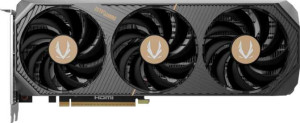
Asus TUF Gaming GeForce RTX 5070 Ti
Zotac Gaming GeForce RTX 5070 Ti Solid SFF

Asus TUF Gaming GeForce RTX 5070 Ti Zotac Gaming GeForce RTX 5070 Ti Solid SFF

Overview

Welcome to our in-depth specification comparison between the Asus TUF Gaming GeForce RTX 5070 Ti and the Zotac Gaming GeForce RTX 5070 Ti Solid SFF. Both cards are built on the same Blackwell architecture and share a remarkable number of technical specifications, yet they take noticeably different approaches when it comes to physical form factor and display connectivity. Read on to find out which card is the right fit for your build.

Common Features

  • Both cards share the same GPU clock speed of 2295 MHz.
  • Both cards share the same GPU turbo speed of 2452 MHz.
  • Both cards deliver a pixel rate of 235.4 GPixel/s.
  • Both cards provide 43.94 TFLOPS of floating-point performance.
  • Both cards offer a texture rate of 686.6 GTexels/s.
  • Both cards use a GPU memory speed of 1750 MHz.
  • Both cards feature 8960 shading units.
  • Both cards include 280 texture mapping units (TMUs).
  • Both cards have an effective memory speed of 28000 MHz.
  • Both cards offer a maximum memory bandwidth of 896 GB/s.
  • Both cards come with 16GB of VRAM.
  • Both cards use GDDR7 memory.
  • Both cards use a 256-bit memory bus width.
  • ECC memory support is available on both cards.
  • Both cards support DirectX 12 Ultimate.
  • Both cards support OpenGL version 4.6.
  • Both cards support OpenCL version 3.
  • Multi-display technology support is available on both cards.
  • Ray tracing support is available on both cards.
  • DLSS support is available on both cards.
  • 3D support is available on both cards.
  • XeSS (XMX) support is not available on either card.
  • Both cards include an HDMI output with HDMI 2.1b.
  • Both cards feature 3 DisplayPort outputs.
  • Neither card includes USB-C, DVI, or mini DisplayPort outputs.
  • Both cards are built on the Blackwell GPU architecture.
  • Both cards have a Thermal Design Power (TDP) of 300W.
  • Both cards use PCIe version 5.
  • Both cards are manufactured on a 5 nm semiconductor process.
  • Both cards feature 45600 million transistors.
  • Air-water cooling is not available on either card.

Main Differences

  • HDMI port count is 2 on the Asus TUF Gaming GeForce RTX 5070 Ti and 1 on the Zotac Gaming GeForce RTX 5070 Ti Solid SFF.
  • Width is 329 mm on the Asus TUF Gaming GeForce RTX 5070 Ti and 304.4 mm on the Zotac Gaming GeForce RTX 5070 Ti Solid SFF.
  • Height is 140 mm on the Asus TUF Gaming GeForce RTX 5070 Ti and 115.8 mm on the Zotac Gaming GeForce RTX 5070 Ti Solid SFF.
Specs Comparison
Asus TUF Gaming GeForce RTX 5070 Ti

Asus TUF Gaming GeForce RTX 5070 Ti

Zotac Gaming GeForce RTX 5070 Ti Solid SFF

Zotac Gaming GeForce RTX 5070 Ti Solid SFF

Performance:
GPU clock speed 2295 MHz 2295 MHz
GPU turbo 2452 MHz 2452 MHz
pixel rate 235.4 GPixel/s 235.4 GPixel/s
floating-point performance 43.94 TFLOPS 43.94 TFLOPS
texture rate 686.6 GTexels/s 686.6 GTexels/s
GPU memory speed 1750 MHz 1750 MHz
shading units 8960 8960
texture mapping units (TMUs) 280 280
render output units (ROPs) 96 96
Has Double Precision Floating Point (DPFP)

In terms of raw GPU performance, the Asus TUF Gaming RTX 5070 Ti and the Zotac Gaming RTX 5070 Ti Solid SFF are built on an identical silicon foundation. Both cards share the same 2295 MHz base clock and 2452 MHz boost clock, resulting in matching throughput figures across the board: 43.94 TFLOPS of floating-point performance, a 686.6 GTexels/s texture fill rate, and a 235.4 GPixel/s pixel rate. The shader count (8960 units), TMU count (280), ROP count (96), and memory speed (1750 MHz) are all identical.

What this means in practice is that both cards will deliver the same frame rates, the same rasterization quality, and the same compute throughput in gaming or creative workloads — assuming equivalent cooling keeps clocks stable. The presence of Double Precision Floating Point (DPFP) support on both cards is a minor plus for users running scientific or professional compute tasks alongside gaming, though it is not a differentiator here.

On performance alone, this is a complete tie. Neither card holds any advantage over the other in this spec group. The meaningful differences between these two products will lie elsewhere — in thermal design, form factor, and power delivery — rather than in the GPU engine itself.

Memory:
effective memory speed 28000 MHz 28000 MHz
maximum memory bandwidth 896 GB/s 896 GB/s
VRAM 16GB 16GB
GDDR version GDDR7 GDDR7
memory bus width 256-bit 256-bit
Supports ECC memory

The Asus TUF Gaming GeForce RTX 5070 Ti and the Zotac Gaming GeForce RTX 5070 Ti Solid SFF are identical in their memory specifications. Both products feature an effective memory speed of 28000 MHz, maximum memory bandwidth of 896 GB/s, and 16GB of VRAM. They also both utilize GDDR7 memory and have a 256-bit memory bus width, ensuring high memory throughput and bandwidth for demanding tasks.

Additionally, both products support Error-Correcting Code (ECC) memory, which helps ensure the integrity of data by automatically detecting and correcting memory errors. This feature is particularly useful in environments that require high reliability in memory performance, such as scientific computing or data-intensive tasks.

Since all memory-related specifications match between the Asus TUF Gaming GeForce RTX 5070 Ti and the Zotac Gaming GeForce RTX 5070 Ti Solid SFF, users can expect the same memory performance from both products.

Features:
DirectX version DirectX 12 Ultimate DirectX 12 Ultimate
OpenGL version 4.6 4.6
OpenCL version 3 3
Supports multi-display technology
supports ray tracing
Supports 3D
supports DLSS
has XeSS (XMX)
AMD SAM / Intel Resizable BAR Intel Resizable BAR Intel Resizable BAR
has LHR
has RGB lighting
supported displays 4 4

The Asus TUF Gaming GeForce RTX 5070 Ti and the Zotac Gaming GeForce RTX 5070 Ti Solid SFF are identical in their feature set. Both products support DirectX 12 Ultimate, OpenGL 4.6, and OpenCL 3, offering comprehensive compatibility with modern applications and games. They also both support multi-display technology, ray tracing, and 3D, which enhances the visual experience and provides smoother, more immersive graphics.

Both products also support DLSS (Deep Learning Super Sampling), which uses AI to boost frame rates and image quality in supported games. Neither product has XeSS (XMX), but both do support Intel Resizable BAR (also known as Intel SAM), which allows for improved GPU memory usage and performance on compatible systems. Additionally, both products are equipped with RGB lighting and support up to 4 displays for an expansive multi-monitor setup.

As for other features, both the Asus TUF Gaming GeForce RTX 5070 Ti and the Zotac Gaming GeForce RTX 5070 Ti Solid SFF are free from LHR (Lite Hash Rate) limitations, meaning they can perform equally well in both gaming and cryptocurrency mining tasks.

Ports:
has an HDMI output
HDMI ports 2 1
HDMI version HDMI 2.1b HDMI 2.1b
DisplayPort outputs 3 3
USB-C ports 0 0
DVI outputs 0 0
mini DisplayPort outputs 0 0

The Asus TUF Gaming GeForce RTX 5070 Ti and the Zotac Gaming GeForce RTX 5070 Ti Solid SFF differ in the number of HDMI ports they offer. The Asus card has 2 HDMI ports, while the Zotac card has only 1. Both products support HDMI 2.1b, ensuring high bandwidth and support for advanced features like higher resolutions and refresh rates.

In terms of DisplayPort outputs, both cards offer 3 DisplayPort outputs, providing ample connectivity for multi-monitor setups. Neither card includes USB-C ports, DVI outputs, or mini DisplayPort outputs.

While both cards offer HDMI 2.1b and DisplayPort connectivity, the Asus model provides an additional HDMI port, which may be beneficial for users with multiple HDMI-compatible devices.

General info:
GPU architecture Blackwell Blackwell
release date January 2025 March 2025
Thermal Design Power (TDP) 300W 300W
PCI Express (PCIe) version 5 5
semiconductor size 5 nm 5 nm
number of transistors 45600 million 45600 million
Has air-water cooling
width 329 mm 304.4 mm
height 140 mm 115.8 mm

Both the Asus TUF Gaming GeForce RTX 5070 Ti and the Zotac Gaming GeForce RTX 5070 Ti Solid SFF share the same GPU architecture, utilizing the Blackwell architecture. They also have identical Thermal Design Power (TDP) of 300W, meaning both cards will require a similar power supply for optimal performance. Additionally, both products use PCI Express (PCIe) version 5, which ensures fast data transfer rates, and feature a semiconductor size of 5 nm with 45,600 million transistors, ensuring high performance and efficiency.

Neither card includes air-water cooling, suggesting they rely on traditional cooling solutions. However, the physical dimensions differ slightly: the Asus TUF Gaming GeForce RTX 5070 Ti measures 329 mm in width and 140 mm in height, while the Zotac Gaming GeForce RTX 5070 Ti Solid SFF is more compact, with a width of 304.4 mm and a height of 115.8 mm.

Overall, the key differences between the two products are their size, with the Zotac card being smaller in both width and height, while the Asus card is larger, potentially affecting case compatibility and airflow.

Comparison Summary & Verdict

After a thorough comparison, the Asus TUF Gaming GeForce RTX 5070 Ti and the Zotac Gaming GeForce RTX 5070 Ti Solid SFF prove to be virtually identical in raw performance, delivering the same 43.94 TFLOPS of floating-point power, 16GB of GDDR7 memory, and a 300W TDP. The real distinctions lie in size and connectivity. The Zotac Gaming GeForce RTX 5070 Ti Solid SFF is the clear choice for small form factor builds, measuring a more compact 304.4 mm wide and 115.8 mm tall. Meanwhile, the Asus TUF Gaming GeForce RTX 5070 Ti caters to users who prioritize a richer multi-monitor setup, offering two HDMI 2.1b ports versus Zotac’s one. Neither card compromises on features, making the decision largely dependent on your case size and display configuration.

Asus TUF Gaming GeForce RTX 5070 Ti
Buy Asus TUF Gaming GeForce RTX 5070 Ti if...

Buy the Asus TUF Gaming GeForce RTX 5070 Ti if you need two HDMI outputs for a multi-monitor or multi-display setup and have a standard full-size case that can accommodate its larger dimensions.

Zotac Gaming GeForce RTX 5070 Ti Solid SFF
Buy Zotac Gaming GeForce RTX 5070 Ti Solid SFF if...

Buy the Zotac Gaming GeForce RTX 5070 Ti Solid SFF if you are building a compact or small form factor PC and need a shorter, slimmer card without sacrificing any performance.