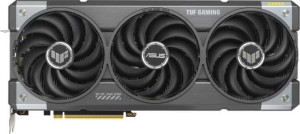
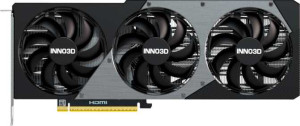
The most telling story in this performance group is the gap in raw compute hardware. The Inno3D RTX 5070 Ti X3 houses 8,960 shading units, 280 TMUs, and 96 ROPs versus the Asus TUF RTX 5070's 6,144 shaders, 192 TMUs, and 80 ROPs — roughly a 46% wider execution engine. This directly translates into the Ti's substantially higher floating-point throughput of 43.94 TFLOPS versus the RTX 5070's 30.87 TFLOPS, a ~42% compute advantage that matters most in shader-heavy workloads like path tracing, AI inference on-GPU, and compute-intensive rendering pipelines.
Interestingly, the Asus TUF RTX 5070 partially compensates through clock speed: its base clock of 2,325 MHz and boost of 2,512 MHz edge out the Ti's 2,295 MHz / 2,452 MHz respectively. However, higher clocks on a smaller shader array cannot close a ~46% unit-count gap — the Ti's texture rate (686.6 GTexels/s vs 482.3 GTexels/s) and pixel rate (235.4 GPixel/s vs 201 GPixel/s) remain decisively ahead, which in practice means faster texture throughput in complex scenes and higher sustainable rasterization output at demanding resolutions. Both cards share identical memory speed at 1,750 MHz and both support Double Precision Floating Point, so neither holds an edge on those fronts.
The Inno3D RTX 5070 Ti X3 holds a clear and substantial performance advantage in this group across every meaningful compute and throughput metric. The RTX 5070's slightly higher clock speeds are a real but minor footnote — they do not change the competitive conclusion. Users prioritizing peak rendering performance and workload throughput will find the Ti meaningfully faster; the Asus TUF RTX 5070 trades raw muscle for what will likely be a lower price point, making it the choice for those who do not need the Ti's extra headroom.