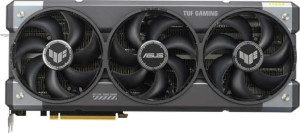
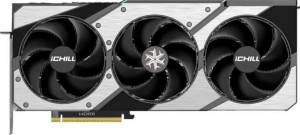
Both the Asus TUF Gaming RTX 5090 and the Inno3D iChill X3 RTX 5090 share the same fundamental silicon configuration: identical 2017 MHz base clocks, 21,760 shading units, 680 TMUs, 176 ROPs, and 1750 MHz memory speed. This means any performance gap between them is driven entirely by boost clock behavior rather than architectural differences — both cards are running the same GPU die with the same pipeline depth.
The meaningful divergence is in the GPU turbo (boost) clock: the iChill X3 reaches 2467 MHz versus the TUF Gaming's 2407 MHz — a 60 MHz advantage. While that gap sounds modest in isolation, it compounds across the derived throughput metrics. The iChill X3 delivers 107.4 TFLOPS of floating-point performance against the TUF's 104.8 TFLOPS, and a texture rate of 1677.6 GTexels/s versus 1637 GTexels/s. In practice, this translates to a roughly 2.5% compute and texturing advantage for the iChill X3 — a difference that is real but unlikely to be perceptible as a consistent frame-rate delta in most workloads without controlled benchmarking.
Based strictly on these specs, the Inno3D iChill X3 holds a clear — if narrow — performance edge in this group, courtesy of its higher factory boost clock. For users prioritizing peak theoretical throughput out of the box, the iChill X3 wins. The TUF Gaming, however, nearly matches it, and the gap is small enough that real-world rendering workloads may not reliably expose the difference.