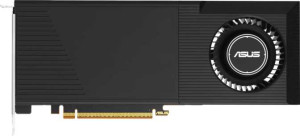
At first glance, the Asus Turbo Radeon AI Pro R9700's 2920 MHz turbo clock versus the RTX 5090's 2410 MHz turbo might suggest AMD has a frequency advantage — and it does. However, raw clock speed is only one part of the GPU performance equation. The RTX 5090's sheer silicon advantage becomes apparent the moment you look at the shader counts: 21,760 shading units against the R9700's 4,096, along with 680 TMUs versus 256. This translates directly into the texture throughput figures — 1638.8 GTexels/s for the RTX 5090 compared to 747.5 GTexels/s — meaning Nvidia's card can process roughly twice the texture workload per second, a gap that is felt in high-resolution rendering and complex scene geometry.
The floating-point performance gap is the most decisive differentiator in this group. The RTX 5090 delivers 104.9 TFLOPS versus the R9700's 47.84 TFLOPS — more than double the compute throughput. In practice, this matters far beyond gaming: AI inference, generative workloads, and GPU-accelerated compute tasks scale closely with FLOP capacity. The R9700 does counter in one area — its 2518 MHz memory speed outpaces the RTX 5090's 1750 MHz, which can reduce memory bandwidth bottlenecks in certain workloads, though this alone cannot offset the compute deficit. Pixel fill rate tells a similar story: the RTX 5090's 424.2 GPixel/s edges out the R9700's 373.8 GPixel/s, aided by its higher ROP count (176 vs 128). Both cards support Double Precision Floating Point, making neither uniquely advantaged for DPFP-specific professional compute tasks.
The RTX 5090 holds a clear and substantial performance advantage in this group across nearly every compute and throughput metric. The R9700's higher boost clock and faster memory speed represent genuine strengths, but they are architectural optimizations within a much smaller execution footprint. For users prioritizing raw rendering throughput, AI compute, or future-proofing at the highest performance tier, the RTX 5090's lead here is commanding.