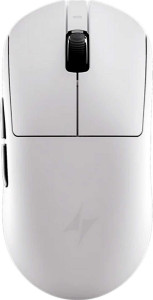
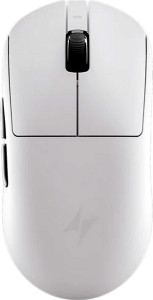
ATK Dragonfly A9
ATK Dragonfly A9 Plus

ATK Dragonfly A9 ATK Dragonfly A9 Plus

Overview

Welcome to our in-depth comparison of the ATK Dragonfly A9 and the ATK Dragonfly A9 Plus, two wireless gaming mice that share the same core performance foundation. Both deliver a 1000 Hz polling rate, a 650 IPS maximum tracking speed, and an identical button layout, making them remarkably similar on paper. Yet a closer look reveals meaningful distinctions in battery life, weight, and sensor variant that could make one a significantly better fit for your needs than the other.

Common Features

  • Both mice have a polling rate of 1000 Hz.
  • Both mice have a maximum speed of 650 IPS.
  • Both mice have a maximum acceleration of 50G.
  • Both mice have a maximum DPI of 26000 DPI.
  • Both mice have a minimum DPI of 50 DPI.
  • Both mice support adjustable DPI.
  • Both mice are gaming mice.
  • Both mice support USB and Bluetooth connectivity.
  • Both mice have no onboard memory profiles.
  • Both mice use Bluetooth version 5.
  • Both mice do not support gestures.
  • Both mice cannot be used while charging.
  • Both mice do not support wireless charging.
  • Both mice have a rechargeable battery.
  • Both mice have 5 buttons in total.
  • Both mice have 2 side buttons.
  • Both mice have 5 programmable buttons.
  • Both mice have a DPI switching button.
  • Both mice do not have a profile switching button.
  • Both mice are designed for right-handed use.
  • Neither mouse features RGB lighting.
  • Neither mouse has a tilting scroll wheel.
  • Neither mouse has a thumb scroll wheel.
  • Neither mouse supports extra weights.
  • Both mice have a cable length of 1.8 m.
  • Both mice have a volume of 320 cm³.
  • Both mice have a thickness of 40 mm.

Main Differences

  • The sensor is PixArt PAW3395 SE on ATK Dragonfly A9 and PixArt PAW3395 on ATK Dragonfly A9 Plus.
  • Battery life is 120 hours on ATK Dragonfly A9 and 240 hours on ATK Dragonfly A9 Plus.
  • Weight is 53 g on ATK Dragonfly A9 and 57 g on ATK Dragonfly A9 Plus.
Specs Comparison
ATK Dragonfly A9

ATK Dragonfly A9

ATK Dragonfly A9 Plus

ATK Dragonfly A9 Plus

Performance:
polling rate 1000 Hz 1000 Hz
maximum speed 650 IPS 650 IPS
maximum acceleration 50G 50G
maximum DPI 26000 DPI 26000 DPI
minimum DPI 50 DPI 50 DPI
has adjustable DPI

In terms of raw performance, the ATK Dragonfly A9 and the ATK Dragonfly A9 Plus are completely identical across every measured spec in this category. Both mice share a 1000 Hz polling rate, a 650 IPS maximum tracking speed, and a 50G maximum acceleration — a combination that positions them firmly in the competitive gaming tier, capable of handling even the most aggressive flick shots without sensor dropout.

On the DPI front, both offer a 26000 DPI ceiling and a 50 DPI floor, with full adjustability in between. The high ceiling is largely a marketing figure for most users — in practice, anything above 3200–6400 DPI introduces pixel-skipping on standard displays — but the low 50 DPI minimum is genuinely useful for precision tasks or ultra-low sensitivity players who prefer to run near-zero DPI with high in-game sensitivity scaling.

Since every performance specification is a perfect match between the two products, this category results in a clear tie. Neither the A9 nor the A9 Plus holds any measurable tracking or responsiveness advantage over the other. If performance is your sole deciding criterion, this group offers no differentiation — buyers should look to other spec groups such as design, connectivity, or weight to make their final call.

General info:
Type Gaming Gaming
connection type USB, Bluetooth USB, Bluetooth
sensor PixArt PAW3395 SE PixArt PAW3395
onboard memory profiles 0 0
Bluetooth version 5 5
has gesture support
Battery life 120 hours 240 hours
can use while charging
has wireless charging
has a rechargeable battery
has a removable battery
warranty period 1 years 1 years
release date March 2025 March 2025

Both mice are purpose-built for gaming and share the same dual-mode connectivity via USB and Bluetooth 5, making them equally versatile for wired competitive play or wireless desktop use. The more meaningful distinction lies under the hood: the A9 runs on the PixArt PAW3395 SE, while the A9 Plus uses the standard PixArt PAW3395. The ″SE″ designation typically denotes a modified or binned variant — not necessarily inferior, but a subtle divergence that suggests ATK may have differentiated component sourcing between the two models.

Where the gap becomes impossible to ignore is battery life. The A9 Plus nearly doubles the endurance of the base model, rated at 240 hours versus the A9′s 120 hours. In practical terms, a user charging once a month on the A9 would charge roughly once every two months on the A9 Plus — a meaningful quality-of-life difference for anyone who dislikes interruptions in their workflow. Neither model supports use while charging or wireless charging, so when the battery does run out, the mouse is temporarily out of commission regardless of which variant you own.

The A9 Plus holds a clear edge in this category. The doubled battery life is a tangible, everyday advantage, and while the sensor variant difference warrants attention, it does not offset the endurance gap. Users who prioritize longer time between charges — especially in wireless-first setups — will find the A9 Plus the more practical choice based strictly on these specs.

Buttons:
number of buttons 5 5
number of side buttons 2 2
number of programmable buttons 5 5
has a DPI switching button
has a profile switching button

The button layout is identical across both mice. Each features 5 total buttons — including 2 side buttons — with all five fully programmable. For a gaming mouse, this is a competent but conservative configuration: enough inputs to cover genre staples like push-to-talk, weapon swapping, or ability binds, without the cluttered button sprawl that can compromise grip consistency.

A dedicated DPI switching button is present on both, allowing on-the-fly sensitivity changes — useful for players who shift between sniping and close-quarters scenarios mid-game. The absence of a profile switching button on either model means users cannot hot-swap full configuration profiles without software, which is a minor limitation for those who share a mouse across multiple games or use cases. Combined with the fact that neither mouse offers onboard memory profiles (as noted in the General Info specs), configuration flexibility is somewhat constrained on both.

This category is a straightforward tie. Every button-related specification is a mirror image between the A9 and the A9 Plus, so hardware input capability plays no role in differentiating the two. The decision here ultimately comes down to the specs covered in other groups.

Design:
Orientation Right-handed Right-handed
weight 53 g 57 g
has RGB lighting
has a tilting scroll wheel
has a thumb scroll wheel
has extra weights
cable length 1.8 m 1.8 m
volume 320 cm³ 320 cm³
thickness 40 mm 40 mm
height 125 mm 125 mm
width 64 mm 64 mm

Physically, these two mice are essentially the same object. Identical dimensions — 125 mm long, 64 mm wide, 40 mm thick — and the same 320 cm³ volume mean the A9 and A9 Plus will feel indistinguishable in hand. Both are right-handed designs, neither carries RGB lighting, and neither offers customizable weight inserts. For users evaluating ergonomics or form factor, there is nothing to separate them.

The one measurable divergence is weight: the A9 comes in at 53 g while the A9 Plus weighs 57 g. A 4-gram difference is at the lower boundary of what most users can perceive during extended sessions, but in the ultra-lightweight gaming mouse segment where every gram is scrutinized, it is worth noting. The A9′s lighter build gives it a marginal edge for players who favor low-mass mice for rapid directional changes and reduced fatigue over long play sessions.

The A9 holds a narrow advantage in this category purely on the basis of its lighter weight. Given that every other design attribute — dimensions, cable length, orientation, and feature set — is completely shared, the 4 g difference is the sole differentiator here. It is a small but real distinction, and for weight-sensitive users, it tips the scale toward the base A9.

Comparison Summary & Verdict

Having examined every available specification, the ATK Dragonfly A9 and ATK Dragonfly A9 Plus emerge as near-twins in most areas, sharing the same 1000 Hz polling rate, 650 IPS maximum speed, 50G acceleration, and a full five-button right-handed layout. The real differentiators are few but impactful. The A9 Plus doubles the endurance of its sibling with a battery life of 240 hours, compared to the A9's 120 hours, making it the stronger companion for extended or travel-heavy use. In return, the ATK Dragonfly A9 shaves 4 grams off the scale at just 53 g and pairs with the PixArt PAW3395 SE sensor, whereas the A9 Plus carries the standard PixArt PAW3395. Choose the A9 if raw lightness is your top priority; choose the ATK Dragonfly A9 Plus if maximizing time away from the charger matters most.

ATK Dragonfly A9
Buy ATK Dragonfly A9 if...

Buy the ATK Dragonfly A9 if you want the lightest possible mouse at just 53 g and are comfortable with 120 hours of battery life between charges.

ATK Dragonfly A9 Plus
Buy ATK Dragonfly A9 Plus if...

Buy the ATK Dragonfly A9 Plus if battery endurance is a top priority, as its 240-hour battery life is double that of the A9, keeping you wireless for far longer between charges.