Audio-Technica ATH-AC5TW
Shokz OpenFit 2

Audio-Technica ATH-AC5TW Shokz OpenFit 2

Overview

When it comes to open-ear true wireless earbuds, the Audio-Technica ATH-AC5TW and the Shokz OpenFit 2 both promise a comfortable, wire-free listening experience — but they take notably different paths to get there. In this comparison, we put both earbuds side by side to examine key areas such as sound performance, battery life, and durability, helping you decide which one is the better fit for your lifestyle and listening habits.

Common Features

  • Both products have an open-ear fit design.
  • Neither product has wires or cables.
  • Neither product is a neckband earbud style.
  • Both products include wingtips.
  • Neither product has RGB lighting.
  • Both products feature stereo speakers.
  • Neither product has a UV light.
  • Neither product has a display.
  • Neither product has active noise cancellation (ANC).
  • Neither product has passive noise reduction.
  • Neither product supports spatial audio.
  • Neither product has Dolby Atmos.
  • Neither product has a neodymium magnet.
  • Neither product supports wireless charging.
  • Neither product has a solar power battery.
  • Both products have a battery level indicator.
  • Both products have a rechargeable battery.
  • Neither product supports fast pairing.
  • Both products have USB Type-C connectivity.
  • Both products use Bluetooth version 5.4.
  • Neither product has LDAC support.
  • Neither product has Bluetooth LE Audio support.
  • Neither product has aptX Adaptive support.
  • Neither product has aptX Low Latency support.
  • Neither product has an ambient sound mode.
  • Neither product has in/on-ear detection.
  • Both products support fast charging.
  • Neither product can read notifications.
  • Both products have a mute function.
  • Both products can be used as a headset.
  • Both products have a control panel placed on the device.
  • Both products have voice prompts.
  • Both products have 4 microphones.
  • Both products feature a noise-canceling microphone.

Main Differences

  • Ingress Protection rating is IPX4 on Audio-Technica ATH-AC5TW and IP55 on Shokz OpenFit 2.
  • Water resistance is sweat resistant on Audio-Technica ATH-AC5TW and water resistant on Shokz OpenFit 2.
  • Weight is 21 g on Audio-Technica ATH-AC5TW and 18.8 g on Shokz OpenFit 2.
  • Driver unit size is 14.3 mm on Audio-Technica ATH-AC5TW and 17.3 mm on Shokz OpenFit 2.
  • Lowest frequency is 20 Hz on Audio-Technica ATH-AC5TW and 50 Hz on Shokz OpenFit 2.
  • Highest frequency is 20000 Hz on Audio-Technica ATH-AC5TW and 16000 Hz on Shokz OpenFit 2.
  • Battery life is 13 hours on Audio-Technica ATH-AC5TW and 11 hours on Shokz OpenFit 2.
  • Battery life of the charging case is 21 hours on Audio-Technica ATH-AC5TW and 37 hours on Shokz OpenFit 2.
  • Charge time is 2 hours on Audio-Technica ATH-AC5TW and 1 hour on Shokz OpenFit 2.
  • A find device feature is available on Shokz OpenFit 2 but not on Audio-Technica ATH-AC5TW.
Specs Comparison
Audio-Technica ATH-AC5TW

Audio-Technica ATH-AC5TW

Shokz OpenFit 2

Shokz OpenFit 2

Design:
Fit Open-ear Open-ear
Ingress Protection (IP) rating IPX4 IP55
water resistance Sweat resistant Water resistant
weight 21 g 18.8 g
has no wires or cables
are neckband earbuds
wingtips included
has RGB lighting
has stereo speakers
has UV light
Has a display

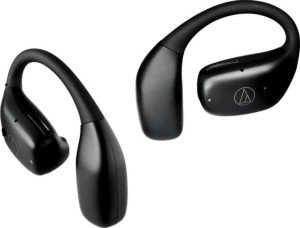
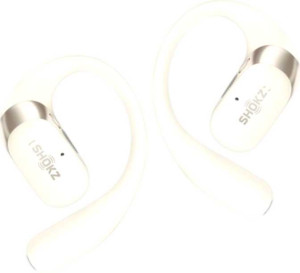
Both the Audio-Technica ATH-AC5TW and the Shokz OpenFit 2 share the same foundational design philosophy: fully wireless, open-ear fit with wingtips included for added stability and stereo playback on both sides. These shared traits mean neither product asks you to compromise on situational awareness or cord-free convenience, and both are clearly aimed at users who want to stay aware of their surroundings during everyday or athletic use.

Where the two diverge meaningfully is in protection and weight. The OpenFit 2 carries an IP55 rating, which covers both dust ingress and resistance to low-pressure water jets from any direction — making it genuinely water resistant. The ATH-AC5TW is rated only IPX4, which protects against sweat and splashing from any angle but provides no dust protection and handles less water exposure overall. For outdoor or gym use, this is a real-world gap: the OpenFit 2 can handle rain or a post-workout rinse more confidently. On weight, the OpenFit 2 also comes in lighter at 18.8 g versus the ATH-AC5TW's 21 g — a modest but noticeable difference during extended wear, where even a few grams can reduce ear fatigue over time.

From a design standpoint, the Shokz OpenFit 2 holds a clear edge: it is lighter and meaningfully better protected against both dust and water. Unless the ATH-AC5TW distinguishes itself elsewhere, the OpenFit 2 is the more durable and comfortable option based on these specs alone.

Sound quality:
has active noise cancellation (ANC)
has passive noise reduction
driver unit size 14.3 mm 17.3 mm
lowest frequency 20 Hz 50 Hz
highest frequency 20000 Hz 16000 Hz
supports spatial audio
has Dolby Atmos
has Dirac Virtuo
has a neodymium magnet

Neither earphone offers ANC, passive noise reduction, or spatial audio processing — a logical trade-off for open-ear designs, where acoustic isolation is never the goal. That shared baseline means the real differentiators come down to driver size and frequency range, which together paint a telling picture of each product's sonic priorities.

The ATH-AC5TW's 20 Hz–20,000 Hz frequency range spans the full theoretical extent of human hearing, capturing deep sub-bass rumble at the low end and airy upper-treble detail at the high end. The OpenFit 2, by contrast, is tuned from 50 Hz to 16,000 Hz — rolling off noticeably in both directions. That 30 Hz gap at the bottom means less visceral bass presence, and the 4 kHz ceiling difference at the top can translate to a slightly duller, less extended high-frequency response, which matters for instruments like cymbals or high strings. On the other hand, the OpenFit 2 fields a larger 17.3 mm driver versus the ATH-AC5TW's 14.3 mm, which can support greater acoustic displacement and potentially higher output volume — but driver size alone does not override the frequency response limits reflected in the specs.

On sound quality specs, the Audio-Technica ATH-AC5TW holds the edge. Its wider frequency response on both ends suggests a more complete sonic tuning, which is a meaningful advantage for listeners who care about bass depth and treble clarity. The OpenFit 2's larger driver is a point in its favor, but the narrower stated range is a harder constraint to ignore.
Power:
Battery life 13 hours 11 hours
Battery life of charging case 21 hours 37 hours
charge time 2 hours 1 hours
has wireless charging
Has a solar power battery
has a battery level indicator
has a rechargeable battery

At the earbud level, the ATH-AC5TW pulls ahead with 13 hours of continuous playback versus the OpenFit 2's 11 hours — a two-hour lead that matters for all-day listeners who prefer to charge infrequently. However, zooming out to the full system tells a very different story. The ATH-AC5TW's case contributes an additional 21 hours, bringing total combined battery life to around 34 hours. The OpenFit 2's case, by contrast, holds a substantial 37 hours of reserve charge, pushing its total system endurance to roughly 48 hours — a gap of nearly a full day and a half over the ATH-AC5TW.

Charge time compounds this further. The OpenFit 2 refills in just 1 hour, while the ATH-AC5TW requires 2 hours to reach full charge. For users who do not plan meticulously around battery, faster charging acts as a practical safety net. Neither product supports wireless charging, so both require a cable when it is time to top up.

The verdict here goes to the Shokz OpenFit 2. Despite falling slightly short on single-session playback, its dramatically larger case reserve and half the charge time give it a decisive advantage for extended trips, heavy daily use, or anyone who wants to think about charging as rarely as possible.

Connectivity:
has fast pairing
Has USB Type-C
Bluetooth version 5.4 5.4
has LDAC
has LDHC
has Bluetooth LE Audio
has aptX Adaptive
has aptX Low Latency
has aptX HD
has aptX
has aptX Lossless
has aptX Voice
has Auracast
maximum Bluetooth range 10 m 10 m
supports Bluetooth pairing using NFC
Can be used wirelessly
has AAC

Connectivity is the rare category where these two earphones are in complete lockstep. Both run on Bluetooth 5.4 — a modern, efficient version of the standard that brings improved connection stability and lower power consumption compared to earlier iterations. Both cap wireless range at 10 m, support AAC as their sole advanced audio codec, and charge via USB-C. Neither offers LDAC, aptX in any form, Bluetooth LE Audio, Auracast, or NFC pairing.

The shared codec picture is worth a closer look. AAC is a solid baseline — well-suited for Apple device users in particular, where AAC tends to perform most efficiently — but the absence of higher-fidelity options like LDAC or aptX HD means neither earphone can stream at the audio quality ceiling that some Android users might expect from a premium product. For open-ear earphones in this category, however, that is a common trade-off.

This group is an unambiguous tie. Every specified connectivity attribute is identical across both products, so connectivity should carry no weight in a purchase decision between them.

Features:
release date March 2025 January 2025
has ambient sound mode
has in/on-ear detection
has find device feature
Supports fast charging
can read notifications
has a mute function
can be used as a headset
control panel placed on a device
Has voice prompts
travel bag is included
Has an in-line control panel
Has a temperature sensor
Has a built-in camera remote control function

Across the broad feature set, these two earphones are remarkably similar in practice. Both support fast charging, offer on-device controls, include a mute function, function as a headset for calls, deliver voice prompts, and even come bundled with a travel bag. For everyday usability, this parity means neither product has a structural advantage in how you interact with it day to day.

The single point of separation is the OpenFit 2's find device feature, which the ATH-AC5TW lacks. In practical terms, this means the OpenFit 2 can help you locate misplaced earbuds — a genuinely useful safeguard given that small, wireless earphones are easy to lose around the house or in a bag. It is not a headline feature, but for disorganized users or frequent travelers, it provides meaningful peace of mind that the ATH-AC5TW simply cannot offer.

The Shokz OpenFit 2 edges ahead in this category, but only narrowly. The find device feature is the sole differentiator, and whether it matters depends entirely on the user — those who are careful with their gear may find this a non-issue, while others may consider it a genuinely useful safety net.

Microphone:
number of microphones 4 4
has a noise-canceling microphone

Microphone hardware is another category where these two earphones land in exactly the same place. Both deploy 4 microphones and both include noise-canceling microphone technology — a configuration that, in open-ear earphones, is particularly important. Without any passive acoustic seal to block ambient sound, the microphone array carries the full burden of isolating your voice from background noise during calls, making beam-forming or noise-canceling mic setups more critical here than in traditional in-ear designs.

A 4-microphone setup is a solid specification at this tier, enabling more sophisticated voice pickup and environmental noise suppression than simpler 2-mic arrangements. The result, on paper, should be cleaner call quality in noisy settings like busy streets or open offices — for both products equally.

With every available data point identical, this category is a clear tie. The specs give no basis for preferring one over the other for call quality or voice capture, and microphone performance should not factor into a decision between these two products.

Comparison Summary & Verdict

Both the Audio-Technica ATH-AC5TW and the Shokz OpenFit 2 are capable open-ear earbuds that share a strong foundation: Bluetooth 5.4, fast charging, USB-C, and a four-microphone noise-canceling setup. However, their differences reveal distinct personalities. The ATH-AC5TW stands out with a wider frequency range (20–20,000 Hz) and a longer 13-hour earbud battery life, making it appealing to audio enthusiasts who want fuller sound reproduction and more playtime per charge. The Shokz OpenFit 2, on the other hand, offers superior IP55 water resistance, a lighter 18.8 g weight, a much larger 37-hour charging case, and a handy find device feature — making it the stronger choice for active users and frequent travelers who prioritize durability and convenience on the go.

Audio-Technica ATH-AC5TW
Buy Audio-Technica ATH-AC5TW if...

Buy the Audio-Technica ATH-AC5TW if you prioritize a wider frequency range and longer per-charge earbud battery life for extended listening sessions.

Shokz OpenFit 2
Buy Shokz OpenFit 2 if...

Buy the Shokz OpenFit 2 if you need stronger water resistance, a lighter fit, a much larger charging case battery, and the convenience of a find device feature.