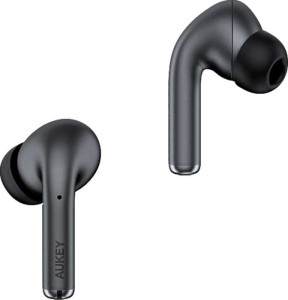
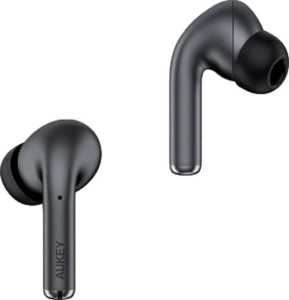
Aukey EP-B1
Aukey EP-B1 Beyond ANC Pro

Aukey EP-B1 Aukey EP-B1 Beyond ANC Pro

Overview

When shopping for true wireless earbuds with active noise cancellation, the Aukey EP-B1 and the Aukey EP-B1 Beyond ANC Pro make for a fascinating head-to-head. Both share a robust IPX5 water-resistant build, a 10 mm driver, and a six-microphone array, yet they diverge in meaningful ways around battery life and charge time — details that can make a real difference for everyday listeners. Read on to see exactly where each model pulls ahead.

Common Features

  • Both products have an in-ear fit.
  • Both products have an IPX5 ingress protection rating, making them water resistant.
  • Both products weigh 9 g.
  • Both products are fully wireless with no wires or cables.
  • Neither product is a neckband earbud design.
  • Wingtips are not included with either product.
  • Neither product has RGB lighting.
  • Both products feature active noise cancellation (ANC).
  • Both products offer passive noise reduction.
  • Both products use a 10 mm driver unit.
  • Both products have a frequency range of 20 Hz to 20000 Hz.
  • Spatial audio is not supported on either product.
  • Dolby Atmos is not available on either product.
  • Dirac Virtuo is not available on either product.
  • Wireless charging is not available on either product.
  • Neither product has a solar power battery.
  • Both products have a battery level indicator.
  • Both products have a rechargeable battery.
  • Fast pairing is not available on either product.
  • Both products feature a USB Type-C connector.
  • LDAC support is not available on either product.
  • LDHC support is not available on either product.
  • Bluetooth LE Audio is not supported on either product.
  • aptX Adaptive is not supported on either product.
  • aptX Low Latency is not supported on either product.
  • aptX HD is not supported on either product.
  • Both products have an ambient sound mode.
  • In/on-ear detection is not present on either product.
  • Both products support fast charging.
  • Neither product can read notifications.
  • Both products have a mute function.
  • Both products can be used as a headset.
  • Both products have a control panel placed on the device.
  • Both products have voice prompts.
  • Both products have 6 microphones.
  • Both products feature a noise-canceling microphone.

Main Differences

  • Battery life is 5 hours on Aukey EP-B1 and 8 hours on Aukey EP-B1 Beyond ANC Pro.
  • Battery life of the charging case is 20 hours on Aukey EP-B1 and 17 hours on Aukey EP-B1 Beyond ANC Pro.
  • Charge time is 1 hour on Aukey EP-B1 and 1.5 hours on Aukey EP-B1 Beyond ANC Pro.
Specs Comparison
Aukey EP-B1

Aukey EP-B1

Aukey EP-B1 Beyond ANC Pro

Aukey EP-B1 Beyond ANC Pro

Design:
Fit In-ear In-ear
Ingress Protection (IP) rating IPX5 IPX5
water resistance Water resistant Water resistant
weight 9 g 9 g
has no wires or cables
are neckband earbuds
wingtips included
has RGB lighting
has stereo speakers
has UV light
Has a display

In terms of design, the Aukey EP-B1 and the Aukey EP-B1 Beyond ANC Pro are effectively identical across every measured specification in this category. Both are in-ear, true wireless earbuds — no neckband, no wires — weighing in at a shared 9 g. At that weight, both sit comfortably in the ultra-light tier for in-ear earbuds, which generally translates to less ear fatigue during extended listening sessions.

Both models carry an IPX5 ingress protection rating, meaning they can withstand sustained water jets from any direction. In practical terms, this makes either pair a solid companion for workouts or light rain exposure, though neither is rated for submersion. Neither model includes wingtips, RGB lighting, a UV light, or a display — keeping the design clean and utilitarian.

Given that every design spec matches exactly, this category is a complete tie. There is no design-based reason to choose one over the other — any differentiation between these two products will need to come from other spec groups such as audio performance, battery life, or feature set.

Sound quality:
has active noise cancellation (ANC)
has passive noise reduction
driver unit size 10 mm 10 mm
lowest frequency 20 Hz 20 Hz
highest frequency 20000 Hz 20000 Hz
supports spatial audio
has Dolby Atmos
has Dirac Virtuo
has a neodymium magnet

Both the Aukey EP-B1 and the EP-B1 Beyond ANC Pro share an identical sound quality specification sheet. Each uses a 10 mm dynamic driver — a size that sits in the mainstream sweet spot for in-ear earbuds, generally capable of delivering a well-rounded bass response without the bulk of larger drivers. The frequency range of 20 Hz – 20,000 Hz covers the full extent of typical human hearing, which is a standard but respectable tuning boundary for this class of earbud.

Notably, both models include active noise cancellation (ANC) alongside passive noise reduction, which is a meaningful combination. Passive isolation physically blocks ambient sound via the ear seal, while ANC electronically counters low-frequency noise like engine rumble or HVAC hum — together, they offer a more complete noise-blocking experience than either method alone. The absence of spatial audio, Dolby Atmos, or Dirac Virtuo means neither earbud offers any virtualized surround-sound processing, keeping the sound profile straightforward and stereo-only.

Since every sound quality spec is a mirror image between the two products, this group is a complete tie. There is no data here to suggest one will sound different from the other — driver size, frequency response, and noise-handling capabilities are all identical.

Power:
Battery life 5 hours 8 hours
Battery life of charging case 20 hours 17 hours
charge time 1 hours 1.5 hours
has wireless charging
Has a solar power battery
has a battery level indicator
has a rechargeable battery

Power is where these two earbuds finally diverge in a meaningful way. The EP-B1 Beyond ANC Pro delivers 8 hours of continuous earbud playback versus just 5 hours on the standard EP-B1 — a 60% increase in single-session endurance. For daily commuters, gym-goers, or anyone spending long stretches away from a charger, that extra three hours per charge can be the difference between making it through a full workday on one earbud charge or not.

The tradeoff is in the charging case. The EP-B1's case holds 20 hours of additional charge, while the Beyond ANC Pro's case provides 17 hours — enough to recharge the earbuds roughly twice over in each scenario. Interestingly, the total combined endurance works out nearly identical at around 25 hours for both, meaning the Beyond ANC Pro has simply redistributed capacity from the case into the earbuds themselves. Users who prefer fewer interruptions mid-session will favor the Pro; those who don't mind topping up more frequently but want a more generous case reserve may find the standard EP-B1 equally practical. The Beyond ANC Pro also takes slightly longer to recharge — 1.5 hours versus 1 hour — a minor but real consideration for quick top-up situations.

On balance, the EP-B1 Beyond ANC Pro holds the edge in this category for most users. Longer per-session battery life is typically the more impactful metric day-to-day, and the 3-hour gain outweighs the modest reduction in case reserve and the slightly longer charge time.

Connectivity:
has fast pairing
Has USB Type-C
has LDAC
has LDHC
has Bluetooth LE Audio
has aptX Adaptive
has aptX Low Latency
has aptX HD
has aptX
has aptX Lossless
has aptX Voice
has Auracast
maximum Bluetooth range 10 m 10 m
supports Bluetooth pairing using NFC
Can be used wirelessly
has AAC

Connectivity is another category where the Aukey EP-B1 and the EP-B1 Beyond ANC Pro are perfectly matched — and worth examining honestly for what they lack. Neither earbud supports any advanced audio codec: no aptX, no LDAC, no AAC. In practical terms, this means audio is transmitted over standard Bluetooth SBC by default, which is the baseline codec and the most compressed option. Audiophiles or users pairing these with high-resolution audio sources will not get the benefit of higher-fidelity wireless transmission that competing earbuds in this space often provide.

The 10 m maximum Bluetooth range is functional but modest — sufficient for typical use cases like keeping a phone in a pocket or on a desk nearby, but not ideal for situations where the source device is across a room. Both models charge via USB-C, which is a practical convenience for users already in a USB-C ecosystem. The absence of fast pairing, NFC pairing, Bluetooth LE Audio, and Auracast means the connection experience is straightforward but unadorned — no one-tap pairing shortcuts or next-generation broadcast audio features.

With every connectivity spec identical, this group is a complete tie. Neither product gains any advantage here, and both share the same notable limitation of having no advanced audio codec support — a factor worth weighing for users who prioritize wireless audio quality.

Features:
release date June 2025 June 2025
has ambient sound mode
has in/on-ear detection
Supports fast charging
can read notifications
has a mute function
can be used as a headset
control panel placed on a device
Has voice prompts
travel bag is included
Has an in-line control panel
Has a temperature sensor
Has a built-in camera remote control function

The feature sets of the Aukey EP-B1 and the EP-B1 Beyond ANC Pro are once again identical, and the shared lineup is genuinely well-rounded for this class of earbud. The combination of ambient sound mode and ANC (noted in the sound quality group) gives users meaningful control over their acoustic environment — ambient mode lets external sound pass through intentionally, which is essential for situational awareness during commutes or outdoor activities.

A few practical highlights stand out. Fast charging support is a welcome inclusion, offsetting the inconvenience of running low mid-day. On-device controls, a mute function, voice prompts, and headset capability round out a package that works well for both casual listening and calls. The inclusion of a travel bag adds a small but tangible everyday convenience. Notably, neither model has in/on-ear detection, meaning audio will not automatically pause when an earbud is removed — a minor usability gap compared to some competitors.

Since the feature spec is a perfect match across both products, this group is a complete tie. Users can expect exactly the same day-to-day feature experience from either model, and the decision between them should rest on the differentiators found in other categories — most notably battery life.

Microphone:
number of microphones 6 6
has a noise-canceling microphone

Microphone hardware is identical across both models: each earbud array totals 6 microphones, paired with noise-canceling microphone processing. A six-mic configuration is notably generous for consumer true wireless earbuds — more microphones allow for more sophisticated beamforming and wind/noise rejection algorithms, which directly translates to cleaner voice pickup during calls in noisy environments like busy streets or open offices.

The presence of active noise-canceling microphone technology means the hardware is designed to isolate the speaker's voice and suppress ambient interference before transmission — a meaningful advantage for anyone who frequently takes calls on the go. This mic count puts both products above the two- or four-mic setups common in budget-tier earbuds, suggesting call quality is a deliberate priority in the design of both models.

With specs perfectly matched, this group is a complete tie. Both the EP-B1 and the EP-B1 Beyond ANC Pro bring the same microphone capability to the table, and neither holds any advantage for voice communication or call quality based on the available data.

Comparison Summary & Verdict

After examining every specification, it is clear that both earbuds deliver a nearly identical feature set — IPX5 water resistance, active noise cancellation, an ambient sound mode, six noise-canceling microphones, fast charging, and USB-C connectivity all come standard on each model. The decision ultimately comes down to how you use them day to day. The Aukey EP-B1 charges in just one hour and its case holds an impressive 20 hours of total backup power, making it the smarter pick for users who want quick top-ups and maximum case capacity. The Aukey EP-B1 Beyond ANC Pro, by contrast, delivers 8 hours of playback on a single charge — three hours more per session — at the cost of a slightly longer 1.5-hour charge time and a case that carries 17 hours total. If uninterrupted, all-day listening matters most, the Beyond ANC Pro is the stronger choice; if rapid charging and a higher-capacity case are the priority, the standard EP-B1 holds its own.

Aukey EP-B1
Buy Aukey EP-B1 if...

Buy the Aukey EP-B1 if you want faster charging and a higher-capacity case for extended backup power. Its one-hour charge time and 20-hour case make it ideal for users who recharge frequently on the go.

Aukey EP-B1 Beyond ANC Pro
Buy Aukey EP-B1 Beyond ANC Pro if...

Buy the Aukey EP-B1 Beyond ANC Pro if longer single-charge playback is your top priority. With 8 hours of battery life per session, it is the better fit for long commutes or full-day use without reaching for the case.