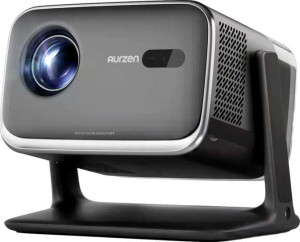
Aurzen Boom Mini
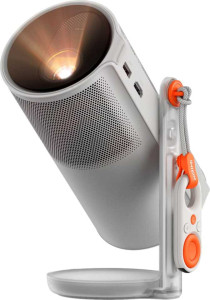
XGIMI MoGo 4 Laser

Aurzen Boom Mini XGIMI MoGo 4 Laser

Overview

Choosing between the Aurzen Boom Mini and the XGIMI MoGo 4 Laser means weighing two genuinely different approaches to portable projection. Both deliver 1080p resolution and a comprehensive smart feature set, but they diverge sharply on light source technology, physical size, and audio output power. This detailed specification comparison explores every key area to help you find the right fit for your needs.

Common Features

  • Both products have a dedicated smartphone app.
  • Both products come with a 1-year warranty.
  • Both products output at 1080p resolution.
  • Both products support 3D content with glasses.
  • Both products have a maximum projection size of 200″.
  • HDR10+ support is not available on either product.
  • Dolby Vision support is not available on either product.
  • HDR10 support is available on both products.
  • Both products have 1 HDMI port.
  • AirPlay is supported on both products.
  • Bluetooth is available on both products.
  • Wi-Fi is supported on both products.
  • Both products have 2 USB ports.
  • Chromecast is built-in on both products.
  • A VGA connector is not present on either product.
  • A DVI connector is not present on either product.
  • Both products have stereo speakers.
  • Vertical lens shift is not available on either product.
  • Horizontal lens shift is not available on either product.
  • Both products include a remote control.
  • Built-in smart TV functionality is present on both products.
  • A built-in speaker is included on both products.
  • A 3.5 mm audio jack socket is available on both products.
  • An external memory slot is not available on either product.

Main Differences

  • Audible noise is 36 dB on Aurzen Boom Mini and 28 dB on XGIMI MoGo 4 Laser.
  • A laser light source is present on XGIMI MoGo 4 Laser but not available on Aurzen Boom Mini.
  • Width is 180 mm on Aurzen Boom Mini and 96.5 mm on XGIMI MoGo 4 Laser.
  • Height is 230 mm on Aurzen Boom Mini and 207.6 mm on XGIMI MoGo 4 Laser.
  • Thickness is 190 mm on Aurzen Boom Mini and 96.5 mm on XGIMI MoGo 4 Laser.
  • Volume is 7866 cm³ on Aurzen Boom Mini and 1933.2231 cm³ on XGIMI MoGo 4 Laser.
  • Minimum throw distance is 1.2 m on Aurzen Boom Mini and 1 m on XGIMI MoGo 4 Laser.
  • DLNA certification is present on XGIMI MoGo 4 Laser but not available on Aurzen Boom Mini.
  • Audio output power is 2 x 10W on Aurzen Boom Mini and 2 x 6W on XGIMI MoGo 4 Laser.
  • Dolby Atmos support is present on XGIMI MoGo 4 Laser but not available on Aurzen Boom Mini.
  • Voice commands are available on Aurzen Boom Mini but not present on XGIMI MoGo 4 Laser.
Specs Comparison
Aurzen Boom Mini

Aurzen Boom Mini

XGIMI MoGo 4 Laser

XGIMI MoGo 4 Laser

General info:
audible noise 36 dB 28 dB
has laser light source
release date January 2025 June 2025
width 180 mm 96.5 mm
height 230 mm 207.6 mm
thickness 190 mm 96.5 mm
Has a dedicated smartphone app
volume 7866 cm³ 1933.2231 cm³
warranty period 1 years 1 years

The most fundamental divide between these two projectors starts with the light source. The XGIMI MoGo 4 Laser uses a laser light source, while the Aurzen Boom Mini does not. In practical terms, laser technology typically delivers more consistent brightness over the product's lifespan, faster startup times, and a longer operational life before the light source degrades — all meaningful advantages for a device you expect to use for years.

Physical footprint is another area where the gap is substantial. The Boom Mini's volume of 7866 cm³ dwarfs the MoGo 4 Laser's remarkably compact 1933 cm³ — roughly four times smaller. This makes the MoGo 4 Laser far more portable and easier to place discreetly in a room or pack for travel. Equally significant is the noise difference: the Boom Mini operates at 36 dB, which is audible and can be distracting during quiet scenes, while the MoGo 4 Laser runs at a much quieter 28 dB — a reduction that, on the logarithmic decibel scale, represents a noticeably calmer viewing environment. Both units share a 1-year warranty and offer a dedicated smartphone app, so neither holds an edge on those fronts.

Overall, the XGIMI MoGo 4 Laser holds a clear advantage in this spec group. Its laser light source, significantly smaller and more portable form factor, and meaningfully lower operating noise all point to a more refined, future-oriented design — whereas the Boom Mini's larger chassis and louder operation position it as the less portable and more intrusive option.

Projection quality:
output resolution 1080p 1080p
displays 3D with glasses
maximum projection size 200" 200"
supports HDR10+
minimum throw distance 1.2 m 1 m
supports Dolby Vision
supports HDR10

Projection quality is remarkably consistent between these two projectors — and that is both reassuring and, for buyers hoping to find a clear winner here, somewhat anticlimactic. Both output at 1080p, cap their maximum image size at 200″, support HDR10, and stop short of HDR10+ and Dolby Vision. For most living room setups, 1080p at up to 200 inches is genuinely excellent, and HDR10 support ensures a wide color volume and good contrast headroom with compatible content.

The sole differentiator in this group is the minimum throw distance: the Aurzen Boom Mini requires at least 1.2 m from the screen, while the MoGo 4 Laser can be placed as close as 1 m away. Those 20 centimeters may seem minor, but in a small room or when mounting on a coffee table close to a wall, that extra flexibility can be the difference between a usable and unusable setup. Both also support 3D content with glasses, a niche but appreciated feature for enthusiasts with a 3D library.

On balance, this group is essentially a tie, with a marginal placement edge going to the MoGo 4 Laser thanks to its shorter minimum throw distance. Buyers should not let projection quality specs alone drive their decision here — the two projectors are functionally equivalent on this dimension, and the real differentiators lie in other specification groups.

Connectivity:
HDMI ports 1 1
has AirPlay
Has Bluetooth
supports Wi-Fi
USB ports 2 2
has Chromecast built-in
has a VGA connector
is DLNA-certified
has a DVI connector
supports Miracast
RJ45 ports 0 0
Has S/PDIF Out port

Connectivity is another area where these two projectors are largely in lockstep. Both carry 1 HDMI port, 2 USB ports, Wi-Fi, Bluetooth, AirPlay, Chromecast built-in, and Miracast — a genuinely comprehensive wireless stack that covers virtually every mainstream streaming and screen-mirroring scenario, whether you are an Apple household, an Android user, or casting from a laptop. The absence of an RJ45 ethernet port on both units means users in environments with unreliable Wi-Fi have no wired fallback, which is worth noting for permanent installations.

The single differentiator here is DLNA certification, which the XGIMI MoGo 4 Laser holds and the Aurzen Boom Mini does not. DLNA allows the projector to act as a certified media renderer on a local network, meaning compatible NAS drives, smart TVs, and media servers can push content directly to it without any additional app or workaround. For users with a home media server setup, this is a tangible convenience advantage. For those who rely purely on streaming services or direct HDMI connections, it is essentially irrelevant.

Overall, this group is very close to a tie, but the MoGo 4 Laser takes a narrow edge thanks to its DLNA certification. It is a niche advantage that will matter meaningfully to some users and not at all to others — but in an otherwise identical connectivity profile, it is the only differentiator available.

Features:
has stereo speakers
has lens shift (vertical)
has lens shift (horizontal)
has a remote control
has built-in smart TV
has a built-in speaker
audio output power 2 x 10W 2 x 6W
has a socket for a 3.5 mm audio jack
has Dolby Atmos
has an external memory slot
has voice commands

Audio is where this group gets genuinely interesting, because the two projectors make opposite bets. The Aurzen Boom Mini puts out 2 × 10W of stereo power, compared to the XGIMI MoGo 4 Laser's 2 × 6W — a 67% increase in raw wattage that translates to noticeably more headroom for filling larger rooms without distortion. The MoGo 4 Laser counters with Dolby Atmos support, a spatial audio format that can produce a more immersive, three-dimensional soundstage from compatible content. Whether processed Atmos on a 6W speaker outperforms a louder non-Atmos system in practice depends heavily on content and room size, but it is a genuine trade-off rather than a clear sweep for either side.

On the control and usability front, the roles reverse. The Boom Mini includes voice commands, allowing hands-free navigation — a convenience that matters most in lean-back home theater setups where reaching for a remote feels like extra effort. The MoGo 4 Laser omits this feature entirely. Both share a solid common feature set: stereo speakers, a built-in smart TV platform, a remote control, a 3.5 mm audio jack for headphones or external speakers, and no external memory slot on either.

This group does not yield a clean winner — it presents a genuine user-preference split. Buyers who prioritize raw volume and voice control will lean toward the Boom Mini; those who value audio format sophistication via Dolby Atmos will find the MoGo 4 Laser more appealing. Neither product dominates outright.

Comparison Summary & Verdict

After examining every specification, both projectors share a strong common foundation — 1080p resolution, HDR10 support, AirPlay, Chromecast, and Bluetooth make either a capable smart projector. However, the two products serve notably different audiences. The XGIMI MoGo 4 Laser stands out for those who value a compact and quiet design backed by a laser light source, DLNA certification, and Dolby Atmos audio, making it ideal for frequent travelers or minimalist setups. The Aurzen Boom Mini, on the other hand, appeals to users who prioritize raw audio power — delivering 2x10W versus the MoGo 4 Laser's 2x6W — alongside the practical convenience of built-in voice commands, albeit in a considerably larger and louder package.

Aurzen Boom Mini
Buy Aurzen Boom Mini if...

Buy the Aurzen Boom Mini if you prioritize louder built-in audio power and the convenience of voice commands in your projector setup.

XGIMI MoGo 4 Laser
Buy XGIMI MoGo 4 Laser if...

Buy the XGIMI MoGo 4 Laser if you want a compact, quiet projector with a laser light source, Dolby Atmos support, and DLNA certification.