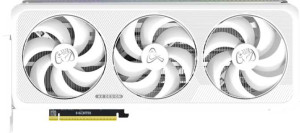
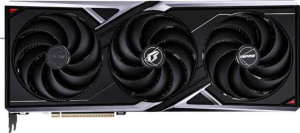
At their core, both the AX Gaming Rebel RTX 5080 X3W Max and the Colorful iGame RTX 5080 Vulcan OC share the same fundamental GPU silicon: identical 2295 MHz base clocks, the same 10,752 shading units, 336 TMUs, and 112 ROPs, along with matching 1875 MHz memory speeds. This means their theoretical rendering pipelines and memory bandwidth are built on an equal foundation — any real-world difference in performance will come down to how aggressively each card boosts under load.
That is precisely where the Colorful iGame Vulcan OC carves out a narrow but consistent advantage. Its 2695 MHz boost clock edges out the Rebel's 2670 MHz by 25 MHz, which cascades into marginally higher figures across every computed throughput metric: 57.95 TFLOPS of floating-point performance versus 57.42 TFLOPS, a texture rate of 905.5 GTexels/s versus 897.1 GTexels/s, and a pixel rate of 301.8 GPixel/s versus 299 GPixel/s. In isolation each gap is under 1%, which in practice translates to differences well within the margin of frame-to-frame variance in most workloads.
Based strictly on these specs, the Colorful iGame Vulcan OC holds a slight performance edge in the Performance category, driven entirely by its higher boost clock. For gamers or creators running sustained GPU-bound workloads, that advantage is real but marginal — likely imperceptible without a benchmark. If raw peak throughput is the deciding factor, the Vulcan OC wins; if the two cards are similarly priced, it earns a narrow recommendation on performance grounds alone.