Aya Neo Pocket S2
Nintendo Switch 2

Aya Neo Pocket S2 Nintendo Switch 2

Overview

Welcome to our in-depth specification comparison between the Aya Neo Pocket S2 and the Nintendo Switch 2. These two handhelds represent very different philosophies in portable gaming, and choosing between them is far from straightforward. In this head-to-head, we examine critical battlegrounds including display quality, raw performance figures, portability, connectivity options, and controller features to help you decide which device truly fits your needs.

Common Features

  • Both devices have 12GB of RAM.
  • Ray tracing support is available on both products.
  • Both use an NVMe SSD for storage.
  • Multithreading support is present on both devices.
  • Both use DDR5 memory.
  • Both devices have an internal power supply.
  • Internal storage is 256GB on both products.
  • Both devices are region free.
  • Neither device has an optical disc drive.
  • Both devices have a 3.5mm audio jack.
  • Wi-Fi support is available on both products.
  • Neither device is DLNA-certified.
  • Both have an external memory slot.
  • Connectivity between home and portable devices is not supported on either product.
  • Both devices have USB Type-C.
  • Neither device has a cellular module.
  • Voice commands are not available on either device.
  • Both devices can play games while they are downloading.
  • Quick resume is supported on both products.
  • Dolby Vision support is not available on either device.
  • Both devices have a touch screen.
  • Optical tracking is not present on either device.
  • An autostereoscopic display is not featured on either product.
  • Neither device has a secondary screen.
  • Adaptive triggers are not present on either device.
  • Motion-sensing controller compatibility is available on both products.
  • Both devices have 2 analog sticks.
  • Neither device has an integrated touchpad.

Main Differences

  • CPU speed is 8 x 3.3 GHz on Aya Neo Pocket S2 and 8 x 1.7 GHz on Nintendo Switch 2.
  • Floating-point performance is 2.7 TFLOPS on Aya Neo Pocket S2 and 4.27 TFLOPS on Nintendo Switch 2.
  • GPU clock speed is 1050 MHz on Aya Neo Pocket S2 and 1400 MHz on Nintendo Switch 2.
  • External drive connectivity is available on Aya Neo Pocket S2 but not on Nintendo Switch 2.
  • Shading units number 256 on Aya Neo Pocket S2 and 1536 on Nintendo Switch 2.
  • Refresh rate is 60Hz on Aya Neo Pocket S2 and 120Hz on Nintendo Switch 2.
  • RAM speed is 8533 MHz on Aya Neo Pocket S2 and 6400 MHz on Nintendo Switch 2.
  • The Aya Neo Pocket S2 is a handheld-only device, while the Nintendo Switch 2 supports both handheld and home use.
  • Output resolution is 1440p on Aya Neo Pocket S2 and 4K on Nintendo Switch 2.
  • Display resolution is 1440p (QHD) on Aya Neo Pocket S2 and 1080p (Full HD) on Nintendo Switch 2.
  • The hard drive is replaceable on Aya Neo Pocket S2 but not on Nintendo Switch 2.
  • Display type is LCD, LED-backlit, IPS on Aya Neo Pocket S2 and LCD on Nintendo Switch 2.
  • Battery power is 8000 mAh on Aya Neo Pocket S2 and 5220 mAh on Nintendo Switch 2.
  • Thickness is 15mm on Aya Neo Pocket S2 and 14mm on Nintendo Switch 2.
  • Width is 228mm on Aya Neo Pocket S2 and 272mm on Nintendo Switch 2.
  • Height is 91mm on Aya Neo Pocket S2 and 115mm on Nintendo Switch 2.
  • Volume is 311.22 cm³ on Aya Neo Pocket S2 and 437.92 cm³ on Nintendo Switch 2.
  • Weight is 428g on Aya Neo Pocket S2 and 535g on Nintendo Switch 2.
  • Typical brightness is 600 nits on Aya Neo Pocket S2 and 430 nits on Nintendo Switch 2.
  • USB port count is 1 on Aya Neo Pocket S2 and 2 on Nintendo Switch 2.
  • HDMI output is present on Nintendo Switch 2 but not available on Aya Neo Pocket S2.
  • Bluetooth version is 5.3 on Aya Neo Pocket S2 and 5.2 on Nintendo Switch 2.
  • NFC support is present on Nintendo Switch 2 but not available on Aya Neo Pocket S2.
  • RJ45 port count is 0 on Aya Neo Pocket S2 and 1 on Nintendo Switch 2.
  • Pixel density is 466 ppi on Aya Neo Pocket S2 and 275 ppi on Nintendo Switch 2.
  • Discord voice chat support is available on Aya Neo Pocket S2 but not on Nintendo Switch 2.
  • 3D audio support is present on Nintendo Switch 2 but not available on Aya Neo Pocket S2.
  • VR support is present on Nintendo Switch 2 but not available on Aya Neo Pocket S2.
  • Screen size is 6.3″ on Aya Neo Pocket S2 and 7.9″ on Nintendo Switch 2.
  • Sound output channels number 2 on Aya Neo Pocket S2 and 5.1 on Nintendo Switch 2.
  • Number of controllers is 4 on Aya Neo Pocket S2 and 8 on Nintendo Switch 2.
  • A wireless controller is included with Nintendo Switch 2 but not with Aya Neo Pocket S2.
  • Dual force feedback is present on Nintendo Switch 2 but not available on Aya Neo Pocket S2.
  • Number of buttons is 16 on Aya Neo Pocket S2 and 14 on Nintendo Switch 2.
Specs Comparison
Aya Neo Pocket S2

Aya Neo Pocket S2

Nintendo Switch 2

Nintendo Switch 2

Performance:
CPU speed 8 x 3.3 GHz 8 x 1.7 GHz
floating-point performance 2.7 TFLOPS 4.27 TFLOPS
RAM 12GB 12GB
GPU clock speed 1050 MHz 1400 MHz
supports ray tracing
Is an NVMe SSD
Can connect to an external drive
shading units 256 1536
uses multithreading
refresh rate 60Hz 120Hz
DDR memory version 5 5
RAM speed 8533 MHz 6400 MHz

Both devices share a solid common foundation: 12GB of DDR5 RAM, NVMe SSD storage, ray tracing support, and 8-core multithreaded CPUs. However, the performance picture diverges sharply once you look beneath those similarities. The Aya Neo Pocket S2 holds a clear edge in raw CPU clock speed at 3.3 GHz per core versus the Switch 2's 1.7 GHz, and its RAM runs significantly faster at 8533 MHz compared to 6400 MHz. In CPU-bound tasks or workloads that benefit from memory bandwidth — such as fast game loading or emulation — the S2 has a tangible advantage.

The GPU story, however, belongs decisively to the Nintendo Switch 2. Its 1536 shading units dwarf the S2's 256, and its floating-point throughput of 4.27 TFLOPS versus 2.7 TFLOPS translates directly into more geometry, more simultaneous shader calculations, and higher fidelity rendering. Combined with a faster GPU clock of 1400 MHz and a 120Hz display refresh rate (double the S2's 60Hz), the Switch 2 is built for smoother, visually richer gaming output. More shading units are the single biggest driver of GPU rendering capability, and the gap here is not marginal — it is structural.

The Aya Neo Pocket S2 does retain one practical advantage: it supports connection to an external drive, which the Switch 2 does not, offering more flexibility for storage expansion. Overall though, for gaming performance specifically, the Nintendo Switch 2 holds a clear GPU edge that will matter most in graphically demanding titles, while the S2 trades that rendering power for a faster CPU and memory subsystem more suited to general compute workloads.
General info:
Type Handheld Handheld, Home
output resolution 1440p 4K
display resolution 1440p (QHD) 1080p (Full HD)
release date June 2025 June 2025
Hard drive is replaceable
Has an internal power supply
Display type LCD, LED-backlit, IPS LCD
internal storage 256GB 256GB
battery power 8000 mAh 5220 mAh
Is region free
thickness 15 mm 14 mm
width 228 mm 272 mm
height 91 mm 115 mm
volume 311.22 cm³ 437.92 cm³
Has an optical disc drive
weight 428 g 535 g
brightness (typical) 600 nits 430 nits

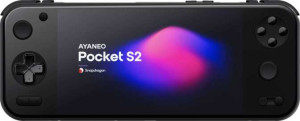
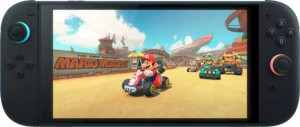
As standalone handhelds, both devices share some meaningful common ground: identical 256GB internal storage, no optical drive, and region-free operation. The divergence starts with form factor. The Aya Neo Pocket S2 is noticeably more compact — 228 mm wide and 428 g — versus the Switch 2's 272 mm width and 535 g. That 107g difference is significant during extended handheld sessions; the S2 will feel meaningfully lighter in hand, and its smaller footprint makes it more pocketable for on-the-go use. The Switch 2, however, doubles as a home console via TV output, which the S2 does not list as a mode — giving Nintendo's device a broader use-case scope.

The display and battery specs reveal an interesting trade-off. The S2 features a 1440p QHD display with a peak brightness of 600 nits, making it sharper and considerably more visible in bright outdoor environments than the Switch 2's 1080p panel at 430 nits. The S2 also uses an IPS LCD with LED backlighting, which typically delivers better color accuracy and viewing angles than a generic LCD. On battery, the gap is stark: the S2's 8000 mAh cell is over 50% larger than the Switch 2's 5220 mAh, which in practice means meaningfully longer play sessions before needing a charge — a critical advantage for portable-first users.

The S2 also allows hard drive replacement, adding long-term repairability and storage upgrade potential that the Switch 2 lacks. Overall, the Aya Neo Pocket S2 holds a clear edge as a pure handheld — better display quality, higher brightness, larger battery, and a more portable form factor. The Switch 2 counters with its hybrid home-console capability, which remains a significant lifestyle differentiator for users who want one device for both couch and commute.

Connectivity:
has a socket for a 3.5 mm audio jack
supports Wi-Fi
is DLNA-certified
USB ports 1 2
has an HDMI output
Bluetooth version 5.3 5.2
has an external memory slot
Supports connectivity between home and portable devices
Has USB Type-C
has a cellular module
has NFC
RJ45 ports 0 1

Shared basics out of the way first: both devices support Wi-Fi, Bluetooth, USB Type-C, a 3.5mm audio jack, and an external memory slot — covering the essentials any handheld user would expect. The meaningful separation comes from the Switch 2's broader physical port set. It includes an HDMI output, a dedicated RJ45 ethernet port, and 2 USB ports compared to the S2's single USB-C. For a device that doubles as a home console, HDMI is expected — but the wired ethernet port is a genuine practical advantage for stable online multiplayer in docked mode, where Wi-Fi latency variability becomes more noticeable.

The Switch 2 also adds NFC, enabling compatibility with physical accessory interactions. The S2 omits NFC entirely, which is a minor gap in isolation but relevant for users invested in NFC-based peripherals or features. On the Bluetooth side, the S2 edges ahead with version 5.3 versus the Switch 2's 5.2 — a marginal difference in practice, offering slightly improved connection efficiency and interference handling, though neither version creates a real-world disadvantage for typical wireless audio or controller use.

Connectivity is a clear win for the Nintendo Switch 2. The combination of HDMI out, wired ethernet, dual USB ports, and NFC gives it a substantially richer physical connectivity profile — particularly valuable in its home console role. The S2's single USB-C port and lack of HDMI or ethernet make it more dependent on wireless solutions, which is an acceptable trade-off for a compact handheld-only device but a limitation worth noting for users who value wired flexibility.

Features:
has voice commands
pixel density 466 ppi 275 ppi
Can play games while they download
supports quick resume
supports Discord voice chat
Supports 3D audio
supports Dolby Vision
supports VR
screen size 6.3" 7.9"
number of channels of sound output 2 5.1
has a touch screen
Has optical tracking
Has an autostereoscopic display
Has a secondary screen
Access high scores and achievements
has stereo speakers
Supports 3D
Uses flash storage
has a child lock

A long list of features aligns between these two devices — touchscreen, stereo speakers, flash storage, quick resume, background downloads, achievements, and child lock are all present on both. The divergence lies in a handful of targeted capabilities that reflect each device's design philosophy. The Aya Neo Pocket S2 stands out with native Discord voice chat support, a feature that speaks directly to the PC gaming audience it targets — being able to stay in voice channels without a companion phone or app is a genuine quality-of-life advantage for that demographic. It also packs a significantly sharper display at 466 ppi, versus the Switch 2's 275 ppi, which on the S2's 6.3″ screen means noticeably crisper text and finer image detail in handheld mode.

The Nintendo Switch 2 counters with a wider audio and immersion feature set. Its 5.1-channel sound output — compared to the S2's stereo 2-channel — enables surround sound decoding when connected to a compatible system, a meaningful upgrade for living room play. It also supports 3D audio and VR, neither of which the S2 offers. The larger 7.9″ screen gives it more visual real estate in handheld mode, even if its pixel density trails the S2's sharper panel.

This group ultimately reflects two different user priorities. The S2's edge in pixel density and Discord integration favors connected, detail-oriented handheld users, while the Switch 2's advantages in audio channels, 3D audio, and VR support point toward a richer multimedia and immersive gaming experience — especially when docked. Neither device dominates outright, but the Switch 2 holds a broader feature edge for users who value audio fidelity and immersion, while the S2 wins on display sharpness and social gaming integration.

Controllers:
number of controllers 4 8
has adaptive triggers
Compatible with a motion-sensing controller(s)
Has a wireless controller
number of analog sticks 2 2
has an integrated touchpad
Has dual force feedback
number of buttons 16 14

Both devices share a standard dual-analog-stick layout with motion-sensing compatibility and no adaptive triggers — a reasonable baseline for modern handheld gaming. The differences, however, reveal a meaningful gap in multiplayer and haptic capability. The Nintendo Switch 2 supports 8 controllers simultaneously versus the S2's 4, which directly expands local multiplayer headroom — relevant for party gaming scenarios where more players can join without hitting a ceiling. More impactfully, the Switch 2 includes dual force feedback, providing haptic responses through both controllers simultaneously. This kind of tactile feedback — feeling terrain, impacts, or in-game events physically — meaningfully deepens immersion in supported titles, and its absence on the S2 is a noticeable gap for players who value that sensory layer.

The Switch 2 also includes a wireless controller option, untethering play from the device itself — particularly useful in docked home console mode. The S2 lacks any listed wireless controller support, which limits flexibility when playing at a distance from the screen. On button count, the S2 edges ahead with 16 buttons to the Switch 2's 14, suggesting a slightly richer direct input layout that could benefit complex control schemes, though the practical impact depends entirely on software implementation.

Taken together, the Nintendo Switch 2 holds a clear controller advantage. Dual force feedback, wireless controller support, and a higher simultaneous controller count give it greater versatility for both solo immersion and group play. The S2's extra buttons are a minor counter, but they do not offset the Switch 2's broader and more feature-rich input ecosystem.

Comparison Summary & Verdict

After examining the full specification sheet, a clear picture emerges for each device. The Aya Neo Pocket S2 stands out for users who prioritize portability and display fidelity in handheld mode: it is lighter at 428g, offers a sharper 1440p display with a striking 466 ppi pixel density, delivers brighter output at 600 nits, features a larger 8000 mAh battery, and even allows hard drive replacement. The Nintendo Switch 2, on the other hand, caters to players who want versatility and raw graphical output: its dual handheld and home console functionality, superior 4K output resolution, faster 120Hz refresh rate, HDMI output, larger 7.9″ screen, 5.1-channel audio, NFC, and a wired LAN port make it an exceptional living-room-friendly device. Both share a solid common foundation of 12GB RAM, 256GB storage, and ray tracing support. Your ideal choice ultimately depends on whether you game on the go or equally at home.

Aya Neo Pocket S2
Buy Aya Neo Pocket S2 if...

Buy the Aya Neo Pocket S2 if you primarily game on the go and want a lighter, sharper handheld with a higher pixel density display, brighter screen, larger battery, and a replaceable hard drive.

Nintendo Switch 2
Buy Nintendo Switch 2 if...

Buy the Nintendo Switch 2 if you want a versatile device that works both as a handheld and a home console, with 4K output, a 120Hz refresh rate, HDMI connectivity, 5.1-channel audio, and wireless controller support.