Baseus Bass BC1
Baseus Bass BP1 Pro

Baseus Bass BC1 Baseus Bass BP1 Pro

Overview

Welcome to our in-depth spec comparison between the Baseus Bass BC1 and the Baseus Bass BP1 Pro. Both earbuds share a solid foundation — IP55 water resistance, Bluetooth 6, fast charging, and dual-device multipoint connectivity — but their approaches to fit, noise management, and battery endurance set them apart in meaningful ways. Whether you value an open-ear listening experience or a feature-rich in-ear design, this comparison will help you find the right match.

Common Features

  • Both products have an IP55 ingress protection rating.
  • Both products are water resistant.
  • Neither product uses wires or cables.
  • Neither product is a neckband earbud design.
  • Neither product includes wingtips.
  • Neither product has RGB lighting.
  • Both products have stereo speakers.
  • Neither product has a UV light.
  • Both products reproduce frequencies from 20 Hz to 20000 Hz.
  • Neither product supports Dolby Atmos.
  • Neither product supports Dirac Virtuo.
  • Neither product uses a neodymium magnet.
  • Both products have a charge time of 1.5 hours.
  • Neither product supports wireless charging.
  • Neither product has a solar power battery.
  • Both products have a battery level indicator.
  • Both products have a rechargeable battery.
  • Neither product supports fast pairing.
  • Both products have a USB Type-C connector.
  • Both products use Bluetooth version 6.
  • Neither product supports LDHC.
  • Neither product supports Bluetooth LE Audio.
  • Neither product supports aptX Adaptive.
  • Neither product supports aptX Low Latency.
  • Neither product supports aptX HD.
  • Neither product has in/on-ear detection.
  • Neither product has a find device feature.
  • Both products support fast charging.
  • Both products support multipoint connection with up to 2 devices.
  • Neither product can read notifications.
  • Neither product has a built-in translator.
  • Both products have a mute function.
  • Both products can be used as a headset.
  • Both products have a noise-canceling microphone.

Main Differences

  • The fit is open-ear on Baseus Bass BC1 and in-ear on Baseus Bass BP1 Pro.
  • Active noise cancellation (ANC) is available on Baseus Bass BP1 Pro but not on Baseus Bass BC1.
  • Passive noise reduction is present on Baseus Bass BP1 Pro but not available on Baseus Bass BC1.
  • Spatial audio support is present on Baseus Bass BP1 Pro but not available on Baseus Bass BC1.
  • Battery life is 7.5 hours on Baseus Bass BC1 and 12 hours on Baseus Bass BP1 Pro.
  • Battery life of the charging case is 20.5 hours on Baseus Bass BC1 and 43 hours on Baseus Bass BP1 Pro.
  • LDAC support is present on Baseus Bass BP1 Pro but not available on Baseus Bass BC1.
  • AAC support is present on Baseus Bass BP1 Pro but not available on Baseus Bass BC1.
  • Ambient sound mode is available on Baseus Bass BP1 Pro but not on Baseus Bass BC1.
  • The number of microphones is 4 on Baseus Bass BC1 and 6 on Baseus Bass BP1 Pro.
Specs Comparison
Baseus Bass BC1

Baseus Bass BC1

Baseus Bass BP1 Pro

Baseus Bass BP1 Pro

Design:
Fit Open-ear In-ear
Ingress Protection (IP) rating IP55 IP55
water resistance Water resistant Water resistant
has no wires or cables
are neckband earbuds
wingtips included
has RGB lighting
has stereo speakers
has UV light
Has a display

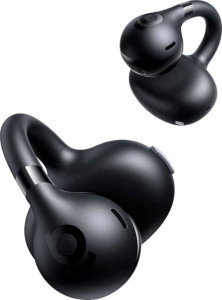
The most meaningful design difference between these two earbuds comes down to a single but consequential spec: fit type. The Baseus Bass BC1 uses an open-ear design, meaning the drivers sit outside the ear canal rather than inside it. This preserves situational awareness — you can hear your environment naturally — making it a better fit for outdoor activities, commuting, or anyone who finds in-ear tips uncomfortable over long sessions. The Baseus Bass BP1 Pro, by contrast, uses a traditional in-ear fit, which creates a seal in the ear canal. That seal is the foundation for passive noise isolation and typically delivers more impactful bass response and overall sound pressure.

Beyond fit, the two products are effectively identical in design terms. Both carry an IP55 rating, meaning they can handle dust ingress and low-pressure water jets from any direction — solid protection for workouts and light rain, though not submersion. Both are fully wireless with no cables, no neckband, no RGB lighting, and no display anywhere in the package. These shared traits confirm both products target the same wireless, active-lifestyle segment.

For design, the BP1 Pro holds a practical edge if audio isolation and bass performance matter most, as its in-ear seal enables both. The BC1 earns its advantage for users who prioritize all-day comfort and ambient awareness — benefits the open-ear format uniquely delivers. The choice here is less about quality and more about which listening philosophy fits your use case.

Sound quality:
has active noise cancellation (ANC)
has passive noise reduction
lowest frequency 20 Hz 20 Hz
highest frequency 20000 Hz 20000 Hz
supports spatial audio
has Dolby Atmos
has Dirac Virtuo
has a neodymium magnet

Both earbuds share an identical frequency range of 20 Hz to 20,000 Hz, covering the full span of human hearing on paper. However, raw frequency range alone tells you little about actual audio performance — what separates these two products in the sound quality category is everything built around that range. The Baseus Bass BP1 Pro ships with both active noise cancellation (ANC) and passive noise reduction, a meaningful combination. Passive reduction comes from the in-ear seal itself, physically blocking ambient sound, while ANC uses microphones and signal processing to cancel out ongoing noise like engine hum or HVAC. Together, they give the BP1 Pro a significantly quieter listening environment, which directly enhances perceived sound clarity and dynamic range — even at lower volumes.

Adding further separation, the BP1 Pro also supports spatial audio, a feature absent on the BC1. Spatial audio processing repositions sound elements around a virtual three-dimensional field, which is particularly noticeable when watching video content or listening to music mixed for immersive formats. Neither earbud supports Dolby Atmos or Dirac Virtuo specifically, so the spatial audio implementation here is likely a proprietary or platform-level solution — useful, but worth tempering expectations against dedicated cinema-grade formats.

The BC1 has no noise isolation of any kind — a direct consequence of its open-ear design — and lacks spatial audio support entirely. For a relaxed, awareness-preserving listen, that is a reasonable trade-off, but from a pure sound quality feature standpoint, the BP1 Pro holds a clear and decisive advantage. It offers a richer, more controlled listening environment through noise cancellation and spatial processing that the BC1 simply cannot match.

Power:
Battery life 7.5 hours 12 hours
Battery life of charging case 20.5 hours 43 hours
charge time 1.5 hours 1.5 hours
has wireless charging
Has a solar power battery
has a battery level indicator
has a rechargeable battery

Battery life is where these two earbuds diverge most sharply in practical, day-to-day terms. The Baseus Bass BP1 Pro delivers 12 hours of playback per charge versus 7.5 hours for the BC1 — a gap of 4.5 hours that translates to real-world consequences. For context, 7.5 hours is sufficient for most single-day use cases, but the BP1 Pro's 12-hour figure comfortably clears a full workday with headroom to spare, making it notably more suitable for long-haul travel, extended work sessions, or users who simply forget to charge regularly.

The gap widens further when factoring in the charging case. The BC1's case extends total system battery to 20.5 hours, while the BP1 Pro's case pushes the combined figure to 43 hours — more than double. That distinction matters most for multi-day trips or situations where access to a power outlet is limited. Both products share an identical 1.5-hour charge time, so neither has a speed advantage when refueling; the BP1 Pro simply stays out of the charger far longer before needing one.

Shared features — rechargeable batteries and battery level indicators on both — keep the comparison clean. There are no surprises or hidden trade-offs on either side. The BP1 Pro holds a commanding advantage in this category across every relevant metric, and for power-conscious users or frequent travelers, that advantage is not marginal — it is substantial.

Connectivity:
has fast pairing
Has USB Type-C
Bluetooth version 6 6
has LDAC
has LDHC
has Bluetooth LE Audio
has aptX Adaptive
has aptX Low Latency
has aptX HD
has aptX
has aptX Lossless
has aptX Voice
has Auracast
maximum Bluetooth range 10 m 10 m
supports Bluetooth pairing using NFC
Can be used wirelessly
has AAC

In terms of connectivity, both the Baseus Bass BC1 and the Baseus Bass BP1 Pro are equipped with Bluetooth version 6 and USB Type-C for charging. They both also have a maximum Bluetooth range of 10 meters and can be used wirelessly. However, the BC1 lacks certain advanced features, such as fast pairing, LDAC, AAC, or Bluetooth pairing using NFC, all of which are included in the BP1 Pro. The BP1 Pro supports LDAC for high-quality audio streaming and AAC for better compatibility with Apple devices.

Neither product supports Bluetooth LE Audio, aptX Adaptive, aptX Low Latency, aptX HD, aptX, aptX Lossless, or aptX Voice, and neither includes the Auracast feature for broadcasting audio to multiple devices.

Overall, while both products offer solid Bluetooth connectivity, the BP1 Pro provides more advanced features like LDAC and AAC support, which may appeal to users seeking better audio quality and device compatibility.

Features:
release date June 2025 August 2025
has ambient sound mode
has in/on-ear detection
has find device feature
Supports fast charging
multipoint count 2 2
can read notifications
Has a built-in translator
has a mute function
can be used as a headset
control panel placed on a device
Has voice prompts
travel bag is included
Has an in-line control panel
Has a temperature sensor
Has a built-in camera remote control function

Across this feature set, the two earbuds are remarkably similar — with one exception that carries genuine practical weight. The Baseus Bass BP1 Pro includes an ambient sound mode, which the BC1 lacks. This feature uses external microphones to pipe in environmental audio deliberately, letting the wearer hear conversations, announcements, or traffic without removing the earbuds. Given that the BP1 Pro already has ANC, ambient mode serves as its natural counterpart — toggling between full immersion and environmental awareness on demand. For the BC1, which uses an open-ear design that inherently passes through ambient sound, the absence of this feature is less of a gap, though it does mean the BC1 offers no electronic control over how much of the outside world comes through.

Where both products genuinely align is in their practical utility features. Both support fast charging, connect to 2 devices simultaneously via multipoint pairing, include on-device controls, voice prompts, a mute function, headset capability for calls, and even a travel bag in the box. Multipoint pairing at count 2 is the current standard for this segment — it means seamlessly switching audio between, say, a laptop and a phone without manual re-pairing, which is a genuine convenience for hybrid workers.

With the feature lists this closely matched, the BP1 Pro claims a narrow but real advantage through its ambient sound mode alone. It gives users active control over their acoustic environment in both directions — blocking the world out or letting it back in — which is a flexibility the BC1 cannot replicate through its controls. For users who value that kind of adaptability, it tips the scale.

Microphone:
number of microphones 4 6
has a noise-canceling microphone

Microphone hardware is sparse on specs here, but the one quantitative difference is telling. The Baseus Bass BP1 Pro packs 6 microphones versus 4 on the BC1. In earbud design, microphone count directly influences how effectively the device can perform beamforming — the process of isolating the user's voice by triangulating sound from multiple capture points while suppressing noise coming from other directions. More microphones generally means the system has more signal data to work with, which can translate to cleaner call audio in noisy environments like busy streets or open offices.

The additional microphones on the BP1 Pro also serve a dual purpose: they support its ANC system, which relies on external mics to sample ambient sound and generate cancellation signals. A higher mic count can improve both the precision of that cancellation and the quality of the ambient mode passthrough discussed in earlier categories. On the BC1, the 4-microphone array is still a respectable configuration for noise-canceling call performance — it is not an entry-level setup — but the architecture has less raw input to process.

Both earbuds share noise-canceling microphone capability, so call intelligibility should be solid on either device in typical conditions. That said, the BP1 Pro holds the edge in this category: its 6-microphone configuration gives it a structural advantage for voice isolation and ANC performance that the BC1's 4-mic setup cannot match on paper.

Comparison Summary & Verdict

After examining the full spec breakdown, both earbuds serve clearly different audiences. The Baseus Bass BC1 is the more straightforward option: its open-ear fit makes it ideal for users who want situational awareness during workouts or daily commutes without the isolation of in-ear tips. It is lighter on features but still delivers solid fundamentals. The Baseus Bass BP1 Pro, on the other hand, is the more capable pair overall, offering active noise cancellation, passive noise reduction, spatial audio, LDAC and AAC codec support, an ambient sound mode, six microphones, and a substantially longer combined battery life of 12 hours plus a 43-hour charging case. If you want premium audio features and extended listening sessions, the BP1 Pro is the clear step up.

Baseus Bass BC1
Buy Baseus Bass BC1 if...

Buy the Baseus Bass BC1 if you prefer an open-ear fit that keeps you aware of your surroundings and do not need active noise cancellation or advanced audio codec support.

Baseus Bass BP1 Pro
Buy Baseus Bass BP1 Pro if...

Buy the Baseus Bass BP1 Pro if you want active noise cancellation, spatial audio, LDAC support, and significantly longer battery life in both the earbuds and charging case.