Baseus Bass BC1
Baseus Bowie WX5

Baseus Bass BC1 Baseus Bowie WX5

Overview

Choosing between the Baseus Bass BC1 and the Baseus Bowie WX5 is no small task — both are fully wireless earbuds from Baseus that share a solid feature foundation, yet take noticeably different approaches in several key areas. In this detailed comparison, we examine them side by side across design and fit, sound quality, battery performance, and connectivity to help you determine which one genuinely suits your listening habits and daily routine best.

Common Features

  • Both products are wireless with no wires or cables.
  • Neither product is a neckband earbud style.
  • Neither product includes wingtips.
  • Neither product has RGB lighting.
  • Both products feature stereo speakers.
  • Neither product has a UV light.
  • Neither product has a display.
  • Neither product has active noise cancellation (ANC).
  • Neither product has passive noise reduction.
  • Both products share a lowest frequency of 20 Hz.
  • Both products share a highest frequency of 20000 Hz.
  • Neither product supports Dolby Atmos.
  • Neither product supports Dirac Virtuo.
  • Neither product uses a neodymium magnet.
  • Neither product supports wireless charging.
  • Neither product has a solar power battery.
  • Both products have a battery level indicator.
  • Both products have a rechargeable battery.
  • Neither product supports fast pairing.
  • Both products have USB Type-C connectivity.
  • Neither product supports LDAC.
  • Neither product supports LDHC.
  • Neither product supports Bluetooth LE Audio.
  • Neither product supports aptX Adaptive.
  • Neither product supports aptX Low Latency.
  • Neither product supports aptX HD.
  • Neither product has an ambient sound mode.
  • Neither product has in/on-ear detection.
  • Neither product has a find device feature.
  • Both products support fast charging.
  • Both products support multipoint connection with 2 devices.
  • Neither product can read notifications.
  • Neither product has a built-in translator.
  • Both products have a mute function.
  • Both products have 4 microphones.
  • Both products feature a noise-canceling microphone.

Main Differences

  • The fit style is open-ear on the Baseus Bass BC1 and earbud on the Baseus Bowie WX5.
  • Water resistance is present on the Baseus Bass BC1 but not available on the Baseus Bowie WX5.
  • The driver unit size is 12 mm on the Baseus Bass BC1 and 13 mm on the Baseus Bowie WX5.
  • Spatial audio support is present on the Baseus Bowie WX5 but not available on the Baseus Bass BC1.
  • Battery life is 7.5 hours on the Baseus Bass BC1 and 6.5 hours on the Baseus Bowie WX5.
  • Battery life of the charging case is 20.5 hours on the Baseus Bass BC1 and 23.5 hours on the Baseus Bowie WX5.
  • Charge time is 1.5 hours on the Baseus Bass BC1 and 1 hour on the Baseus Bowie WX5.
  • The Bluetooth version is 6 on the Baseus Bass BC1 and 5.3 on the Baseus Bowie WX5.
  • AAC support is present on the Baseus Bowie WX5 but not available on the Baseus Bass BC1.
Specs Comparison
Baseus Bass BC1

Baseus Bass BC1

Baseus Bowie WX5

Baseus Bowie WX5

Design:
Fit Open-ear Earbud
water resistance Water resistant None
has no wires or cables
are neckband earbuds
wingtips included
has RGB lighting
has stereo speakers
has UV light
Has a display

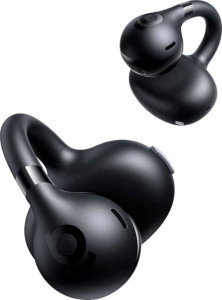
The most fundamental design difference between these two Baseus earbuds lies in their fit style: the Bass BC1 uses an open-ear design, while the Bowie WX5 opts for a traditional earbud fit. In practice, this shapes the entire wearing experience. An open-ear design sits outside the ear canal, preserving ambient sound awareness — ideal for outdoor use, commuting, or anyone who finds in-canal earbuds uncomfortable over long periods. The WX5's earbud fit, by contrast, provides a more direct audio path and typically better passive noise isolation, making it better suited for focused listening in quieter environments.

The other meaningful differentiator is water resistance: the BC1 carries a water-resistant rating, whereas the WX5 offers none. This matters significantly for active users — the BC1 can handle sweat during workouts or light rain, while the WX5 should be kept away from moisture entirely, limiting its versatility in outdoor or fitness scenarios.

Both earbuds are fully wireless, share a stereo speaker setup, and lack extras like RGB lighting or a display — so beyond fit and durability, they are structurally similar. Overall, the Bass BC1 holds a clear design edge for users who prioritize situational awareness and weather resilience. The Bowie WX5 is the better choice only if the user specifically prefers the isolation and audio seal of a traditional earbud fit and plans to use them in dry, controlled settings.

Sound quality:
has active noise cancellation (ANC)
has passive noise reduction
driver unit size 12 mm 13 mm
lowest frequency 20 Hz 20 Hz
highest frequency 20000 Hz 20000 Hz
supports spatial audio
has Dolby Atmos
has Dirac Virtuo
has a neodymium magnet

Both earbuds share an identical 20 Hz – 20,000 Hz frequency range, covering the full spectrum of human hearing. Neither features active noise cancellation or passive noise reduction, so the listening experience on both will be shaped largely by fit and environment rather than any electronic or physical isolation. These shared baselines mean the sound quality comparison narrows down to a couple of more subtle but meaningful distinctions.

On driver size, the Bowie WX5 edges ahead with a 13 mm driver versus the BC1's 12 mm driver. Larger drivers can move more air, which often translates to a fuller low-end response and greater overall volume potential — though driver size alone does not guarantee superior sound quality without knowing tuning and materials. It is a modest but real hardware advantage for the WX5. More significantly, the WX5 supports spatial audio, while the BC1 does not. Spatial audio processing creates a more three-dimensional soundstage, making content — especially movies, gaming, or spatially mixed music — feel more immersive and directionally accurate rather than flat and centered.

Taking both factors together, the Bowie WX5 holds a clear edge in sound quality for this group. The slightly larger driver and, more importantly, spatial audio support give it a tangible advantage for users who care about an expansive, immersive listening experience. The Bass BC1 is a capable pair for standard stereo listening, but it lacks the tools to compete on audio dimensionality.

Power:
Battery life 7.5 hours 6.5 hours
Battery life of charging case 20.5 hours 23.5 hours
charge time 1.5 hours 1 hours
has wireless charging
Has a solar power battery
has a battery level indicator
has a rechargeable battery

Per-session battery life favors the Bass BC1, which delivers 7.5 hours on a single charge compared to the Bowie WX5's 6.5 hours. That extra hour is genuinely meaningful for long commutes, flights, or extended work sessions where reaching for the case is inconvenient. However, the WX5 flips the advantage at the case level, offering 23.5 hours of total backup versus the BC1's 20.5 hours — meaning over a multi-day trip without access to a charger, the WX5 system as a whole lasts longer.

Charge time is another area where the WX5 pulls ahead: it refills in 1 hour, while the BC1 needs 1.5 hours. For users who rely on quick top-ups between uses, that 30-minute difference can matter in practice. Neither model supports wireless charging, so both require a wired connection to replenish.

Ultimately, this is a genuine trade-off rather than a clean win for either side. The Bass BC1 is better suited for uninterrupted single-session use, while the Bowie WX5 offers a faster recharge and greater total system endurance — making it the stronger choice for travelers or users who regularly cycle through multiple charges over several days.

Connectivity:
has fast pairing
Has USB Type-C
Bluetooth version 6 5.3
has LDAC
has LDHC
has Bluetooth LE Audio
has aptX Adaptive
has aptX Low Latency
has aptX HD
has aptX
has aptX Lossless
has aptX Voice
has Auracast
maximum Bluetooth range 10 m 10 m
supports Bluetooth pairing using NFC
Can be used wirelessly
has AAC

The headline difference in Bluetooth hardware is the version: the Bass BC1 runs on Bluetooth 6, while the Bowie WX5 uses Bluetooth 5.3. Bluetooth 6 is a more recent standard, bringing improvements in connection precision and power efficiency — though notably, neither earbud activates the most impactful Bluetooth 6 features like LE Audio or Auracast, which limits how much of that generational leap users will actually feel in day-to-day use. Still, the newer core specification gives the BC1 a modest forward-looking advantage in link stability and energy management.

Where the WX5 punches back is codec support: it includes AAC, while the BC1 offers none beyond the baseline SBC. AAC is particularly relevant for Apple device users, as iPhones and iPads prioritize AAC and can deliver noticeably better wireless audio fidelity compared to SBC alone. For Android users the gap is smaller, but AAC still generally outperforms SBC across most devices that support it. The absence of any codec support on the BC1 is a real limitation for audio quality over Bluetooth, regardless of its newer radio standard.

Weighing both factors, this group produces a split verdict. The BC1 leads on raw Bluetooth infrastructure, but the WX5's AAC support delivers a more tangible, everyday benefit for most users — especially those in the Apple ecosystem. Neither product supports advanced codecs like LDAC or aptX, so audiophile-grade wireless audio is off the table for both.

Features:
release date June 2025 July 2025
has ambient sound mode
has in/on-ear detection
has find device feature
Supports fast charging
multipoint count 2 2
can read notifications
Has a built-in translator
has a mute function
can be used as a headset
control panel placed on a device
Has voice prompts
travel bag is included
Has an in-line control panel
Has a temperature sensor
Has a built-in camera remote control function

Across every feature in this group, the Bass BC1 and Bowie WX5 are a perfect mirror of each other. Both support fast charging, connect to up to 2 devices simultaneously via multipoint pairing, include on-device controls, voice prompts, and a mute function — and both ship with a travel bag. These are genuinely useful conveniences: multipoint pairing means seamless switching between, say, a laptop and a phone without manual re-pairing, and fast charging pairs well with the charge time advantages already visible in the Power group.

Neither earbud offers ambient sound mode, in-ear detection, or a find-my-device feature — omissions that are increasingly common on mid-range competitors and worth noting for users who rely on those tools. However, since neither product includes them, this does not affect how the two compare against each other.

With no differentiating data point to separate them, this group is a complete tie. Buyers evaluating these two products on features alone will find no reason to favor one over the other — the decision must rest on the distinctions surfaced in other spec groups.

Microphone:
number of microphones 4 4
has a noise-canceling microphone

Microphone hardware is identical across both earbuds: each packs 4 microphones with noise-canceling capability. A quad-mic array at this price tier is a solid offering — more microphones allow for better beamforming, meaning the earbuds can more effectively isolate the user's voice while suppressing wind noise, street noise, and other environmental interference during calls.

This is a complete tie. With no specification differing between the two, call quality performance on paper is evenly matched, and neither product holds any measurable advantage in this group.

Comparison Summary & Verdict

After a thorough look at the specs, both the Baseus Bass BC1 and the Baseus Bowie WX5 emerge as well-rounded wireless earbuds sharing fast charging, multipoint support for two devices, and a four-microphone noise-canceling setup. The BC1 sets itself apart with an open-ear fit, water resistance, and a longer per-earbud battery life of 7.5 hours, making it the stronger pick for active users who need comfort and durability in outdoor environments. The WX5, meanwhile, caters to audio enthusiasts with spatial audio support, AAC codec compatibility, a quicker one-hour charge time, and a higher-capacity charging case delivering 23.5 hours of additional playback. Reach for the BC1 if outdoor resilience and extended listening time are your priorities; choose the WX5 if richer audio features and faster top-ups matter most.

Baseus Bass BC1
Buy Baseus Bass BC1 if...

Buy the Baseus Bass BC1 if you prefer an open-ear design with water resistance and need a longer per-earbud battery life, especially for active or outdoor use.

Baseus Bowie WX5
Buy Baseus Bowie WX5 if...

Buy the Baseus Bowie WX5 if spatial audio support, AAC compatibility, and a faster one-hour charge time with a higher-capacity case battery are your top priorities.