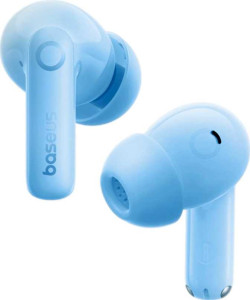
Baseus Bass BP1 Pro
Baseus Bowie WX5

Baseus Bass BP1 Pro Baseus Bowie WX5

Overview

Welcome to our in-depth spec comparison between the Baseus Bass BP1 Pro and the Baseus Bowie WX5. Both are wireless earbuds sharing a broad 20 Hz–20000 Hz frequency range and spatial audio support, but they take noticeably different approaches when it comes to noise cancellation, battery endurance, and connectivity features. Read on to see how these two Baseus models stack up across every major category.

Common Features

  • Both products are wireless with no wires or cables.
  • Neither product is a neckband earbud style.
  • Neither product includes wingtips.
  • Neither product features RGB lighting.
  • Both products have stereo speakers.
  • Neither product includes a UV light.
  • Neither product has a display.
  • Both products share a frequency range of 20 Hz to 20000 Hz.
  • Spatial audio is supported on both products.
  • Dolby Atmos is not available on either product.
  • Dirac Virtuo is not available on either product.
  • Neither product uses a neodymium magnet.
  • Wireless charging is not available on either product.
  • Neither product has a solar power battery.
  • Both products include a battery level indicator.
  • Both products have a rechargeable battery.
  • Fast pairing is not available on either product.
  • Both products feature a USB Type-C connector.
  • LDHC is not supported on either product.
  • Bluetooth LE Audio is not supported on either product.
  • aptX Adaptive is not supported on either product.
  • aptX Low Latency is not supported on either product.
  • aptX HD is not supported on either product.
  • aptX is not supported on either product.
  • Neither product has in/on-ear detection.
  • Neither product includes a find device feature.
  • Fast charging is supported on both products.
  • Both products support multipoint connection with 2 devices.
  • Neither product can read notifications.
  • Neither product has a built-in translator.
  • Both products include a mute function.
  • Both products can be used as a headset.
  • Both products have a noise-canceling microphone.

Main Differences

  • The fit style is in-ear on Baseus Bass BP1 Pro and earbud on Baseus Bowie WX5.
  • Water resistance is present on Baseus Bass BP1 Pro but not available on Baseus Bowie WX5.
  • Active noise cancellation is available on Baseus Bass BP1 Pro but not on Baseus Bowie WX5.
  • Passive noise reduction is present on Baseus Bass BP1 Pro but not on Baseus Bowie WX5.
  • Battery life is 12 hours on Baseus Bass BP1 Pro and 6.5 hours on Baseus Bowie WX5.
  • Battery life of the charging case is 43 hours on Baseus Bass BP1 Pro and 23.5 hours on Baseus Bowie WX5.
  • Charge time is 1.5 hours on Baseus Bass BP1 Pro and 1 hour on Baseus Bowie WX5.
  • Bluetooth version is 6 on Baseus Bass BP1 Pro and 5.3 on Baseus Bowie WX5.
  • LDAC support is present on Baseus Bass BP1 Pro but not available on Baseus Bowie WX5.
  • Ambient sound mode is available on Baseus Bass BP1 Pro but not on Baseus Bowie WX5.
  • The number of microphones is 6 on Baseus Bass BP1 Pro and 4 on Baseus Bowie WX5.
Specs Comparison
Baseus Bass BP1 Pro

Baseus Bass BP1 Pro

Baseus Bowie WX5

Baseus Bowie WX5

Design:
Fit In-ear Earbud
water resistance Water resistant None
has no wires or cables
are neckband earbuds
wingtips included
has RGB lighting
has stereo speakers
has UV light
Has a display

The most meaningful design difference between these two earbuds lies in their fit style and water resistance. The Baseus Bass BP1 Pro uses an in-ear fit, meaning the eartips seal inside the ear canal — this typically provides better passive noise isolation and a more secure hold during physical activity. The Baseus Bowie WX5, by contrast, uses an earbud fit, which rests in the outer ear without sealing the canal. This tends to feel less fatiguing over long sessions but offers little noise isolation and is more prone to falling out during movement.

On durability, the BP1 Pro holds a clear edge: it is rated as water resistant, making it a reasonable companion for workouts or light rain exposure. The Bowie WX5 has no water resistance rating at all, which is a notable omission and a real-world liability if the user sweats or is caught in the elements.

Both models are fully wireless, neither uses a neckband, and both share stereo playback with no RGB lighting or display. These shared traits make them similarly modern and minimal in form. Overall, the Baseus Bass BP1 Pro has a clear design advantage for active or outdoor use, thanks to its in-ear seal and water resistance — while the Bowie WX5 may suit casual, stationary listening where comfort over long periods is the priority.

Sound quality:
has active noise cancellation (ANC)
has passive noise reduction
lowest frequency 20 Hz 20 Hz
highest frequency 20000 Hz 20000 Hz
supports spatial audio
has Dolby Atmos
has Dirac Virtuo
has a neodymium magnet

The standout differentiator in this group is noise isolation. The Baseus Bass BP1 Pro features both Active Noise Cancellation (ANC) and passive noise reduction — a combination that actively suppresses ambient sound while the in-ear seal physically blocks it. The Baseus Bowie WX5 has neither, meaning environmental noise passes through freely. In practical terms, the BP1 Pro is significantly better suited for commuting, open offices, or any noisy environment where distractions are a concern.

Where the two products are evenly matched is frequency response: both cover the standard 20 Hz–20,000 Hz range, spanning the full audible spectrum. This means neither has an inherent advantage in raw frequency coverage. Both also support spatial audio, which enables a wider, more immersive soundstage — a welcome feature at any price point. Neither product includes proprietary processing like Dolby Atmos or Dirac Virtuo, so the spatial experience relies on the headset's own implementation.

The verdict for sound quality clearly favors the BP1 Pro. Identical frequency range and spatial audio support mean the baseline listening capability is comparable, but the addition of ANC gives it a meaningful real-world edge — the ability to control your listening environment, not just what's in your ears.

Power:
Battery life 12 hours 6.5 hours
Battery life of charging case 43 hours 23.5 hours
charge time 1.5 hours 1 hours
has wireless charging
Has a solar power battery
has a battery level indicator
has a rechargeable battery

Battery life is where the Baseus Bass BP1 Pro pulls ahead decisively. Its earbuds last 12 hours on a single charge, compared to 6.5 hours for the Baseus Bowie WX5 — nearly double the per-session endurance. For anyone using earbuds through a full workday, a long flight, or back-to-back meetings, that gap is the difference between reaching for the case once or twice versus constantly monitoring battery levels.

The advantage compounds when factoring in the charging case. The BP1 Pro's case extends total available playback to 43 hours, while the Bowie WX5 tops out at 23.5 hours combined. In practical terms, the BP1 Pro could last several days of heavy use before needing a wall outlet, whereas the WX5 demands more frequent recharging. The tradeoff is charge time: the WX5 refills in 1 hour versus 1.5 hours for the BP1 Pro — a modest difference that does little to offset the overall capacity gap.

Neither model supports wireless charging, and both include a battery level indicator — so users of either product will always know where they stand. But on the whole, the power category is a clear win for the BP1 Pro, offering roughly twice the total battery capacity with only a minor penalty in charge time.

Connectivity:
has fast pairing
Has USB Type-C
Bluetooth version 6 5.3
has LDAC
has LDHC
has Bluetooth LE Audio
has aptX Adaptive
has aptX Low Latency
has aptX HD
has aptX
has aptX Lossless
has aptX Voice
has Auracast
maximum Bluetooth range 10 m 10 m
supports Bluetooth pairing using NFC
Can be used wirelessly
has AAC

Two specifications set these products apart in connectivity. First, the Baseus Bass BP1 Pro runs on Bluetooth 6, while the Baseus Bowie WX5 uses Bluetooth 5.3. The newer version brings improvements in connection stability, reduced latency, and more efficient power consumption — advantages that are subtle day-to-day but meaningful over time, particularly in crowded wireless environments like offices or public transit.

More impactful for audiophiles is the BP1 Pro's support for LDAC, Sony's high-resolution audio codec capable of transmitting up to three times more data than standard Bluetooth audio. The Bowie WX5 lacks LDAC entirely. In practice, users pairing the BP1 Pro with a compatible Android device can stream near-lossless audio, preserving significantly more detail than the AAC codec — which both earbuds share — can deliver. For casual listeners, AAC is perfectly adequate, but for those who invest in high-quality streaming services or local lossless files, LDAC is a tangible upgrade.

On all other fronts — range, USB-C charging, NFC, and wireless operation — the two are identical. The connectivity edge belongs clearly to the BP1 Pro, courtesy of its newer Bluetooth version and LDAC support, which together offer a more future-proof and higher-fidelity wireless experience.

Features:
release date August 2025 July 2025
has ambient sound mode
has in/on-ear detection
has find device feature
Supports fast charging
multipoint count 2 2
can read notifications
Has a built-in translator
has a mute function
can be used as a headset
control panel placed on a device
Has voice prompts
travel bag is included
Has an in-line control panel
Has a temperature sensor
Has a built-in camera remote control function

Across most features, these two earbuds are remarkably alike. Both support fast charging, connect to 2 devices simultaneously via multipoint pairing, include on-device controls, voice prompts, a mute function, headset capability, and even a travel bag. For everyday usability, this shared foundation means neither product is functionally disadvantaged out of the box.

The one feature that breaks the tie is ambient sound mode, which the Baseus Bass BP1 Pro has and the Baseus Bowie WX5 does not. This mode pipes in environmental audio through the microphones, allowing the user to stay aware of their surroundings — conversations, announcements, traffic — without removing the earbuds. It's a particularly valuable feature for commuters, runners, or anyone who needs situational awareness while listening. Its absence on the Bowie WX5 is a meaningful omission, especially given that the WX5 already lacks ANC and passive isolation, meaning users are exposed to ambient noise anyway but without the ability to manage or leverage it intentionally.

The BP1 Pro takes this category by a narrow but practical margin. The shared feature set is strong on both sides, but ambient sound mode adds a layer of real-world versatility that the Bowie WX5 simply cannot match.

Microphone:
number of microphones 6 4
has a noise-canceling microphone

Both earbuds feature noise-canceling microphones, so call clarity in quiet environments is a baseline expectation for either. The meaningful difference is microphone count: the Baseus Bass BP1 Pro packs 6 microphones, while the Baseus Bowie WX5 uses 4. More microphones allow for more sophisticated beamforming and noise suppression algorithms — the system can sample audio from multiple angles, isolate the user's voice more precisely, and reject wind, crowd, or background noise more aggressively.

In practice, this gap matters most during calls in noisy settings. A 6-mic array gives the BP1 Pro's firmware more raw data to work with, which typically translates to cleaner voice pickup on the other end of a call — even in challenging environments like busy streets or open-plan offices. The Bowie WX5's 4-mic setup is still a respectable configuration and should handle standard call scenarios well, but it is working with less input to achieve the same goal.

For users who prioritize call quality — whether for remote work, frequent phone calls, or voice assistants — the BP1 Pro holds a clear edge here. The shared noise-canceling capability levels the playing field in ideal conditions, but the higher microphone count gives the BP1 Pro a structural advantage when conditions are less than ideal.

Comparison Summary & Verdict

After reviewing every specification, these two earbuds clearly target different types of users. The Baseus Bass BP1 Pro is the stronger all-rounder: its active noise cancellation, water resistance, LDAC support, Bluetooth 6, ambient sound mode, and impressive 12-hour battery life (plus 43 hours from the case) make it ideal for commuters, travelers, and audiophiles who demand premium features. The Baseus Bowie WX5, on the other hand, offers a simpler earbud fit, a faster 1-hour charge time, and a more straightforward feature set at what is likely a lower price point, making it a sensible pick for casual listeners who prioritize convenience over advanced audio technology.

Baseus Bass BP1 Pro
Buy Baseus Bass BP1 Pro if...

Buy the Baseus Bass BP1 Pro if you want active noise cancellation, longer battery life, LDAC audio support, and water resistance for commuting or travel.

Baseus Bowie WX5
Buy Baseus Bowie WX5 if...

Buy the Baseus Bowie WX5 if you prefer a lighter feature set with a faster charge time and a traditional earbud fit for everyday casual listening.