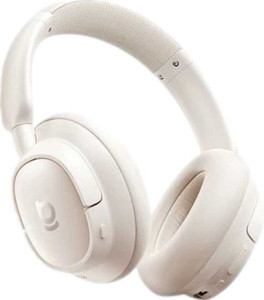
Baseus BH1
Baseus Bowie 30 Max

Baseus BH1 Baseus Bowie 30 Max

Overview

Welcome to our in-depth spec comparison between the Baseus BH1 and the Baseus Bowie 30 Max, two over-ear wireless headphones from Baseus that take notably different approaches to the listening experience. While they share a strong foundation — including LDAC support, USB-C charging, and multipoint connectivity — the key battlegrounds lie in active noise cancellation, driver size, battery endurance, and audio latency. Read on to see which headphone best suits your needs.

Common Features

  • Both headphones use an over-ear fit.
  • Both headphones come with a detachable cable.
  • Neither headphone has water resistance.
  • Neither headphone is designed for kids.
  • Both headphones feature a tangle-free cable.
  • Neither headphone uses an open-back design.
  • Both headphones have stereo speakers.
  • Both headphones reproduce audio starting from 20 Hz at the lowest frequency.
  • Spatial audio support is available on both headphones.
  • Neither headphone uses a neodymium magnet.
  • Passive noise reduction is present on both headphones.
  • Both headphones charge via USB Type-C.
  • A battery level indicator is present on both headphones.
  • Wireless charging is not supported on either headphone.
  • Neither headphone has a solar power battery.
  • Both headphones have a rechargeable battery.
  • Neither headphone has a removable battery.
  • Both headphones support wireless and wired connectivity.
  • LDAC audio codec support is available on both headphones.
  • aptX Adaptive support is not available on either headphone.
  • aptX support is not available on either headphone.
  • LDHC support is not available on either headphone.
  • Bluetooth LE Audio support is not available on either headphone.
  • aptX Low Latency support is not available on either headphone.
  • aptX HD support is not available on either headphone.
  • Both headphones feature a noise-canceling microphone.
  • In/on-ear detection is not available on either headphone.
  • Both headphones support multipoint connection with up to 2 devices.
  • A control panel placed on the device is present on both headphones.
  • Both headphones can be used as a headset.
  • Neither headphone has an in-line control panel.

Main Differences

  • Weight is 238 g on Baseus BH1 and 320 g on Baseus Bowie 30 Max.
  • Active noise cancellation (ANC) is present on Baseus Bowie 30 Max but not available on Baseus BH1.
  • Driver unit size is 40 mm on Baseus BH1 and 50 mm on Baseus Bowie 30 Max.
  • Battery life is 80 hours on Baseus BH1 and 65 hours on Baseus Bowie 30 Max.
  • Battery life with ANC is 55 hours on Baseus BH1 and 50 hours on Baseus Bowie 30 Max.
  • Bluetooth version is 6 on Baseus BH1 and 5.4 on Baseus Bowie 30 Max.
  • Audio latency is 38 ms on Baseus BH1 and 60 ms on Baseus Bowie 30 Max.
  • Ambient sound mode is present on Baseus Bowie 30 Max but not available on Baseus BH1.
  • Number of microphones is 10 on Baseus BH1 and 2 on Baseus Bowie 30 Max.
Specs Comparison
Baseus BH1

Baseus BH1

Baseus Bowie 30 Max

Baseus Bowie 30 Max

Design:
Fit Over-ear Over-ear
weight 238 g 320 g
has a detachable cable
water resistance None None
is designed for kids
has a tangle free cable
has an open-back design
has stereo speakers

Both the Baseus BH1 and the Baseus Bowie 30 Max share the same fundamental design blueprint: over-ear, closed-back headphones with stereo speakers, a tangle-free detachable cable, and no water resistance. For most users, these shared traits mean a broadly similar wearing experience and equivalent cable convenience — the detachable cable in particular is a practical advantage on both, making replacements easy and storage tidier.

Where the two diverge meaningfully is weight. The BH1 comes in at 238 g, while the Bowie 30 Max is noticeably heavier at 320 g — a difference of 82 g, or roughly 34% more mass. In real-world use, this gap becomes increasingly apparent during extended listening sessions: a lighter headphone reduces fatigue on the neck and head, making the BH1 the more comfortable choice for long-haul use such as travel, work, or extended gaming.

On design, the Baseus BH1 has a clear edge due solely to its lower weight. All other design attributes are identical between the two, so if portability and wearing comfort over long periods are priorities, the BH1 is the stronger choice in this category.

Sound quality:
has active noise cancellation (ANC)
lowest frequency 20 Hz 20 Hz
driver unit size 40 mm 50 mm
supports spatial audio
has a neodymium magnet
has passive noise reduction

The Baseus BH1 and Baseus Bowie 30 Max differ significantly in their sound quality features. The BH1 does not have active noise cancellation (ANC), while the Bowie 30 Max includes ANC, which may enhance listening experiences in noisy environments. Both headphones share the same lowest frequency of 20 Hz, ensuring deep bass response.

When it comes to driver unit size, the BH1 uses a 40 mm driver, while the Bowie 30 Max has a larger 50 mm driver, potentially offering a more powerful sound output. Both headphones support spatial audio, providing an immersive listening experience, and both feature passive noise reduction to help block out external sounds.

Neither model includes a neodymium magnet, so the magnetic design does not impact sound quality for either product. Overall, while both products offer similar features like spatial audio and passive noise reduction, the Bowie 30 Max stands out with its inclusion of ANC and a larger driver unit.

Power:
Battery life 80 hours 65 hours
Battery life (ANC) 55 hours 50 hours
Has USB Type-C
has a battery level indicator
has wireless charging
Has a solar power battery
has a rechargeable battery
has a removable battery

The Baseus BH1 offers a longer battery life compared to the Baseus Bowie 30 Max. The BH1 provides up to 80 hours of battery life in standard mode and 55 hours with ANC, while the Bowie 30 Max offers 65 hours in standard mode and 50 hours with ANC. Both models include a battery level indicator and feature USB Type-C for charging.

Neither product supports wireless charging or has a solar power battery. Both models are equipped with rechargeable batteries, but neither offers a removable battery, making both options less flexible in terms of battery replacement.

In summary, the BH1 offers a slightly longer battery life than the Bowie 30 Max, both with and without ANC activated. However, the charging features and battery design are quite similar between the two products.

Connectivity:
connectivity Wireless & wired Wireless & wired
Bluetooth version 6 5.4
has aptX Adaptive
has aptX
has LDAC
has LDHC
has Bluetooth LE Audio
has aptX Low Latency
has aptX HD
has aptX Lossless
has AAC
has Auracast
audio latency 38 ms 60 ms
maximum Bluetooth range 10 m 10 m
has fast pairing
supports Bluetooth pairing using NFC

Both the Baseus BH1 and Baseus Bowie 30 Max offer wireless and wired connectivity, allowing for versatile usage. The BH1 supports Bluetooth version 6, while the Bowie 30 Max uses Bluetooth version 5.4, with the BH1 having a slightly newer version. Both headphones support LDAC and AAC for high-quality wireless audio, but neither has support for aptX Adaptive, aptX, LDHC, Bluetooth LE Audio, aptX Low Latency, aptX HD, or aptX Lossless.

The BH1 has an audio latency of 38 ms, which is lower than the 60 ms latency of the Bowie 30 Max, making the BH1 potentially better for applications requiring lower delay, such as gaming or video watching. Both models have a maximum Bluetooth range of 10 meters, and neither supports fast pairing or Bluetooth pairing using NFC.

In summary, while both products share several key connectivity features, the BH1 stands out with its newer Bluetooth version and lower audio latency compared to the Bowie 30 Max.

Features:
release date July 2025 January 2025
has a noise-canceling microphone
has ambient sound mode
has in/on-ear detection
number of microphones 10 2
multipoint count 2 2
control panel placed on a device
can be used as a headset
Has an in-line control panel

Both the Baseus BH1 and Baseus Bowie 30 Max are equipped with noise-canceling microphones, making them suitable for clear communication. However, the BH1 features 10 microphones, while the Bowie 30 Max has only 2 microphones, potentially affecting the clarity and noise isolation during calls or recordings.

The BH1 does not offer ambient sound mode, while the Bowie 30 Max does, allowing users to hear surrounding sounds while listening. Both products support multipoint connectivity with a count of 2, meaning they can connect to two devices simultaneously. Additionally, both have a control panel placed on the device and can be used as a headset, but neither has an in-line control panel.

In summary, the BH1 offers more microphones for potentially better call quality, while the Bowie 30 Max includes ambient sound mode, which the BH1 lacks. Both headphones have similar features like multipoint connectivity and headset functionality.

Comparison Summary & Verdict

After examining the full spec sheet, both headphones serve distinct audiences. The Baseus BH1 stands out with its lighter 238 g build, superior 80-hour battery life, cutting-edge Bluetooth 6 with an ultra-low 38 ms latency, and an impressive 10-microphone array — making it the stronger pick for users who prioritize call clarity, gaming, and all-day wireless freedom. The Baseus Bowie 30 Max, on the other hand, brings active noise cancellation, an ambient sound mode, and larger 50 mm drivers to the table, appealing to commuters and focus-driven listeners who need immersive sound isolation and situational awareness in one package. Neither headphone is a clear-cut winner for everyone; your ideal choice depends entirely on whether ANC and immersion or lightweight endurance and low latency matters most to you.

Baseus BH1
Buy Baseus BH1 if...

Buy the Baseus BH1 if you want a lighter headphone with longer battery life, ultra-low audio latency, and a superior microphone setup for calls or gaming.

Baseus Bowie 30 Max
Buy Baseus Bowie 30 Max if...

Buy the Baseus Bowie 30 Max if active noise cancellation and an ambient sound mode are essential for your commute or focused listening sessions.