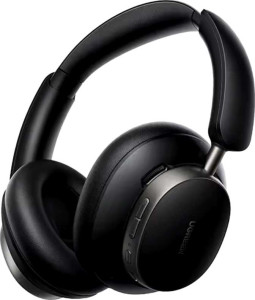
Baseus Bowie 30 Max
Ugreen Studio Pro

Baseus Bowie 30 Max Ugreen Studio Pro

Overview

Welcome to our detailed specification comparison between the Baseus Bowie 30 Max and the Ugreen Studio Pro, two over-ear wireless headphones that share a strong feature foundation yet differ in some meaningful ways. Both deliver ANC, LDAC support, and multipoint connectivity, but the real questions lie in how they approach battery endurance, audio range, and microphone performance. Read on to see how every spec stacks up before you decide.

Common Features

  • Both headphones have an over-ear fit.
  • Both headphones have a detachable cable.
  • Neither headphone has water resistance.
  • Both headphones can be folded.
  • Neither headphone is designed for kids.
  • Both headphones have a tangle-free cable.
  • Neither headphone has an open-back design.
  • Both headphones have stereo speakers.
  • Both headphones have active noise cancellation (ANC).
  • The lowest frequency on both headphones is 20 Hz.
  • Both headphones support spatial audio.
  • Neither headphone has a neodymium magnet.
  • Both headphones have passive noise reduction.
  • Both headphones have a USB Type-C charging port.
  • Both headphones have a battery level indicator.
  • Neither headphone supports wireless charging.
  • Neither headphone has a solar power battery.
  • Both headphones have a rechargeable battery.
  • Neither headphone has a removable battery.
  • Both headphones support wireless and wired connectivity.
  • Neither headphone supports aptX Adaptive.
  • Neither headphone supports aptX.
  • Both headphones support LDAC.
  • Neither headphone supports LDHC.
  • Neither headphone supports Bluetooth LE Audio.
  • Neither headphone supports aptX Low Latency.
  • Neither headphone supports aptX HD.
  • Both headphones have a noise-canceling microphone.
  • Both headphones have an ambient sound mode.
  • Neither headphone has in/on-ear detection.
  • Neither headphone has a mute function.
  • Both headphones support multipoint connection with 2 devices.
  • Both headphones have a control panel placed on the device.
  • Both headphones can be used as a headset.
  • Neither headphone has an in-line control panel.

Main Differences

  • The weight is 320 g on Baseus Bowie 30 Max and 315 g on Ugreen Studio Pro.
  • The highest frequency is 20000 Hz on Baseus Bowie 30 Max and 40000 Hz on Ugreen Studio Pro.
  • The driver unit size is 50 mm on Baseus Bowie 30 Max and 40 mm on Ugreen Studio Pro.
  • Battery life is 65 hours on Baseus Bowie 30 Max and 120 hours on Ugreen Studio Pro.
  • The Bluetooth version is 5.4 on Baseus Bowie 30 Max and 6 on Ugreen Studio Pro.
  • The maximum Bluetooth range is 10 m on Baseus Bowie 30 Max and 15 m on Ugreen Studio Pro.
  • The number of microphones is 2 on Baseus Bowie 30 Max and 4 on Ugreen Studio Pro.
Specs Comparison
Baseus Bowie 30 Max

Baseus Bowie 30 Max

Ugreen Studio Pro

Ugreen Studio Pro

Design:
Fit Over-ear Over-ear
weight 320 g 315 g
has a detachable cable
water resistance None None
can be folded
is designed for kids
has a tangle free cable
has an open-back design
has stereo speakers

From a design standpoint, the Baseus Bowie 30 Max and the Ugreen Studio Pro are remarkably similar. Both are closed-back, over-ear headphones that fold for portability, feature detachable and tangle-free cables, offer no water resistance, and are built for adult use. In practical terms, this means buyers on either side get the same core design conveniences — portability-friendly folding and cable replaceability — without any meaningful structural trade-off between the two.

The only measurable difference in this group is weight: the Bowie 30 Max comes in at 320 g versus the Studio Pro's 315 g. A 5-gram gap is negligible in real-world use and is unlikely to be perceptible during extended listening sessions. It would not be a reasonable basis for a purchasing decision on its own.

Given how closely matched these two headphones are across every design dimension, this group is effectively a tie. Neither product holds a meaningful design advantage over the other based solely on the available specifications.

Sound quality:
has active noise cancellation (ANC)
lowest frequency 20 Hz 20 Hz
highest frequency 20000 Hz 40000 Hz
driver unit size 50 mm 40 mm
supports spatial audio
has a neodymium magnet
has passive noise reduction

The Baseus Bowie 30 Max and the Ugreen Studio Pro both feature active noise cancellation (ANC), providing a similar level of immersion by reducing ambient noise. The lowest frequency supported by both models is 20 Hz, ensuring deep bass performance. However, the Ugreen Studio Pro has a wider frequency range, extending to 40,000 Hz, compared to the Baseus Bowie 30 Max’s 20,000 Hz. This suggests that the Ugreen Studio Pro may offer a broader spectrum of high-frequency sound.

In terms of driver size, the Baseus Bowie 30 Max comes with a larger 50 mm driver unit, while the Ugreen Studio Pro uses a smaller 40 mm driver unit. While both sizes are standard for over-ear headphones, the larger driver on the Baseus model could contribute to a more powerful sound output.

Both headphones support spatial audio, which enhances the audio experience by providing a more immersive and 3D sound field. Additionally, neither model includes a neodymium magnet, and both feature passive noise reduction to further isolate sound from the surrounding environment.

Power:
Battery life 65 hours 120 hours
Has USB Type-C
has a battery level indicator
has wireless charging
Has a solar power battery
has a rechargeable battery
has a removable battery

The Baseus Bowie 30 Max and the Ugreen Studio Pro both come with a rechargeable battery, ensuring that users can enjoy extended listening sessions without worrying about frequent battery replacements. However, there is a significant difference in battery life: the Baseus Bowie 30 Max offers 65 hours of playback, while the Ugreen Studio Pro provides up to 120 hours, giving it more than double the battery life.

Both models feature a battery level indicator, allowing users to easily monitor their remaining charge. Additionally, both support USB Type-C for charging, ensuring fast and convenient recharging. Neither product offers wireless charging, and neither includes a solar power battery option.

In terms of battery design, neither the Baseus Bowie 30 Max nor the Ugreen Studio Pro has a removable battery, meaning users cannot swap out the batteries themselves. Both headphones are designed with long-lasting, integrated rechargeable batteries that cannot be replaced by the user.

Connectivity:
connectivity Wireless & wired Wireless & wired
Bluetooth version 5.4 6
has aptX Adaptive
has aptX
has LDAC
has LDHC
has Bluetooth LE Audio
has aptX Low Latency
has aptX HD
has aptX Lossless
has AAC
has Auracast
audio latency 60 ms 60 ms
maximum Bluetooth range 10 m 15 m
has fast pairing
supports Bluetooth pairing using NFC

The Baseus Bowie 30 Max and the Ugreen Studio Pro both offer wireless and wired connectivity, allowing users flexibility in how they connect to devices. The Baseus model uses Bluetooth version 5.4, while the Ugreen model features the more recent Bluetooth version 6. This suggests that the Ugreen Studio Pro may offer improvements in connection stability and efficiency, though both products share the same audio latency of 60 ms.

Both headphones support LDAC for high-resolution audio streaming, but neither includes LDHC or Bluetooth LE Audio support. Additionally, both models have AAC support, ensuring compatibility with a wide range of devices. Neither product offers support for aptX (Adaptive, Low Latency, HD, or Lossless), nor does either model have Auracast or fast pairing features.

In terms of Bluetooth range, the Baseus Bowie 30 Max has a maximum Bluetooth range of 10 meters, while the Ugreen Studio Pro offers a longer range of 15 meters, providing more flexibility in where you can use the headphones without losing connection. Neither model supports Bluetooth pairing via NFC.

Features:
release date January 2025 May 2025
has a noise-canceling microphone
has ambient sound mode
has in/on-ear detection
number of microphones 2 4
has a mute function
multipoint count 2 2
control panel placed on a device
can be used as a headset
Has an in-line control panel

Both the Baseus Bowie 30 Max and the Ugreen Studio Pro feature a noise-canceling microphone and ambient sound mode, allowing for clear communication and a more immersive listening experience. Neither model includes in/on-ear detection, so users will need to manually control the device when putting them on or taking them off.

In terms of microphone setup, the Baseus Bowie 30 Max has two microphones, while the Ugreen Studio Pro is equipped with four microphones. This difference may impact sound clarity and voice pickup, with the Ugreen model potentially offering better noise isolation or clearer voice capture.

Both products support multipoint connectivity, allowing users to connect to two devices simultaneously. They also have a control panel placed on the device itself for managing settings. Both headphones can be used as headsets, but neither model features an in-line control panel or a mute function.

Comparison Summary & Verdict

After reviewing all the specifications, both headphones are well-matched in core areas — offering ANC, LDAC, ambient sound mode, foldable over-ear designs, and dual-device multipoint pairing. However, the key differentiators are clear. The Ugreen Studio Pro pulls ahead with a remarkable 120-hour battery life, a wider 40000 Hz frequency range, the newer Bluetooth 6 with a 15 m range, and four microphones for superior call clarity. The Baseus Bowie 30 Max counters with a larger 50 mm driver, which some listeners prefer for a fuller sound signature. If longevity, extended audio detail, and communication quality are your priorities, the Ugreen Studio Pro is the stronger pick. If you value a bigger driver unit and the package still suits your needs, the Baseus Bowie 30 Max remains a capable choice.

Baseus Bowie 30 Max
Buy Baseus Bowie 30 Max if...

Buy the Baseus Bowie 30 Max if you prefer a larger 50 mm driver unit and a headphone that still delivers solid ANC, LDAC, and multipoint connectivity at a competitive level.

Ugreen Studio Pro
Buy Ugreen Studio Pro if...

Buy the Ugreen Studio Pro if you need exceptional battery life of 120 hours, a wider frequency response up to 40000 Hz, a longer Bluetooth range, and four microphones for clearer calls.