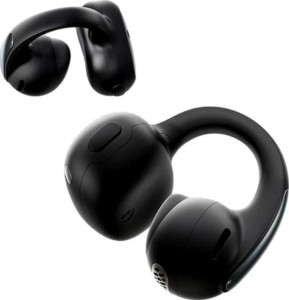
Baseus Bowie MC1
Moondrop Pill

Baseus Bowie MC1 Moondrop Pill

Overview

When choosing between the Baseus Bowie MC1 and the Moondrop Pill, open-ear earbuds fans will find two compelling options that share a solid foundation yet diverge in meaningful ways. Both deliver a wireless, cable-free experience with stereo sound and fast charging, but key battlegrounds emerge around battery endurance, ingress protection, driver size, and Bluetooth capabilities — making the choice far from straightforward for the discerning buyer.

Common Features

  • Both products use an open-ear fit design.
  • Neither product has wires or cables.
  • Neither product is a neckband earbud style.
  • Neither product includes wingtips.
  • Neither product features RGB lighting.
  • Both products have stereo speakers.
  • Neither product has a UV light.
  • Neither product has a display.
  • Neither product has active noise cancellation (ANC).
  • Neither product offers passive noise reduction.
  • Both products have a lowest frequency of 20 Hz and a highest frequency of 20000 Hz.
  • Neither product supports spatial audio.
  • Neither product has a neodymium magnet.
  • Both products have a charge time of 1.5 hours.
  • Neither product supports wireless charging.
  • Both products have a battery level indicator.
  • Both products have a rechargeable battery.
  • Both products use USB Type-C for charging.
  • Neither product supports LDAC, LDHC, Bluetooth LE Audio, aptX Adaptive, aptX Low Latency, or aptX HD.
  • Neither product has an ambient sound mode.
  • Neither product has in/on-ear detection.
  • Both products support fast charging.
  • Both products have a mute function.
  • Both products can be used as a headset.
  • Both products have a control panel placed on the device.
  • Both products have voice prompts.
  • Both products have a noise-canceling microphone.

Main Differences

  • Ingress Protection rating is IP57 on Baseus Bowie MC1 and IPX4 on Moondrop Pill.
  • Baseus Bowie MC1 is water resistant, while Moondrop Pill is sweat resistant.
  • Driver unit size is 10.8 mm on Baseus Bowie MC1 and 13 mm on Moondrop Pill.
  • Battery life is 9 hours on Baseus Bowie MC1 and 8 hours on Moondrop Pill.
  • Battery life of the charging case is 31 hours on Baseus Bowie MC1 and 20 hours on Moondrop Pill.
  • Battery power is 48 mAh on Baseus Bowie MC1 and 40 mAh on Moondrop Pill.
  • Charging case battery power is 600 mAh on Baseus Bowie MC1 and 300 mAh on Moondrop Pill.
  • Bluetooth version is 5.4 on Baseus Bowie MC1 and 6 on Moondrop Pill.
  • AAC support is present on Moondrop Pill but not available on Baseus Bowie MC1.
Specs Comparison
Baseus Bowie MC1

Baseus Bowie MC1

Moondrop Pill

Moondrop Pill

Design:
Fit Open-ear Open-ear
Ingress Protection (IP) rating IP57 IPX4
water resistance Water resistant Sweat resistant
has no wires or cables
are neckband earbuds
wingtips included
has RGB lighting
has stereo speakers
has UV light
Has a display

Both the Baseus Bowie MC1 and the Moondrop Pill share a fundamentally identical design philosophy: open-ear, fully wireless form factors with no neckband, no wingtips, no RGB lighting, and no display. For users deciding between the two based on design, the shared elements are extensive — making the few differences that do exist all the more decisive.

The most meaningful differentiator is water resistance. The Bowie MC1 carries an IP57 rating, meaning it is protected against dust ingress and can withstand immersion in water up to 1 meter deep for 30 minutes. The Moondrop Pill, by contrast, holds only an IPX4 rating — no dust certification, and protection limited to splashes from any direction. In practical terms, the Bowie MC1 can handle rain, sweat, and accidental submersion with confidence, while the Pill is really only suited for light perspiration and incidental moisture. For active users or anyone likely to use these outdoors in variable conditions, this is a significant gap.

Overall, both earbuds are well-matched in structural design, but the Baseus Bowie MC1 holds a clear edge in durability thanks to its substantially stronger ingress protection rating. If ruggedness and environmental resilience matter to you, the Bowie MC1 is the stronger choice in this category.

Sound quality:
has active noise cancellation (ANC)
has passive noise reduction
driver unit size 10.8 mm 13 mm
lowest frequency 20 Hz 20 Hz
highest frequency 20000 Hz 20000 Hz
supports spatial audio
has Dolby Atmos
has Dirac Virtuo
has a neodymium magnet

At a high level, both the Baseus Bowie MC1 and the Moondrop Pill occupy the same sonic territory: no active noise cancellation, no passive noise reduction, identical frequency ranges of 20 Hz – 20,000 Hz, and no spatial audio or premium audio processing technologies like Dolby Atmos or Dirac Virtuo. For listeners hoping for immersive or noise-isolated sound, neither product delivers that — which is expected given their open-ear design.

The one tangible differentiator within these specs is driver size. The Moondrop Pill uses a 13 mm driver versus the Bowie MC1's 10.8 mm driver. A larger driver diaphragm generally has more surface area to move air, which can translate to more authoritative bass reproduction and a fuller overall sound. That said, driver size alone does not guarantee better sound quality — tuning, diaphragm material, and acoustic engineering all play a role — and neither product lists a neodymium magnet, which is a common marker of higher driver efficiency. Still, on paper, the larger driver gives the Moondrop Pill a potential advantage in low-end weight and dynamic presence.

The Moondrop Pill holds a narrow edge in this category purely on the basis of its larger driver unit, which suggests greater potential for bass depth and soundstage. However, given how many other variables govern actual sound output, this advantage is theoretical rather than guaranteed from specs alone.

Power:
Battery life 9 hours 8 hours
Battery life of charging case 31 hours 20 hours
charge time 1.5 hours 1.5 hours
battery power 48 mAh 40 mAh
battery power (charging case) 600mAh 300mAh
has wireless charging
Has a solar power battery
has a battery level indicator
has a rechargeable battery

Battery endurance is where the Baseus Bowie MC1 pulls ahead meaningfully. It offers 9 hours of earbud playback versus the Moondrop Pill's 8 hours — a modest but real difference for long travel days or extended listening sessions. The more striking gap, however, is in the charging case capacity: the Bowie MC1's case holds 600 mAh and delivers a total combined runtime of 31 hours, while the Moondrop Pill's case carries only 300 mAh for a combined total of 20 hours. That is over 50% more total battery life in favor of the Bowie MC1 — a significant practical advantage for users who go days between charges.

Where the two products are evenly matched: both share an identical 1.5-hour charge time, neither supports wireless charging, and both include a battery level indicator, which is a useful quality-of-life feature that prevents unexpected shutdowns. The absence of wireless charging on both is a minor limitation but consistent with their respective price tiers.

The Baseus Bowie MC1 wins this category decisively. Its larger earbud battery, substantially bigger charging case, and superior total runtime make it the stronger choice for users who prioritize longevity between top-ups — especially given that neither product offers any charging convenience features like wireless charging to offset a smaller battery.

Connectivity:
has fast pairing
Has USB Type-C
Bluetooth version 5.4 6
has LDAC
has LDHC
has Bluetooth LE Audio
has aptX Adaptive
has aptX Low Latency
has aptX HD
has aptX
has aptX Lossless
has aptX Voice
has Auracast
maximum Bluetooth range 10 m 10 m
supports Bluetooth pairing using NFC
Can be used wirelessly
has AAC

Connectivity is where the Moondrop Pill earns a quiet but meaningful advantage on two fronts. First, it runs on Bluetooth 6.0 compared to the Bowie MC1's Bluetooth 5.4. While both are modern standards that deliver reliable wireless performance at the shared maximum range of 10 meters, Bluetooth 6.0 introduces improvements in connection precision and channel sounding that can translate to more stable links in congested environments like busy commutes or crowded offices.

The second differentiator is codec support. The Moondrop Pill supports AAC, while the Bowie MC1 does not. AAC is particularly relevant for iPhone users, as Apple devices transmit audio over Bluetooth using AAC by default — without it, the Bowie MC1 falls back to the more compressed SBC codec, which can result in slightly lower audio fidelity over wireless. For Android users the gap is less pronounced, but AAC still offers a more efficient transmission than SBC on compatible devices. Neither earbud supports higher-tier codecs like LDAC or aptX, so AAC represents the ceiling for both — and only the Pill reaches it.

Shared features — USB Type-C charging, wireless-only operation, and the absence of NFC or fast pairing — keep the two products on equal footing elsewhere. Overall, the Moondrop Pill has the edge in connectivity, thanks to its newer Bluetooth version and AAC support, the latter being especially consequential for Apple ecosystem users.

Features:
release date February 2025 May 2025
has ambient sound mode
has in/on-ear detection
Supports fast charging
can read notifications
has a mute function
can be used as a headset
control panel placed on a device
Has voice prompts
travel bag is included
Has an in-line control panel
Has a temperature sensor
Has a built-in camera remote control function

Across every single spec in this category, the Baseus Bowie MC1 and the Moondrop Pill are a perfect match. Both support fast charging, include on-device controls, offer voice prompts, feature a mute function, and ship with a travel bag — a practical inclusion that speaks to the portability-focused positioning of both products.

A few of these shared features are worth highlighting for their real-world value. The mute function and headset capability mean both earbuds are genuinely work-call ready — users can jump into meetings and silence themselves without fumbling for a phone. Fast charging on both is a welcome safety net, especially given that neither product supports wireless charging. Voice prompts add a layer of usability polish, reducing reliance on visual cues for connection status and battery alerts. The included travel bag, while a small detail, suggests both brands are targeting users who want a complete, portable-friendly package out of the box.

This category is a complete tie. There is no differentiator to speak of — every feature present on one is equally present on the other. Users should look to other spec groups, such as connectivity or battery life, to break the decision in this comparison.

Microphone:
has a noise-canceling microphone

The microphone spec data here is minimal but consistent: both the Baseus Bowie MC1 and the Moondrop Pill feature a noise-canceling microphone. For open-ear earbuds — which by nature do not isolate the wearer from ambient sound — a noise-canceling mic is particularly important. Without it, call recipients would hear a full wash of environmental noise alongside the speaker's voice. The inclusion of mic noise cancellation on both products signals that each is designed to handle voice calls in real-world, noisy conditions, not just in quiet rooms.

This category is a complete tie. With only a single shared data point available, there is no basis for distinguishing one product from the other here. Both clear the baseline threshold for call-ready functionality, but deeper microphone performance differences — such as the number of microphone arrays or beamforming capability — are not reflected in the provided specs and cannot be assessed.

Comparison Summary & Verdict

After a thorough side-by-side look, both the Baseus Bowie MC1 and the Moondrop Pill prove to be capable open-ear companions, but they cater to slightly different priorities. The Baseus Bowie MC1 pulls ahead in longevity, offering a longer 9-hour battery life and a significantly larger 600 mAh charging case that extends total playback to 31 hours — a clear edge for endurance-focused users. It also carries a more robust IP57 water resistance rating, making it better suited for outdoor or active use in wet conditions. The Moondrop Pill, on the other hand, answers with a larger 13 mm driver for potentially richer audio, the more modern Bluetooth 6 standard, and AAC codec support for improved wireless audio quality with compatible devices. Choose the Baseus Bowie MC1 if battery life and durability top your list; opt for the Moondrop Pill if audio fidelity and cutting-edge connectivity matter most.

Baseus Bowie MC1
Buy Baseus Bowie MC1 if...

Buy the Baseus Bowie MC1 if you need maximum battery endurance and stronger water resistance — its 31-hour total playtime and IP57 rating make it the better pick for active, all-day use.

Moondrop Pill
Buy Moondrop Pill if...

Buy the Moondrop Pill if audio quality and modern connectivity are your priorities, thanks to its larger 13 mm driver, Bluetooth 6 support, and AAC codec compatibility.