Baseus Bowie MF1
Baseus MC1 Pro

Baseus Bowie MF1 Baseus MC1 Pro

Overview

Welcome to our in-depth comparison of the Baseus Bowie MF1 and the Baseus MC1 Pro. Both are fully wireless earbuds sharing a number of core features, yet they diverge in some meaningful ways. Key battlegrounds include their fit style and water resistance, battery endurance, and how each approaches sound reproduction and connectivity. Read on to discover which of these two earbuds is the right match for your lifestyle.

Common Features

  • Both products are wireless with no wires or cables.
  • Neither product is a neckband earbud design.
  • Neither product includes wingtips.
  • Neither product features RGB lighting.
  • Both products have stereo speakers.
  • Neither product has a UV light.
  • Neither product has a display.
  • Neither product has active noise cancellation (ANC).
  • Both products share the same lowest frequency of 20 Hz.
  • Neither product supports spatial audio.
  • Neither product has Dolby Atmos.
  • Neither product has Dirac Virtuo.
  • Neither product has a neodymium magnet.
  • Neither product supports wireless charging.
  • Neither product has a solar power battery.
  • Both products have a battery level indicator.
  • Both products have a rechargeable battery.
  • Neither product supports fast pairing.
  • Both products have USB Type-C connectivity.
  • Both products support LDAC.
  • Neither product has LDHC support.
  • Neither product has Bluetooth LE Audio.
  • Neither product has aptX Adaptive.
  • Neither product has aptX Low Latency.
  • Neither product has aptX HD.
  • Neither product has an ambient sound mode.
  • Neither product has in/on-ear detection.
  • Neither product has a find device feature.
  • Both products support fast charging.
  • Neither product can read notifications.
  • Both products have a mute function.
  • Both products can be used as a headset.
  • Both products have a control panel placed on the device.
  • Both products have a noise-canceling microphone.

Main Differences

  • Fit is in-ear on Baseus Bowie MF1 and open-ear on Baseus MC1 Pro.
  • Ingress Protection rating is IPX4 on Baseus Bowie MF1 and IP67 on Baseus MC1 Pro.
  • Water resistance is sweat resistant on Baseus Bowie MF1 and waterproof on Baseus MC1 Pro.
  • Passive noise reduction is present on Baseus Bowie MF1 but not available on Baseus MC1 Pro.
  • Highest frequency is 20000 Hz on Baseus Bowie MF1 and 40000 Hz on Baseus MC1 Pro.
  • Battery life is 12 hours on Baseus Bowie MF1 and 8 hours on Baseus MC1 Pro.
  • Battery life of the charging case is 48 hours on Baseus Bowie MF1 and 32 hours on Baseus MC1 Pro.
  • Charge time is 2 hours on Baseus Bowie MF1 and 1.5 hours on Baseus MC1 Pro.
  • Bluetooth version is 5.4 on Baseus Bowie MF1 and 6 on Baseus MC1 Pro.
Specs Comparison
Baseus Bowie MF1

Baseus Bowie MF1

Baseus MC1 Pro

Baseus MC1 Pro

Design:
Fit In-ear Open-ear
Ingress Protection (IP) rating IPX4 IP67
water resistance Sweat resistant Waterproof
has no wires or cables
are neckband earbuds
wingtips included
has RGB lighting
has stereo speakers
has UV light
Has a display

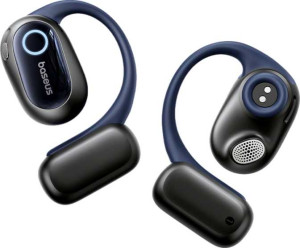
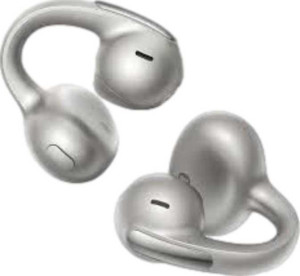
The most fundamental design difference between these two earbuds is their fit style. The Bowie MF1 uses a traditional in-ear design, meaning the earbud sits inside the ear canal to create a passive seal — this typically aids noise isolation and bass response. The MC1 Pro, by contrast, adopts an open-ear form factor, which rests near the ear without sealing the canal. Open-ear designs preserve situational awareness (you can still hear your environment), but generally sacrifice bass depth and isolation. This is the single most consequential design choice between the two products and should be the primary filter for most buyers.

Water resistance is another area where the two products diverge sharply. The Bowie MF1 carries an IPX4 rating, meaning it is protected against sweat and light splashing from any direction — adequate for workouts, but not for submersion or heavy rain. The MC1 Pro steps up significantly with a full IP67 rating, which means it is both dust-tight and capable of withstanding immersion in water up to 1 meter for 30 minutes. For outdoor athletes, swimmers, or users in wet environments, this is a meaningful practical advantage.

Beyond these two differentiators, both products share an identical design profile: fully wireless with no cables or neckband, stereo playback, and no display, RGB lighting, or UV features. The MC1 Pro holds a clear design edge in terms of weather durability thanks to its superior IP67 rating, while the choice between in-ear and open-ear fit ultimately comes down to whether the user prioritizes audio isolation or environmental awareness.

Sound quality:
has active noise cancellation (ANC)
has passive noise reduction
lowest frequency 20 Hz 20 Hz
highest frequency 20000 Hz 40000 Hz
supports spatial audio
has Dolby Atmos
has Dirac Virtuo
has a neodymium magnet

Both earbuds share a standard 20 Hz lower frequency floor, meaning neither has a particular advantage in reproducing deep bass fundamentals. Where they diverge is at the top end: the Bowie MF1 reaches a conventional 20,000 Hz ceiling — the textbook upper limit of human hearing — while the MC1 Pro extends all the way to 40,000 Hz. This places the MC1 Pro in hi-res audio territory. While most listeners cannot consciously perceive frequencies above 20 kHz, a wider driver excursion range can contribute to a more refined, less strained reproduction of upper frequencies that sit just at the edge of audibility, which some listeners describe as improved ″air″ and detail in high-frequency content.

On the noise management front, the positions are reversed. Neither product offers active noise cancellation, but the Bowie MF1 does provide passive noise reduction — a direct consequence of its in-ear fit creating a physical seal in the ear canal. The MC1 Pro, with its open-ear design, offers no noise reduction of any kind, leaving the listener fully exposed to ambient sound. For commuters or focus-oriented listeners, this is a real limitation of the MC1 Pro. Neither model supports spatial audio, Dolby Atmos, or Dirac Virtuo, so immersive audio processing is off the table for both.

Weighing these factors, there is no single winner — the two products target different listening priorities. The MC1 Pro has the edge in raw frequency capability, appealing to detail-oriented listeners and hi-res audio fans. The Bowie MF1 holds the advantage in noise isolation, making it the stronger choice for noisy environments. The right pick depends entirely on whether the user values audio fidelity range or ambient sound blocking more.

Power:
Battery life 12 hours 8 hours
Battery life of charging case 48 hours 32 hours
charge time 2 hours 1.5 hours
has wireless charging
Has a solar power battery
has a battery level indicator
has a rechargeable battery

Battery endurance is where the Bowie MF1 pulls ahead decisively. Its earbuds last 12 hours on a single charge versus 8 hours for the MC1 Pro — a 50% advantage per session. Factor in the charging case and the gap widens further: the MF1 system delivers a combined 48 hours of total playback, compared to 32 hours for the MC1 Pro. For frequent travelers, commuters, or anyone who forgets to charge regularly, this difference translates directly into fewer interruptions and less dependency on finding a power source.

The MC1 Pro does recover some ground in charge speed, refilling in 1.5 hours versus the MF1's 2 hours. That 30-minute advantage is a minor convenience for users who top up frequently, but it does not offset the larger capacity gap for most real-world use cases. Neither model supports wireless charging, so both require a wired connection to the case — a shared limitation at this tier.

Overall, the Bowie MF1 holds a clear power advantage, offering significantly more total listening time per charge cycle. The MC1 Pro's faster charge time is a modest consolation but is unlikely to be the deciding factor for battery-conscious buyers. Users who prioritize going longer between charges should lean toward the MF1.

Connectivity:
has fast pairing
Has USB Type-C
Bluetooth version 5.4 6
has LDAC
has LDHC
has Bluetooth LE Audio
has aptX Adaptive
has aptX Low Latency
has aptX HD
has aptX
has aptX Lossless
has aptX Voice
has Auracast
maximum Bluetooth range 10 m 10 m
supports Bluetooth pairing using NFC
Can be used wirelessly
has AAC

The headline difference here is the Bluetooth version. The Bowie MF1 runs on Bluetooth 5.4, which is already a modern, capable standard offering solid stability and efficiency. The MC1 Pro steps up to Bluetooth 6, the latest generation, which brings improvements in connection robustness, reduced interference handling, and more precise channel management. In practice, users in crowded wireless environments — airports, gyms, busy offices — may notice marginally more stable connections with the MC1 Pro, though both products share an identical stated maximum range of 10 meters.

On audio codec support, the two products are evenly matched. Both carry LDAC and AAC, which together cover the most important use cases: LDAC enables high-resolution wireless audio streaming for Android users willing to trade some latency for quality, while AAC provides efficient, good-quality transmission for Apple device users. Neither product supports aptX variants or Bluetooth LE Audio, so the codec ceiling is the same for both — LDAC is the top-tier option available on each.

Shared features — USB-C charging, full wireless operation, and the absence of NFC or fast pairing — mean the connectivity experience is largely comparable day-to-day. The MC1 Pro holds a narrow edge by virtue of its newer Bluetooth 6 standard, which offers a degree of future-proofing and potential interference resilience the MF1 cannot match. However, for most users in typical environments, the practical difference will be difficult to perceive.
Features:
release date March 2025 May 2025
has ambient sound mode
has in/on-ear detection
has find device feature
Supports fast charging
can read notifications
has a mute function
can be used as a headset
control panel placed on a device
Has voice prompts
travel bag is included
Has an in-line control panel
Has a temperature sensor
Has a built-in camera remote control function

Unusually, the Features category produces a complete tie — every single specification in this group is identical between the Bowie MF1 and the MC1 Pro. Both support fast charging, include on-device touch or button controls, offer voice prompts, and ship with a travel bag. Both can function as a headset for calls and include a mute function, making either a practical choice for remote workers or frequent callers.

It is worth noting what neither product offers: there is no ambient sound mode, no ear detection to auto-pause playback, and no find-my-device feature. These are conveniences increasingly common at this tier, and their absence is a shared limitation rather than a differentiator. The lack of ambient mode is particularly relevant given that the MC1 Pro's open-ear design already provides natural environmental awareness — but for the MF1's in-ear users, the omission is more noticeable.

With no separating data points in this group, the two products are evenly matched on features. Buyers looking for a richer feature set — ambient mode, ear detection, or device-finding — will need to look elsewhere regardless of which model they consider.

Microphone:
has a noise-canceling microphone

Microphone data for these two products is limited to a single shared specification: both the Bowie MF1 and the MC1 Pro feature a noise-canceling microphone. This means both are equipped to suppress background noise during calls — a practical necessity for anyone using earbuds in offices, on commutes, or in other noisy settings. In terms of call clarity, neither product has a documented advantage over the other based on the available data.

This group is a complete tie. With only one data point provided and both products matching on it, there is no differentiator to analyze here. Buyers prioritizing microphone performance beyond this baseline — such as multi-microphone arrays or beamforming technology — will not find distinguishing information in the specs available for either model.

Comparison Summary & Verdict

After a thorough look at the specs, both earbuds share a strong foundation: LDAC support, fast charging, a noise-canceling microphone, and USB Type-C connectivity. However, their differences reveal two distinct profiles. The Baseus Bowie MF1 stands out with a longer 12-hour battery life and a 48-hour charging case, plus passive noise reduction thanks to its in-ear fit — making it the stronger companion for long listening sessions and commutes. The Baseus MC1 Pro, on the other hand, offers a superior IP67 waterproof rating, a wider frequency range reaching 40000 Hz, and the latest Bluetooth 6 — positioning it as the better pick for active, outdoor use where durability and audio fidelity take priority.

Baseus Bowie MF1
Buy Baseus Bowie MF1 if...

Buy the Baseus Bowie MF1 if you prioritize longer battery life and passive noise reduction for daily commutes or extended listening sessions.

Baseus MC1 Pro
Buy Baseus MC1 Pro if...

Buy the Baseus MC1 Pro if you need a fully waterproof earbud with a wider frequency range and the latest Bluetooth 6 for active or outdoor use.