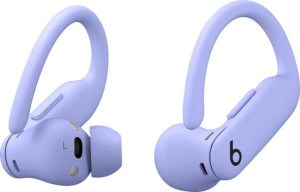
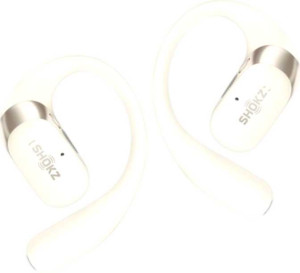
The frequency response gap between these two earphones is significant. The Beats Powerbeats Pro 2 covers the full audible spectrum from 20 Hz to 20,000 Hz, which aligns with the theoretical range of human hearing and means it can reproduce deep bass and crisp high-end detail. The Shokz OpenFit 2, by contrast, ranges from 50 Hz to 16,000 Hz — trimming both the low-end rumble and the upper-frequency air and sparkle. In practice, this means the OpenFit 2 will sound comparatively thinner, with less sub-bass punch and slightly rolled-off treble. This is a direct consequence of the open-ear driver design, which cannot physically pressurize the ear canal the way an in-ear driver can.
The noise handling difference is equally stark. The Powerbeats Pro 2 offers both active noise cancellation (ANC) and passive noise reduction — a combination that blocks out ambient sound at both a physical and electronic level, letting you focus on your audio in noisy environments. The OpenFit 2 has neither, which is consistent with its open-ear philosophy: it is designed to let environmental sound in, not block it out. These are genuinely opposing use cases rather than a simple win or loss, but if raw audio immersion is the goal, the Powerbeats Pro 2 has a structural advantage.
Spatial audio support further widens the gap. The Powerbeats Pro 2 supports spatial audio, enabling a three-dimensional soundstage for compatible content — a notable feature for music, gaming, or film. The OpenFit 2 offers no equivalent. Across every measurable sound quality dimension in this data set, the Powerbeats Pro 2 holds a clear and decisive edge, with broader frequency coverage, noise isolation, and spatial audio all absent from the OpenFit 2's spec sheet.