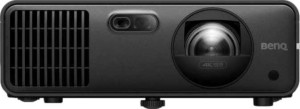
BenQ AK700ST
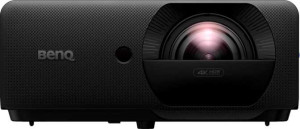
BenQ LK830ST

BenQ AK700ST BenQ LK830ST

Overview

Welcome to our in-depth specification comparison between the BenQ AK700ST and the BenQ LK830ST, two 4K laser projectors that share a common foundation yet diverge sharply in how they approach installation flexibility, connectivity, and image processing. Whether you are drawn to advanced motorized optics or built-in smart features and wireless streaming, this head-to-head breakdown covers every key spec to help you make an informed decision.

Common Features

  • Both projectors use a laser light source.
  • Audible noise in eco mode is 29 dB on both projectors.
  • Both projectors weigh 3400 g.
  • Both projectors output 4000 ANSI lumens.
  • Both projectors have a 4K output resolution.
  • HDR10 support is available on both projectors.
  • HDR10+ support is not available on either projector.
  • Dolby Vision support is not available on either projector.
  • Neither projector has a VGA connector.
  • Neither projector has a DVI connector.
  • Both projectors have 0 RJ45 ports.
  • Neither projector has stereo speakers.
  • Both projectors include a remote control.
  • Both projectors have a built-in speaker.
  • Dolby Atmos support is not available on either projector.

Main Differences

  • Audible noise is 32 dB on BenQ AK700ST and 33 dB on BenQ LK830ST.
  • Operating power consumption is 192W on BenQ AK700ST and 320W on BenQ LK830ST.
  • Lamp life in eco mode is 20000 h on BenQ AK700ST and 0.5 h on BenQ LK830ST.
  • Width is 300 mm on BenQ AK700ST and 296 mm on BenQ LK830ST.
  • Height is 110 mm on BenQ AK700ST and 120 mm on BenQ LK830ST.
  • Thickness is 230 mm on BenQ AK700ST and 232 mm on BenQ LK830ST.
  • Volume is 7590 cm³ on BenQ AK700ST and 8240.64 cm³ on BenQ LK830ST.
  • Motorized focus is available on BenQ AK700ST but not on BenQ LK830ST.
  • Motorized zoom is available on BenQ AK700ST but not on BenQ LK830ST.
  • Manual focus is available on BenQ LK830ST but not on BenQ AK700ST.
  • Maximum projection size is 200″ on BenQ AK700ST and 180″ on BenQ LK830ST.
  • Bit depth is 10-bit on BenQ AK700ST and 30-bit on BenQ LK830ST.
  • Minimum throw distance is 2.2 m on BenQ AK700ST and 0.5 m on BenQ LK830ST.
  • HLG support is present on BenQ LK830ST but not available on BenQ AK700ST.
  • HDMI ports number 2 on BenQ AK700ST and 1 on BenQ LK830ST.
  • USB ports number 3 on BenQ AK700ST and 2 on BenQ LK830ST.
  • AirPlay support is present on BenQ LK830ST but not available on BenQ AK700ST.
  • Bluetooth is present on BenQ LK830ST but not available on BenQ AK700ST.
  • Wi-Fi support is present on BenQ LK830ST but not available on BenQ AK700ST.
  • Chromecast built-in is present on BenQ LK830ST but not available on BenQ AK700ST.
  • Miracast support is present on BenQ LK830ST but not available on BenQ AK700ST.
  • An S/PDIF Out port is present on BenQ LK830ST but not available on BenQ AK700ST.
  • Built-in smart TV functionality is present on BenQ LK830ST but not available on BenQ AK700ST.
  • Audio output power is 1 x 10W on BenQ AK700ST and 1 x 15W on BenQ LK830ST.
Specs Comparison
BenQ AK700ST

BenQ AK700ST

BenQ LK830ST

BenQ LK830ST

General info:
audible noise 32 dB 33 dB
has laser light source
audible noise (eco) 29 dB 29 dB
release date February 2025 August 2025
operating power consumption 192W 320W
lamp life (eco mode) 20000 h 0.5 h
width 300 mm 296 mm
height 110 mm 120 mm
thickness 230 mm 232 mm
weight 3400 g 3400 g
volume 7590 cm³ 8240.64 cm³

Both the BenQ AK700ST and BenQ LK830ST share a laser light source, which is the most important shared trait in this group — laser-based projectors eliminate the need for traditional lamp replacements and deliver consistent brightness over time. Their physical footprints are nearly identical, with virtually the same weight of 3400 g and comparable dimensions, meaning neither has a meaningful portability or installation advantage over the other.

Where the two diverge significantly is in power consumption and lamp longevity. The AK700ST draws 192W versus the LK830ST's 320W — a difference of over 60%, which translates to noticeably higher electricity costs over extended use. More strikingly, the provided eco-mode lamp life figures show the AK700ST rated at 20,000 hours compared to just 0.5 hours for the LK830ST, a disparity so extreme it likely reflects a data gap rather than real-world performance — but based strictly on the available data, the AK700ST holds a decisive advantage here.

On acoustic performance, both projectors match at 29 dB in eco mode, making them equally quiet for noise-sensitive environments like classrooms or conference rooms. In standard mode, the AK700ST is marginally quieter at 32 dB versus 33 dB. Overall, the AK700ST has the clear edge in this group due to substantially lower power consumption and the dramatically superior lamp life figure, making it the more operationally efficient choice based on the provided specs.

Projection quality:
ANSI lumens 4000 lumens 4000 lumens
output resolution 4K 4K
has motorized focus
maximum projection size 200" 180"
has motorized zoom
supports HDR10+
bit depth 10-bit 30-bit
has manual focus
minimum throw distance 2.2 m 0.5 m
supports Dolby Vision
supports HDR10
supports HLG

At the foundation, both projectors share 4K resolution and 4000 ANSI lumens, making them evenly matched on raw brightness and sharpness — capable of delivering a vivid, detailed image even in moderately lit rooms. HDR10 support is also common to both, ensuring compatibility with the most widespread HDR standard on streaming platforms and physical media.

The differences emerge in the details. The LK830ST's 30-bit color depth versus the AK700ST's 10-bit is a significant jump on paper — more gradation steps mean smoother color transitions and reduced banding in subtle gradients. The LK830ST also adds HLG support, a format used in broadcast and live content, which broadens its compatibility. On the other hand, the AK700ST can project up to 200″ versus the LK830ST's 180″, and its motorized focus and zoom offer hands-free, precise adjustments — a meaningful convenience advantage in permanent or semi-permanent installations where fine-tuning the image remotely matters. The LK830ST counters with a minimum throw distance of 0.5 m compared to 2.2 m on the AK700ST, making it far more flexible in tight spaces where the projector must sit close to the screen.

The verdict depends heavily on use case. For a dedicated home theater or large venue with ample throw distance, the AK700ST's motorized optics and larger max image size give it an installation edge. But for versatile deployment in smaller or variable rooms, the LK830ST's ultra-short throw capability, superior color depth, and broader HDR format support give it the stronger overall projection quality profile — making the LK830ST the edge winner in this group for most real-world scenarios.

Connectivity:
HDMI ports 2 1
has AirPlay
Has Bluetooth
supports Wi-Fi
USB ports 3 2
has Chromecast built-in
has a VGA connector
has a DVI connector
supports Miracast
RJ45 ports 0 0
Has S/PDIF Out port

These two projectors represent fundamentally different connectivity philosophies. The AK700ST is built around wired connections, offering 2 HDMI ports and 3 USB ports — useful for simultaneously connecting multiple source devices like a Blu-ray player, gaming console, or media stick without swapping cables. The LK830ST, by contrast, trims wired options to a single HDMI and 2 USB ports, but compensates with a comprehensive wireless stack: Wi-Fi, Bluetooth, AirPlay, Chromecast built-in, and Miracast are all present, covering virtually every major screen-mirroring and streaming ecosystem in use today.

The practical implications are significant. For a user who wants to cast directly from a smartphone, laptop, or tablet without any additional hardware, the LK830ST removes all friction — no dongles, no cables, no adapters. The addition of a S/PDIF optical audio output also gives it an edge for home theater setups that route audio through a dedicated receiver or soundbar via digital connection, a feature entirely absent on the AK700ST.

The LK830ST wins this group clearly. Unless a user specifically requires multiple simultaneous wired HDMI sources, the breadth of wireless protocols and the S/PDIF output make it the more versatile and future-friendly choice for modern content consumption workflows.

Features:
has stereo speakers
has a remote control
has built-in smart TV
has a built-in speaker
audio output power 1 x 10W 1 x 15W
has Dolby Atmos

Shared ground between the two is substantial here: both include a remote control, a built-in mono speaker, and neither supports Dolby Atmos. For users planning to pair either projector with a dedicated audio system, the built-in speaker is a secondary convenience rather than a primary selling point — but it does enable standalone use without external equipment.

Two differences stand out. The LK830ST outputs 15W versus the AK700ST's 10W, a 50% increase that translates to noticeably more headroom in volume and presence, particularly useful in larger rooms or noisy environments. More meaningfully, the LK830ST includes a built-in smart TV platform, which the AK700ST entirely lacks. This means the LK830ST can stream apps and content natively without any external device, while the AK700ST depends on a connected source for all content delivery.

The LK830ST takes this group. The smart TV functionality alone is a substantial convenience differentiator — it reduces setup complexity and hardware dependency — and the higher audio output adds further practical value for everyday use.

Comparison Summary & Verdict

Both the BenQ AK700ST and the BenQ LK830ST deliver 4000 ANSI lumens with a 4K laser light source, but they clearly target different users. The BenQ AK700ST is the stronger choice for dedicated home theater or professional installation setups, offering motorized focus and zoom, a larger maximum projection size of 200″, lower power consumption of 192W, and an impressive 20000-hour eco lamp life. The BenQ LK830ST, by contrast, caters to users who value versatility and convenience, bringing built-in smart TV functionality, Wi-Fi, Bluetooth, AirPlay, Chromecast, Miracast, a much shorter minimum throw distance of 0.5 m, and a higher 30-bit color depth to the table. Your ideal pick depends entirely on whether installation precision or plug-and-play flexibility matters most to you.

BenQ AK700ST
Buy BenQ AK700ST if...

Buy the BenQ AK700ST if you want motorized focus and zoom, a larger 200″ maximum projection size, lower power consumption, and an exceptionally long 20000-hour lamp life for a dedicated, fixed installation setup.

BenQ LK830ST
Buy BenQ LK830ST if...

Buy the BenQ LK830ST if you need a versatile short-throw projector with built-in smart TV, Wi-Fi, Bluetooth, AirPlay, Chromecast, and Miracast support for a flexible, wireless-first experience.