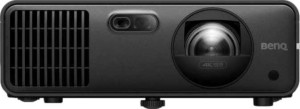
BenQ AK700ST
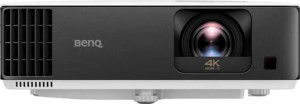
BenQ TK700ST

BenQ AK700ST BenQ TK700ST

Overview

Welcome to our detailed spec comparison between the BenQ AK700ST and the BenQ TK700ST, two short-throw 4K projectors that share the same resolution and HDR10 support but take notably different approaches in several key areas. In this head-to-head, we examine how they stack up across light source technology, brightness output, projection capabilities, and connectivity options to help you find the right fit for your home cinema or gaming setup.

Common Features

  • Both projectors have a height of 110 mm.
  • Both projectors come with a 3-year warranty period.
  • Both projectors output a 4K resolution.
  • Neither projector supports HDR10+.
  • Both projectors offer 10-bit color depth.
  • Neither projector supports Dolby Vision.
  • Both projectors support HDR10.
  • Both projectors have 2 HDMI ports.
  • Neither projector supports AirPlay.
  • Neither projector has Bluetooth.
  • Neither projector supports Wi-Fi.
  • Neither projector has Chromecast built-in.
  • Neither projector is DLNA-certified.
  • Neither projector has a DVI connector.
  • Neither projector supports Miracast.
  • Neither projector has stereo speakers.
  • Neither projector has vertical lens shift.
  • Neither projector has horizontal lens shift.
  • Both projectors include a remote control.
  • Neither projector has a built-in smart TV platform.
  • Both projectors have a built-in speaker with 1 x 10W audio output power.
  • Both projectors have a 3.5 mm audio jack socket.

Main Differences

  • Audible noise is 32 dB on BenQ AK700ST and 34 dB on BenQ TK700ST.
  • Audible noise in eco mode is 29 dB on BenQ AK700ST and 28 dB on BenQ TK700ST.
  • Operating power consumption is 192W on BenQ AK700ST and 305W on BenQ TK700ST.
  • Lamp life in eco mode is 20000 hours on BenQ AK700ST and 15000 hours on BenQ TK700ST.
  • Width is 300 mm on BenQ AK700ST and 310 mm on BenQ TK700ST.
  • Thickness is 230 mm on BenQ AK700ST and 240 mm on BenQ TK700ST.
  • Weight is 3400 g on BenQ AK700ST and 3100 g on BenQ TK700ST.
  • Volume is 7590 cm³ on BenQ AK700ST and 8184 cm³ on BenQ TK700ST.
  • A laser light source is present on BenQ AK700ST but not on BenQ TK700ST.
  • Brightness is 4000 lumens on BenQ AK700ST and 3000 lumens on BenQ TK700ST.
  • Motorized focus is available on BenQ AK700ST but not on BenQ TK700ST.
  • 3D with glasses is supported on BenQ TK700ST but not on BenQ AK700ST.
  • Maximum projection size is 200″ on BenQ AK700ST and 150″ on BenQ TK700ST.
  • Motorized zoom is available on BenQ AK700ST but not on BenQ TK700ST.
  • Manual focus is available on BenQ TK700ST but not on BenQ AK700ST.
  • Minimum throw distance is 2.2 m on BenQ AK700ST and 2.4 m on BenQ TK700ST.
  • HLG support is present on BenQ TK700ST but not on BenQ AK700ST.
  • USB ports number 3 on BenQ AK700ST and 1 on BenQ TK700ST.
  • A VGA connector is present on BenQ TK700ST but not on BenQ AK700ST.
  • Dolby Atmos support is present on BenQ TK700ST but not on BenQ AK700ST.
Specs Comparison
BenQ AK700ST

BenQ AK700ST

BenQ TK700ST

BenQ TK700ST

General info:
audible noise 32 dB 34 dB
has laser light source
audible noise (eco) 29 dB 28 dB
release date February 2025 January 2025
operating power consumption 192W 305W
lamp life (eco mode) 20000 h 15000 h
width 300 mm 310 mm
height 110 mm 110 mm
thickness 230 mm 240 mm
weight 3400 g 3100 g
volume 7590 cm³ 8184 cm³
warranty period 3 years 3 years

The most significant differentiator in this group is the light source technology. The AK700ST uses a laser light source, while the TK700ST relies on a traditional lamp. This single distinction has a cascade of real-world consequences: the AK700ST draws only 192W versus the TK700ST's 305W — a roughly 37% reduction in power consumption — and its rated lamp life in eco mode reaches 20,000 hours compared to 15,000 hours for the TK700ST. In practical terms, laser-based projectors also eliminate the need for costly bulb replacements and typically maintain more consistent brightness over their lifespan, making the AK700ST significantly cheaper to run over time.

On noise and physical footprint, the gap is narrower but still present. The AK700ST operates at 32 dB in standard mode versus the TK700ST's 34 dB, a modest but perceptible difference in quiet environments like bedrooms or small home theaters. In eco mode the situation nearly reverses — the TK700ST edges down to 28 dB versus 29 dB — though both are acceptably quiet. Physically, the AK700ST is slightly more compact at 7,590 cm³ versus 8,184 cm³, while the TK700ST is a touch lighter at 3,100 g compared to 3,400 g. These differences are minor enough to be negligible for fixed installations.

Overall, the AK700ST holds a clear advantage in this group. Its laser light source delivers meaningfully lower power draw, a longer operational lifespan, and lower running costs — benefits that compound significantly over years of use. Both projectors share the same 3-year warranty and identical height profile, so neither wins on those points. Unless budget is the primary constraint, the AK700ST's light source technology makes it the more future-proof and cost-efficient choice based purely on the general specs.

Projection quality:
ANSI lumens 4000 lumens 3000 lumens
output resolution 4K 4K
has motorized focus
displays 3D with glasses
maximum projection size 200" 150"
has motorized zoom
supports HDR10+
bit depth 10-bit 10-bit
has manual focus
minimum throw distance 2.2 m 2.4 m
supports Dolby Vision
supports HDR10
supports HLG

Brightness is where these two projectors diverge most meaningfully. The AK700ST delivers 4,000 ANSI lumens versus the TK700ST's 3,000 lumens — a 33% increase that translates directly to a larger usable image in ambient light conditions. This advantage is reinforced by the AK700ST's maximum projection size of 200″, compared to the TK700ST's cap of 150″. More lumens spread across a larger canvas means the AK700ST is genuinely suited for large dedicated home theater spaces or bright rooms, while the TK700ST is better constrained to controlled, darker environments at more modest screen sizes.

Operationally, the two take opposite approaches to setup convenience. The AK700ST features both motorized focus and motorized zoom, enabling precise, repeatable adjustments without physically touching the projector — a major practical advantage in fixed ceiling or shelf installations. The TK700ST, by contrast, relies on manual focus only with no zoom motor, requiring hands-on adjustment every time. On the other hand, the TK700ST supports 3D content with glasses and adds HLG to its HDR repertoire alongside HDR10, which can be useful for broadcast and streaming content encoded in that format. The AK700ST skips both of these capabilities.

Both projectors output native 4K resolution at 10-bit color depth and support HDR10, so the foundational image quality baseline is shared. However, the AK700ST's superior brightness, larger maximum image size, and motorized optics give it a clear overall edge in projection quality for most home cinema use cases. The TK700ST's 3D support and HLG compatibility are meaningful additions for a specific subset of users, but they do not offset the brightness and usability gap for the majority.

Connectivity:
HDMI ports 2 2
has AirPlay
Has Bluetooth
supports Wi-Fi
USB ports 3 1
has Chromecast built-in
has a VGA connector
is DLNA-certified
has a DVI connector
supports Miracast
RJ45 ports 0 0
Has S/PDIF Out port

Connectivity is a notably sparse category for both projectors, and the differences between them are few but practical. Neither unit offers any wireless capability — no Wi-Fi, Bluetooth, AirPlay, Chromecast, or Miracast — so both are strictly dependent on physical cable connections. For a 4K home theater projector, this means the source device must always be within cable reach, which is worth factoring into room planning.

Where the two diverge is in USB and legacy connectivity. The AK700ST provides 3 USB ports compared to just 1 on the TK700ST, offering meaningfully more flexibility for simultaneously connecting peripherals, storage devices, or service dongles without a hub. The TK700ST counters with a VGA connector, which the AK700ST lacks entirely. While VGA is an aging standard, it remains relevant for connecting older laptops, PCs, or presentation equipment — giving the TK700ST a niche but genuine advantage in office or mixed-use environments.

On balance, neither projector stands out as connectivity-rich, and the ″winner″ here depends entirely on use case. For home theater setups where USB versatility matters, the AK700ST has the edge. For users who need to connect legacy VGA sources, the TK700ST is the only option. Their shared 2 HDMI ports provide the same baseline for modern source connections, leaving connectivity as a tie for the majority of users.

Features:
has stereo speakers
has lens shift (vertical)
has lens shift (horizontal)
has a remote control
has built-in smart TV
has a built-in speaker
audio output power 1 x 10W 1 x 10W
has a socket for a 3.5 mm audio jack
has Dolby Atmos
has an external memory slot
has voice commands

Feature parity is remarkably high between these two projectors — both ship with a remote control, a single built-in speaker at 10W, and a 3.5mm audio jack for external audio output. Neither offers lens shift in any direction, stereo speakers, a smart TV platform, voice commands, or an external memory slot. For a pair of 4K projectors at this level, the absence of lens shift is a notable shared limitation, as it places the full burden of image alignment on physical placement and throw angle alone.

The one meaningful differentiator in this group is Dolby Atmos support, which the TK700ST carries and the AK700ST does not. In practice, Dolby Atmos on a projector primarily affects audio passthrough — it allows the projector to decode or relay an Atmos signal to a compatible sound system via its audio output. Given that both units rely on a single 10W mono speaker, Atmos has no impact on the projector's built-in audio experience itself, but it does become relevant for users routing audio to an external Atmos-capable receiver or soundbar.

For users building a full home theater audio chain, the TK700ST's Dolby Atmos compatibility gives it a tangible, if narrow, advantage in this group. Those relying solely on the projector's built-in speaker — or using a non-Atmos audio setup — will find the two models functionally identical here. The TK700ST takes the edge, but only in specific audio configurations.

Comparison Summary & Verdict

After reviewing all the specs, the BenQ AK700ST stands out as the stronger choice for users who prioritize long-term reliability and image scale, thanks to its laser light source, higher brightness of 4000 lumens, larger maximum projection size of 200″, motorized focus and zoom, and greater number of USB ports. The BenQ TK700ST, on the other hand, appeals to a different audience: those who value 3D projection with glasses, HLG and Dolby Atmos support, and a lower upfront power draw. It also weighs less and offers manual focus and a VGA connector for legacy device compatibility. Both share 4K output, HDR10 support, and a 3-year warranty, making either a solid foundation — but your ideal pick depends on whether you lean toward premium image flexibility or a more entertainment-focused, format-rich feature set.

BenQ AK700ST
Buy BenQ AK700ST if...

Buy the BenQ AK700ST if you want a laser-powered projector with higher brightness, a larger maximum projection size, and motorized focus and zoom for a more flexible, future-proof setup.

BenQ TK700ST
Buy BenQ TK700ST if...

Buy the BenQ TK700ST if you prioritize 3D projection support, Dolby Atmos audio, and HLG compatibility, and you need a VGA connector for connecting legacy devices.