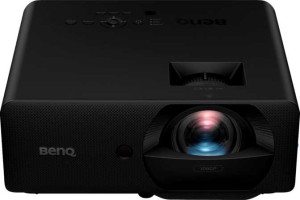
BenQ LH830ST
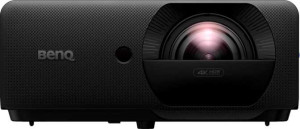
BenQ LK830ST

BenQ LH830ST BenQ LK830ST

Overview

Welcome to our in-depth specification comparison between the BenQ LH830ST and the BenQ LK830ST, two short-throw laser projectors that share the same core platform yet diverge in meaningful ways. Both models deliver 4000 ANSI lumens of brightness and support modern wireless standards, but key differences in output resolution, bit depth, and audio output power set them apart. Whether you are equipping a boardroom, a classroom, or a home cinema setup, understanding where these projectors align and where they differ is essential to making the right choice.

Common Features

  • Both projectors have a laser light source.
  • Lamp life is 200 h on both projectors.
  • Lamp life in eco mode is 0.5 h on both projectors.
  • Audible noise is 33 dB on both projectors.
  • Audible noise in eco mode is 29 dB on both projectors.
  • Operating power consumption is 320W on both projectors.
  • Standby power consumption is 0.5W on both projectors.
  • Weight is 3400 g on both projectors.
  • Both projectors deliver 4000 ANSI lumens.
  • Response time is 16.7 ms on both projectors.
  • Maximum projection size is 180″ on both projectors.
  • Minimum throw distance is 0.5 m on both projectors.
  • Motorized focus is not available on either projector.
  • Motorized zoom is not available on either projector.
  • Manual focus is available on both projectors.
  • HDR10+ support is not available on either projector.
  • Both projectors have 1 HDMI port.
  • Both projectors have 2 USB ports.
  • AirPlay is supported on both projectors.
  • Bluetooth is available on both projectors.
  • Wi-Fi is supported on both projectors.
  • Chromecast is built into both projectors.
  • Neither projector has a VGA connector.
  • Neither projector has a DVI connector.
  • Stereo speakers are not present on either projector.
  • A remote control is included with both projectors.
  • Built-in smart TV functionality is available on both projectors.
  • A built-in speaker is present on both projectors.
  • Dolby Atmos is not supported on either projector.

Main Differences

  • Width is 279.2 mm on BenQ LH830ST and 296 mm on BenQ LK830ST.
  • Height is 120.5 mm on BenQ LH830ST and 120 mm on BenQ LK830ST.
  • Thickness is 229.3 mm on BenQ LH830ST and 232 mm on BenQ LK830ST.
  • Volume is 7714.47748 cm³ on BenQ LH830ST and 8240.64 cm³ on BenQ LK830ST.
  • Output resolution is 1080p on BenQ LH830ST and 4K on BenQ LK830ST.
  • Bit depth is 10-bit on BenQ LH830ST and 30-bit on BenQ LK830ST.
  • Audio output power is 1 x 2W on BenQ LH830ST and 1 x 15W on BenQ LK830ST.
Specs Comparison
BenQ LH830ST

BenQ LH830ST

BenQ LK830ST

BenQ LK830ST

General info:
lamp life 200 h 200 h
audible noise 33 dB 33 dB
has laser light source
audible noise (eco) 29 dB 29 dB
release date August 2025 August 2025
operating power consumption 320W 320W
lamp life (eco mode) 0.5 h 0.5 h
width 279.2 mm 296 mm
height 120.5 mm 120 mm
thickness 229.3 mm 232 mm
weight 3400 g 3400 g
standby power consumption 0.5W 0.5W
volume 7714.47748 cm³ 8240.64 cm³

In terms of general characteristics, the BenQ LH830ST and BenQ LK830ST are remarkably similar siblings. Both projectors share a laser light source, identical 200-hour lamp life, the same 320W operating power consumption, and equal acoustic profiles of 33 dB standard and 29 dB in eco mode — meaning neither has an edge in running costs, longevity, or noise in day-to-day use.

The one tangible differentiator in this group is physical size. The LH830ST measures 279.2 × 120.5 × 229.3 mm, while the LK830ST is slightly larger at 296 × 120 × 232 mm, resulting in a meaningfully larger footprint volume — roughly 8,241 cm³ versus 7,714 cm³. Despite this size gap, both units weigh an identical 3,400 g, which means the LH830ST achieves a marginally better weight-to-volume ratio. In practical terms, the LH830ST will fit more easily into tight installation spaces or carry bags.

For this spec group, the LH830ST holds a modest advantage purely on the basis of its more compact chassis — all other general specs being equal. If space efficiency or portability is a priority in your installation, the LH830ST is the better choice; if physical dimensions are not a constraint, the two models are effectively tied here.

Projection quality:
ANSI lumens 4000 lumens 4000 lumens
output resolution 1080p 4K
response time 16.7 ms 16.7 ms
has motorized focus
maximum projection size 180" 180"
has motorized zoom
supports HDR10+
bit depth 10-bit 30-bit
has manual focus
minimum throw distance 0.5 m 0.5 m
refresh rate 60Hz 60Hz
supports Dolby Vision
supports HDR10
supports HLG

The most consequential difference in this group comes down to two tightly linked specs: output resolution and bit depth. The LH830ST outputs at 1080p with a 10-bit color depth, while the LK830ST steps up to 4K resolution and a substantial 30-bit color depth. At typical large-screen projection sizes — both models cap at 180″ — the jump from 1080p to 4K translates to noticeably sharper text, finer detail in images, and a significantly smoother color gradient rendering thanks to the expanded bit depth. For presentations with dense data visuals or cinematic content, that distinction is tangible.

Where the two models converge is equally worth noting. Both deliver 4000 ANSI lumens, share an identical 16.7 ms response time and 60Hz refresh rate, and support the same HDR formats — HDR10 and HLG — while neither supports HDR10+ or Dolby Vision. The short-throw geometry is also identical, with a 0.5 m minimum throw distance, making both suitable for space-constrained rooms. Focus adjustment is manual on both units, with no motorized zoom or focus on either.

The LK830ST holds a clear advantage in this group. Its 4K resolution and 30-bit color pipeline make it the stronger choice for any use case where image fidelity matters — whether that is detailed visual presentations, large-venue display, or video content. The LH830ST's 1080p output is perfectly capable for general-purpose projection, but if resolution and color depth are priorities, the LK830ST is the definitive pick.

Connectivity:
HDMI ports 1 1
has AirPlay
Has Bluetooth
supports Wi-Fi
USB ports 2 2
has Chromecast built-in
has a VGA connector
has a DVI connector
supports Miracast
RJ45 ports 0 0
Has S/PDIF Out port

Connectivity is the one area where choosing between the LH830ST and LK830ST requires no deliberation at all — the two projectors are completely identical across every specification in this group. Both carry a single HDMI port, two USB ports, and an S/PDIF optical audio output, with no VGA, DVI, or wired Ethernet (RJ45) on either unit.

On the wireless side, the picture is equally symmetrical. Both models support Wi-Fi, Bluetooth, AirPlay, Chromecast built-in, and Miracast — a comprehensive suite that covers virtually every mainstream screen-mirroring and streaming ecosystem. In practice, this means users can cast wirelessly from Apple, Android, and Windows devices without adapters or additional hardware, regardless of which model they choose.

This group is a complete tie. Neither projector holds any connectivity advantage over the other, and the decision between them should rest entirely on the differentiators identified in other spec groups — namely resolution and physical size.

Features:
has stereo speakers
has a remote control
has built-in smart TV
has a built-in speaker
audio output power 1 x 2W 1 x 15W
has Dolby Atmos

Across most feature specs, the LH830ST and LK830ST are once again in lockstep — both include a built-in smart TV platform, a remote control, and a mono built-in speaker, while neither offers stereo speakers or Dolby Atmos. The smart TV integration is worth highlighting as a genuine usability perk, allowing standalone content playback without any external source device.

The sole differentiator here is audio output power, and it is a significant one. The LH830ST's speaker is rated at a modest 1 × 2W, which is barely sufficient for a quiet room and will struggle in any environment with ambient noise. The LK830ST, by contrast, delivers 1 × 15W — more than seven times the power output. In practical terms, this means the LK830ST can fill a mid-sized room with audible, usable sound without an external speaker, whereas the LH830ST's 2W output is realistically only adequate as a temporary or fallback option.

The LK830ST holds a clear advantage in this group. While neither projector is designed to replace a dedicated audio system, the 15W speaker meaningfully expands the LK830ST's usefulness for standalone deployments — classrooms, meeting rooms, or casual viewing — where connecting external audio is not always practical.

Comparison Summary & Verdict

After reviewing every specification, it is clear that the BenQ LH830ST and BenQ LK830ST are closely matched siblings that diverge where it matters most for different audiences. Both share the same laser light source, 4000 ANSI lumens output, identical connectivity suite, and smart platform features, making either a capable short-throw solution. The decisive factors come down to image resolution and audio power: the LH830ST delivers 1080p at 10-bit colour depth with a modest 2W speaker, making it a cost-conscious pick for everyday presentations and classrooms. The LK830ST steps up to 4K resolution with 30-bit colour depth and a substantially louder 15W speaker, catering to users who demand cinematic image fidelity and room-filling sound. Choose based on whether pixel density and richer colour gradation justify the premium for your specific environment.

BenQ LH830ST
Buy BenQ LH830ST if...

Buy the BenQ LH830ST if 1080p resolution meets your needs and you want a slightly more compact projector at a lower price point without sacrificing the core laser platform.

BenQ LK830ST
Buy BenQ LK830ST if...

Buy the BenQ LK830ST if you require 4K resolution, richer 30-bit colour depth, and a more powerful 15W built-in speaker for a more immersive and detail-rich projection experience.