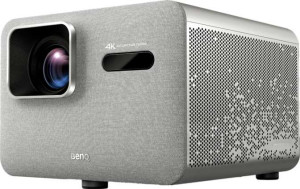
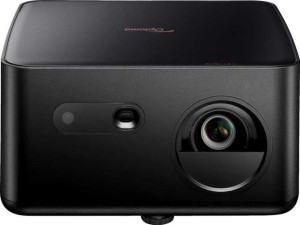
The most consequential difference in this group is the light source. The BenQ TK705i uses a laser, while the Optoma Photon Life PK32 relies on a conventional lamp. In practice, a laser light source delivers more consistent brightness and color accuracy over time, since it does not suffer from the gradual lumen depreciation that lamp-based projectors experience. Both units share the same rated 30,000-hour lamp life in eco mode, but that figure is more reliably achieved with a laser — making the TK705i the stronger long-term investment from a maintenance standpoint.
On the physical side, the two projectors sit in noticeably different size and weight classes. The Optoma is significantly more compact at 6,864 cm³ versus the TK705i's 9,775 cm³, and at 2,200 g it is nearly 40% lighter than the TK705i's 3,800 g. For users who need portability or have limited shelf space, the Optoma has a clear practical edge. The trade-off is power draw: the TK705i consumes 250W compared to the Optoma's 163W, which partly reflects the demands of its laser engine and likely higher brightness output — though brightness figures are not provided in this group's data.
The TK705i also includes a dedicated smartphone app, which the Optoma lacks entirely. This adds meaningful convenience for wireless control, content management, or smart-home integration without a remote. Overall, the BenQ TK705i holds a technical edge in light source quality and smart features, while the Optoma Photon Life PK32 wins on portability and energy efficiency — making the right choice dependent on whether the user prioritizes performance and longevity or compact, low-consumption use.