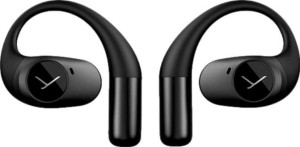
Both earbuds share an identical lower frequency bound of 20 Hz, the standard threshold of human hearing. Where they diverge is at the top end: the Amiron 200 reaches 20,000 Hz, covering the full conventional audible range, while the Sense Pro extends to 40,000 Hz — well into ultrasonic territory. In practice, humans cannot consciously hear above roughly 20 kHz, so the extended range does not directly translate to audible benefit for most listeners. However, a wider high-frequency driver capability can sometimes correlate with cleaner reproduction in the upper audible range, and it also positions the Sense Pro for compatibility with high-resolution audio formats that encode beyond 20 kHz.
On noise handling, the gap is meaningful. The Amiron 200 offers neither active nor passive noise reduction, which is consistent with its open-ear design — ambient sound bleed is essentially by design. The Sense Pro, by contrast, provides passive noise reduction through its in-ear seal, blocking environmental noise without any powered circuitry. For commuters or gym users in louder environments, this passive isolation can make a tangible difference in perceived audio clarity, even without ANC. Additionally, the Sense Pro supports spatial audio, enabling a wider, more three-dimensional soundstage for compatible content — a feature entirely absent on the Amiron 200.
The Sense Pro holds a clear edge in this category. Its combination of passive isolation, extended frequency response, and spatial audio support gives it a more versatile and technically capable sound profile based strictly on the available specs. The Amiron 200 is not without merit in sound contexts where openness is preferred, but it cannot match the Sense Pro's feature set here.