Blackview Oscal Marine 2
Ulefone Armor 34

Blackview Oscal Marine 2 Ulefone Armor 34

Overview

When choosing between the Blackview Oscal Marine 2 and the Ulefone Armor 34, buyers face a fascinating clash of philosophies in the rugged smartphone space. Both handsets share IP68 waterproofing and run Android 15, but they diverge sharply across display quality, raw performance, and battery endurance. Whether portability or sheer power matters most to you, this side-by-side breakdown covers every key specification to help you make the right call.

Common Features

  • Both phones are waterproof with an IP68 ingress protection rating.
  • Neither phone can be folded.
  • Both phones have a touchscreen display.
  • HDR10 support is not available on either product.
  • HDR10+ support is not available on either product.
  • Always-On Display is not available on either product.
  • Dolby Vision support is not available on either product.
  • Neither phone has a secondary screen.
  • Both phones run Android 15.
  • Both phones have integrated LTE.
  • Both phones support 64-bit processing.
  • Both phones use big.LITTLE CPU technology with 8 threads.
  • Neither phone has built-in optical image stabilization.
  • Both phones have a CMOS sensor.
  • Both phones support continuous autofocus when recording video.
  • Both phones have phase-detection autofocus for photos.
  • Both phones have a built-in HDR mode and manual exposure.
  • Wireless charging is not available on either product.
  • Both phones support fast charging and come with a charger in the box.
  • Neither phone has a removable battery.
  • Stereo speakers are not available on either product.
  • Neither phone supports aptX, LDAC, aptX HD, aptX Adaptive, aptX Lossless, or any lossless Bluetooth audio codec.
  • Both phones use a dual SIM setup with an external memory slot.
  • Both phones have USB Type-C, NFC, and a fingerprint scanner.
  • Emergency SOS via satellite is not available on either product.
  • Crash detection is not available on either product.
  • Both phones have a video light.
  • Neither phone has sapphire glass, a curved display, or an e-paper display.
  • Both phones have clipboard warnings and location privacy options.
  • Both phones allow blocking of app tracking.
  • Camera and microphone privacy options are available on both phones.

Main Differences

  • Weight is 395 g on Blackview Oscal Marine 2 and 673 g on Ulefone Armor 34.
  • Thickness is 18.3 mm on Blackview Oscal Marine 2 and 32.7 mm on Ulefone Armor 34.
  • Volume is 273.43 cm³ on Blackview Oscal Marine 2 and 513.41 cm³ on Ulefone Armor 34.
  • A rugged build is present on Ulefone Armor 34 but not on Blackview Oscal Marine 2.
  • Display type is LCD IPS on Blackview Oscal Marine 2 and OLED/AMOLED on Ulefone Armor 34.
  • Screen size is 6.56″ on Blackview Oscal Marine 2 and 6.95″ on Ulefone Armor 34.
  • Resolution is 720 x 1612 px on Blackview Oscal Marine 2 and 1080 x 2460 px on Ulefone Armor 34.
  • Pixel density is 269 ppi on Blackview Oscal Marine 2 and 387 ppi on Ulefone Armor 34.
  • Refresh rate is 90Hz on Blackview Oscal Marine 2 and 144Hz on Ulefone Armor 34.
  • Branded damage-resistant glass is present on Blackview Oscal Marine 2 but not on Ulefone Armor 34.
  • Chipset is Unisoc T615 on Blackview Oscal Marine 2 and MediaTek Dimensity 7300 on Ulefone Armor 34.
  • RAM is 8 GB on Blackview Oscal Marine 2 and 16 GB on Ulefone Armor 34.
  • Internal storage is 256 GB on Blackview Oscal Marine 2 and 512 GB on Ulefone Armor 34.
  • Semiconductor size is 12 nm on Blackview Oscal Marine 2 and 4 nm on Ulefone Armor 34.
  • Geekbench 6 multi-core score is 1461 on Blackview Oscal Marine 2 and 2932 on Ulefone Armor 34.
  • Geekbench 6 single-core score is 437 on Blackview Oscal Marine 2 and 1026 on Ulefone Armor 34.
  • RAM speed is 1866 MHz (DDR4) on Blackview Oscal Marine 2 and 6400 MHz (DDR5) on Ulefone Armor 34.
  • Main camera is a single 16 MP lens on Blackview Oscal Marine 2 and a triple-lens 64 + 50 + 50 MP system on Ulefone Armor 34.
  • Front camera is 8 MP on Blackview Oscal Marine 2 and 32 MP on Ulefone Armor 34.
  • Maximum video resolution is 1080p at 30 fps on Blackview Oscal Marine 2 and 4K at 30 fps on Ulefone Armor 34.
  • Slow-motion video recording is supported on Blackview Oscal Marine 2 but not on Ulefone Armor 34.
  • Battery capacity is 11000 mAh on Blackview Oscal Marine 2 and 25500 mAh on Ulefone Armor 34.
  • Charging speed is 18W on Blackview Oscal Marine 2 and 66W on Ulefone Armor 34.
  • A 3.5 mm audio jack is present on Ulefone Armor 34 but not on Blackview Oscal Marine 2.
  • A built-in FM radio is available on Ulefone Armor 34 but not on Blackview Oscal Marine 2.
  • 5G support is available on Ulefone Armor 34 but not on Blackview Oscal Marine 2.
  • Wi-Fi 6 (802.11ax) support is available on Ulefone Armor 34 but not on Blackview Oscal Marine 2.
  • Download speed is 300 Mbit/s on Blackview Oscal Marine 2 and 3270 Mbit/s on Ulefone Armor 34.
  • An infrared sensor is present on Ulefone Armor 34 but not on Blackview Oscal Marine 2.
  • A barometer is present on Ulefone Armor 34 but not on Blackview Oscal Marine 2.
  • A built-in projector is present on Ulefone Armor 34 but not on Blackview Oscal Marine 2.
Specs Comparison
Blackview Oscal Marine 2

Blackview Oscal Marine 2

Ulefone Armor 34

Ulefone Armor 34

Design:
water resistance Waterproof Waterproof
weight 395 g 673 g
thickness 18.3 mm 32.7 mm
width 83.1 mm 86.6 mm
height 179.8 mm 181.3 mm
volume 273.427254 cm³ 513.408966 cm³
Ingress Protection (IP) rating IP68 IP68
has a rugged build
can be folded

Both the Blackview Oscal Marine 2 and the Ulefone Armor 34 share an IP68 waterproof rating, placing them on equal footing when it comes to water resistance. In practical terms, this means both can handle submersion and are suited for wet or outdoor environments. However, this is where the similarities in design largely end.

The most striking difference is physical form. The Marine 2 weighs just 395 g and measures 18.3 mm thick, giving it a volume of roughly 273 cm³. The Armor 34, by contrast, tips the scales at a substantial 673 g — nearly 70% heavier — and is 32.7 mm thick, almost double the Marine 2's profile, resulting in a volume exceeding 513 cm³. In day-to-day use, the Armor 34's bulk will be noticeable in a pocket or during extended one-handed use, while the Marine 2 handles much closer to a conventional smartphone. Crucially, the Armor 34 explicitly carries a rugged build designation, which typically implies reinforced frames, shock-absorbing materials, and drop resistance — attributes the Marine 2 does not claim despite its waterproofing.

The choice here depends on the intended use case. If portability and a sleeker form factor are priorities, the Marine 2 has a clear edge. But if the device needs to withstand drops, impacts, and harsh physical environments beyond water exposure, the Armor 34's rugged construction gives it a meaningful advantage despite — and partly because of — its considerably larger and heavier chassis.
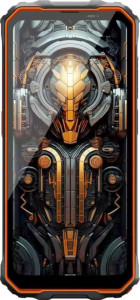
Display:
Display type LCD, IPS OLED/AMOLED
screen size 6.56" 6.95"
pixel density 269 ppi 387 ppi
resolution 720 x 1612 px 1080 x 2460 px
refresh rate 90Hz 144Hz
has branded damage-resistant glass
supports HDR10
supports HDR10+
Always-On Display
supports Dolby Vision
Has a secondary screen
has a touch screen

The display gap between these two devices is significant. The Armor 34 uses an OLED/AMOLED panel, which delivers true blacks, higher contrast, and more vivid colors compared to the Marine 2's LCD IPS screen. For outdoor or rugged use — where glare and visibility under sunlight matter — OLED panels generally have a meaningful advantage in perceived brightness and contrast.

The resolution and sharpness difference compounds this further. The Armor 34 resolves at 1080 x 2460 px with a pixel density of 387 ppi, producing a noticeably crisp image. The Marine 2, at 720 x 1612 px and 269 ppi, is functional but will appear softer, especially when reading small text or viewing detailed content. The refresh rate gap is equally wide: the Armor 34's 144Hz panel makes scrolling and animations appear considerably smoother than the Marine 2's 90Hz display, which, while an improvement over the standard 60Hz baseline, falls well short. One point in the Marine 2's favor is its branded damage-resistant glass, a protection layer the Armor 34 lacks — an ironic omission for a device marketed as rugged.

On display quality alone, the Armor 34 holds a clear advantage across panel technology, sharpness, and refresh rate. The Marine 2's damage-resistant glass is a practical differentiator but does not offset the substantial gap in visual performance.

Performance:
internal storage 256GB 512GB
RAM 8GB 16GB
Chipset (SoC) name Unisoc T615 MediaTek Dimensity 7300
GPU name Mali G57 Mali G615 MC2
CPU speed 2 x 1.8 & 6 x 1.6 GHz 4 x 2.5 & 4 x 2 GHz
Geekbench 6 result (multi) 1461 2932
Geekbench 6 result (single) 437 1026
GPU clock speed 850 MHz 1047 MHz
Has integrated LTE
RAM speed 1866 MHz 6400 MHz
semiconductor size 12 nm 4 nm
Supports 64-bit
Has integrated graphics
Uses big.LITTLE technology
CPU threads 8 threads 8 threads
maximum memory amount 12GB 16GB
DDR memory version 4 5

The chipset generation gap here is substantial. The Marine 2 runs on the Unisoc T615, a 12 nm chip with modest CPU cores topping out at 1.8 GHz, while the Armor 34 is powered by the MediaTek Dimensity 7300 built on a much more efficient 4 nm process. That three-generation leap in fabrication technology matters beyond raw speed — smaller nodes translate to better energy efficiency, meaning the Armor 34 can deliver more performance per milliwatt. The Geekbench 6 results make the performance delta concrete: the Armor 34 scores 1026 single-core and 2932 multi-core, versus the Marine 2's 437 and 1461 respectively — roughly 2x faster across the board in real-world computational tasks.

Memory tells a similar story. The Armor 34 pairs 16 GB of DDR5 RAM running at 6400 MHz against the Marine 2's 8 GB of DDR4 at 1866 MHz. In practice, this means the Armor 34 can keep significantly more apps active in the background without reloading, and data-intensive tasks like image processing or multitasking will feel notably more fluid. The Armor 34 also doubles the baseline storage with 512 GB versus 256 GB on the Marine 2. On the GPU side, the Armor 34's Mali G615 MC2 clocked at 1047 MHz outpaces the Marine 2's Mali G57 at 850 MHz, giving it an edge in graphics-heavy applications and gaming.

Across every measurable dimension of performance — CPU throughput, GPU capability, RAM capacity, memory bandwidth, and process efficiency — the Armor 34 has a decisive advantage. The Marine 2's specs are adequate for basic daily tasks, but users who demand responsive multitasking or plan to run demanding applications will find the Armor 34 in a different league entirely.

Cameras:
megapixels (main camera) 16 MP 64 & 50 & 50 MP
Has a dual-lens (or multi-lens) main camera
megapixels (front camera) 8MP 32MP
has built-in optical image stabilization
video recording (main camera) 1080 x 30 fps 2160 x 30 fps
Has a dual-tone LED flash
number of flash LEDs 1 2
has a BSI sensor
has a CMOS sensor
has continuous autofocus when recording movies
Has phase-detection autofocus for photos
supports slow-motion video recording
has a built-in HDR mode
has manual exposure
has a flash
optical zoom 0x 0x
has manual ISO
has a serial shot mode
has manual focus
has a front camera
Has laser autofocus
Shoots 360° panorama
has manual white balance
shoots raw
has touch autofocus
has manual shutter speed
can create panoramas in-camera
Has a front-facing LED flash
has a dual-lens (or multi-lens) front camera
supports HDR10 recording
supports Dolby Vision recording
has a front-facing camera under the display
Has a RGB LED flash
has 3D photo/video recording capabilities

Camera hardware is where the Armor 34 pulls well ahead. It features a triple rear camera system with sensors at 64 MP, 50 MP, and 50 MP, offering versatility across different shooting scenarios, while the Marine 2 relies on a single 16 MP rear shooter. More lenses mean more compositional options and the ability to capture different perspectives without digital cropping — a meaningful real-world difference for anyone who uses their phone as a primary camera. The front camera gap is equally wide: 32 MP on the Armor 34 versus 8 MP on the Marine 2, which will be noticeable in selfie sharpness and video call quality.

Video capability further separates the two. The Armor 34 records at 4K (2160p) at 30 fps, while the Marine 2 caps out at 1080p at 30 fps. For anyone documenting outdoor activities or fieldwork — a natural use case for rugged devices — that resolution difference is significant. Interestingly, the Marine 2 counters with slow-motion video recording, a feature the Armor 34 lacks according to the provided specs, which may appeal to users who need that specific capability. The Armor 34 also has two flash LEDs versus one on the Marine 2, offering slightly better flash coverage in low-light scenes.

Despite the Marine 2's slow-motion advantage, the overall camera edge belongs firmly to the Armor 34 — its multi-lens rear system, significantly higher resolution across front and rear, and 4K video recording represent a substantially more capable imaging package by the numbers.

Operating system:
Android version Android 15 Android 15
has clipboard warnings
has location privacy options
has camera/microphone privacy options
has Mail Privacy Protection
has theme customization
can block app tracking
blocks cross-site tracking
has on-device machine learning
has notification permissions
has media picker
Can play games while they download
has dark mode
has Wi-Fi password sharing
has battery health check
has an extra dim mode
has focus modes
has dynamic theming
can offload apps
Has customizable notifications
has Live Text
has full-page screenshots
supports split screen
gets direct OS updates
has PiP
Can be used as a PC
Has sharing intents
has a child lock
Supports widgets
Is free and open source
Has offline voice recognition
has voice commands
Tracks the current position of a mobile device
is a multi-user system
has Quick Start

This is a rare case of complete parity: the Blackview Oscal Marine 2 and the Ulefone Armor 34 are identical across every single operating system specification provided. Both ship with Android 15 and neither receives direct OS updates from Google, meaning future software support will depend entirely on each manufacturer's own update cadence.

The shared feature set is reasonably strong for an Android implementation. Both devices cover the privacy essentials — location controls, camera and microphone permissions, clipboard warnings, and app tracking blocks — alongside productivity staples like split-screen multitasking, Picture-in-Picture, widgets, and offline voice recognition. Notable absences on both include Wi-Fi password sharing, focus modes, and cross-site tracking protection, which are features found on more software-forward platforms.

With no differentiating data point anywhere in this category, the operating system comparison is a complete tie. A buyer's software experience will be functionally identical on either device, making this a non-factor in the purchasing decision.

Battery:
battery power 11000 mAh 25500 mAh
has wireless charging
Supports fast charging
charging speed 18W 66W
comes with a charger
has a removable battery
has a battery level indicator
has a rechargeable battery

Battery capacity is where the Armor 34 makes its most dramatic statement. Its 25,500 mAh cell is more than double the Marine 2's already-generous 11,000 mAh — and both figures are exceptional by smartphone standards, where 5,000 mAh is considered large. In practical terms, the Armor 34 is designed to function as a multi-day or even week-long device for users in the field, while the Marine 2 itself already offers runtime that would comfortably outlast most conventional smartphones by a wide margin.

Charging speed further separates the two. The Armor 34 supports 66W fast charging, which is critical given the sheer volume of energy its battery holds — a slow charger on a 25,500 mAh cell would make top-ups impractically long. The Marine 2's 18W charging is adequate for its capacity but significantly slower, meaning longer waits when the battery does run down. Both devices come bundled with a charger and neither supports wireless charging, so that trade-off is equal.

For battery life and replenishment speed combined, the Armor 34 has a commanding advantage. The Marine 2's 11,000 mAh is a strong offering in its own right, but the Armor 34's capacity is in a different category entirely — clearly positioning it as a device built for prolonged off-grid or heavy-use scenarios where access to power is limited.

Audio:
has a socket for a 3.5 mm audio jack
has stereo speakers
has aptX
has LDAC
has aptX HD
has aptX Adaptive
has aptX Lossless
Has a radio

Audio is a lean category for both devices, but the Armor 34 holds a modest yet practical edge. It includes a 3.5 mm headphone jack — absent on the Marine 2 — which matters considerably in rugged and outdoor contexts where wireless earbuds may be impractical, battery-dependent, or easy to lose. For workers or users in the field who rely on wired headsets or external speakers, this is a tangible convenience the Marine 2 simply cannot offer. The Armor 34 also includes a built-in radio, a feature that carries real utility in remote environments where cellular connectivity may be unreliable and emergency broadcasts may be relevant.

Neither device supports high-resolution Bluetooth audio codecs such as aptX, LDAC, or their variants, and neither offers stereo speakers. This means both are limited to standard Bluetooth audio quality for wireless listening, and neither will deliver a wide or immersive speaker experience from the device itself.

Given the shared limitations, the Armor 34 has the edge in this category purely on the strength of its headphone jack and radio — two features with disproportionate practical value for the rugged device use case, even if the overall audio spec sheet for both phones remains modest.

Connectivity & Features:
release date May 2025 August 2025
has 5G support
Wi-Fi version Wi-Fi 4 (802.11n), Wi-Fi 5 (802.11ac) Wi-Fi 4 (802.11n), Wi-Fi 5 (802.11ac), Wi-Fi 6 (802.11ax)
SIM cards 2 SIM 2 SIM
has an external memory slot
Has USB Type-C
has NFC
download speed 300 MBits/s 3270 MBits/s
upload speed 150 MBits/s 3270 MBits/s
Has a fingerprint scanner
has emergency SOS via satellite
has crash detection
is DLNA-certified
has a gyroscope
supports ANT+
Has a heart rate monitor
has GPS
has a compass
supports Wi-Fi
Has an infrared sensor
has an accelerometer
has a cellular module
Has a barometer
has an HDMI output
Uses 3D facial recognition
Has an iris scanner
Stylus included
supports Galileo
Has motion tracking
Has optical tracking
Has a built-in projector

Wireless connectivity is a meaningful point of separation. The Armor 34 supports 5G and adds Wi-Fi 6 (802.11ax) to the same Wi-Fi 4/5 baseline that the Marine 2 offers. The real-world impact of these upgrades is reflected starkly in the cellular data speeds: the Armor 34 lists both download and upload speeds of 3270 Mbits/s, compared to the Marine 2's 300 Mbits/s down and 150 Mbits/s up. For users who transfer large files, stream high-resolution content, or operate in data-intensive environments, the Armor 34's network ceiling is in a different category entirely.

Beyond raw connectivity, the Armor 34 brings several sensor and hardware additions that the Marine 2 lacks. A barometer is a genuinely useful tool for outdoor and field users — it enables altitude tracking and weather monitoring, capabilities well suited to a rugged device. An infrared sensor adds the ability to control compatible appliances. Most unusually, the Armor 34 includes a built-in projector, a rare feature that allows content to be displayed on flat surfaces without any external hardware — a distinctive differentiator for professional or group use scenarios.

Both devices share a solid common foundation: dual SIM, expandable storage, USB-C, NFC, fingerprint scanner, and GPS with Galileo support. But the additions on the Armor 34 side — 5G, Wi-Fi 6, dramatically faster data speeds, a barometer, and a built-in projector — give it a clear and wide connectivity and features advantage over the Marine 2.

Miscellaneous:
has a video light
Has sapphire glass display
Has a curved display
Has an e-paper display

The miscellaneous category offers no differentiating data between these two devices. Both include a video light, and neither features sapphire glass, a curved display, or an e-paper display — the four data points provided are identical across the board.

This is a complete tie, and with such a limited and uniform spec set, this category carries no weight in distinguishing one device from the other. Buyers should look to the other specification groups for meaningful points of comparison.

Comparison Summary & Verdict

After examining every specification, the two phones serve very different kinds of users. The Blackview Oscal Marine 2 is the lighter, slimmer choice at just 395 g and 18.3 mm thick, making it the more pocketable everyday companion for those who need basic waterproof protection without bulk. The Ulefone Armor 34, on the other hand, dominates on virtually every performance metric: its MediaTek Dimensity 7300 chipset, 16 GB of DDR5 RAM, a vivid 144Hz AMOLED display, and a colossal 25500 mAh battery with 66W fast charging make it a powerhouse built for extreme demands. Add a built-in projector, barometer, infrared sensor, and 5G connectivity, and the Armor 34 clearly targets users who need a feature-rich field device. Choose the Marine 2 for lightweight simplicity; choose the Armor 34 when only the best specs will do.

Blackview Oscal Marine 2
Buy Blackview Oscal Marine 2 if...

Buy the Blackview Oscal Marine 2 if you want a lightweight, slim waterproof phone for everyday use and slow-motion video recording matters to you.

Ulefone Armor 34
Buy Ulefone Armor 34 if...

Buy the Ulefone Armor 34 if you need maximum performance, a massive battery with fast charging, 5G connectivity, and feature extras like a built-in projector and infrared sensor.