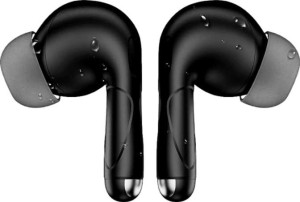
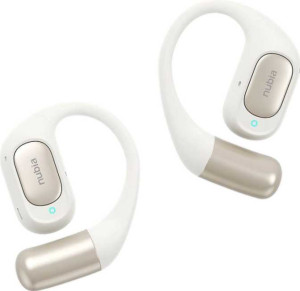
The most meaningful design difference between the boAt Airdopes Pulse and the Nubia LiveFlip lies in their fit style. The Airdopes Pulse uses an in-ear fit, which creates a physical seal in the ear canal — this typically improves passive noise isolation and helps the buds stay secure during movement. The LiveFlip, by contrast, adopts an open-ear fit, which sits outside the ear canal entirely. Open-ear designs allow ambient sound to pass through naturally, making them better suited for users who need situational awareness (e.g., commuters or outdoor runners), but they generally sacrifice bass response and isolation compared to in-ear alternatives.
To help compensate for the inherently looser fit of an open-ear design, the LiveFlip includes wingtips — a practical addition that anchors the earbuds more securely during physical activity. The Airdopes Pulse omits wingtips, which is a reasonable tradeoff given that its in-ear seal already provides a degree of natural retention. Both products share several design traits worth noting: both are fully wireless, both carry an IPX4 sweat-resistance rating (adequate for workouts but not submersion), and neither includes RGB lighting or a display — keeping their profiles clean and straightforward.
On design, the two products serve genuinely different user preferences rather than one being objectively superior. If passive isolation and a snug in-ear feel are priorities, the Airdopes Pulse has the edge. If ambient awareness and comfort over long wear sessions matter more, the LiveFlip's open-ear approach is the stronger choice — and its included wingtips help address the fit security that open-ear styles can lack.