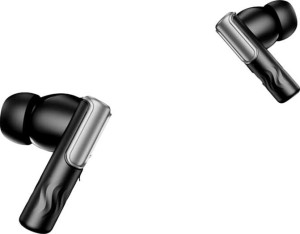
boAt Nirvana Ivy Pro
OnePlus Buds 4

boAt Nirvana Ivy Pro OnePlus Buds 4

Overview

When choosing between the boAt Nirvana Ivy Pro and the OnePlus Buds 4, you are comparing two capable true wireless earbuds that share a surprising amount of common ground — yet diverge sharply in areas that matter most to demanding listeners. From audio codec support and frequency range to battery strategy and durability ratings, this head-to-head breaks down exactly where each pair pulls ahead, helping you make the most informed decision for your ears and lifestyle.

Common Features

  • Both products use an in-ear fit.
  • Neither product has wires or cables.
  • Neither product is a neckband earbud design.
  • Neither product includes wingtips.
  • Neither product features RGB lighting.
  • Both products have stereo speakers.
  • Neither product has a UV light.
  • Neither product has a display.
  • Both products have active noise cancellation (ANC).
  • Both products have passive noise reduction.
  • Both products use an 11 mm driver unit size.
  • Neither product has a neodymium magnet.
  • Neither product supports wireless charging.
  • Neither product has a solar power battery.
  • Both products have a battery level indicator.
  • Both products have a rechargeable battery.
  • Both products support fast pairing.
  • Both products have USB Type-C connectivity.
  • Neither product supports Bluetooth LE Audio.
  • Neither product supports aptX, aptX Adaptive, aptX Low Latency, aptX HD, or aptX Lossless.
  • Both products have an ambient sound mode.
  • Both products have in/on-ear detection.
  • Both products support fast charging.
  • Both products support multipoint connection for up to 2 devices.
  • Neither product can read notifications.
  • Both products have a mute function.
  • Both products can be used as a headset.
  • Both products have a control panel placed on the device.
  • Both products have 6 microphones.
  • Both products have a noise-canceling microphone.

Main Differences

  • Ingress Protection rating is IPX4 on boAt Nirvana Ivy Pro and IP55 on OnePlus Buds 4.
  • Water resistance is sweat resistant on boAt Nirvana Ivy Pro and water resistant on OnePlus Buds 4.
  • Lowest frequency is 20 Hz on boAt Nirvana Ivy Pro and 15 Hz on OnePlus Buds 4.
  • Highest frequency is 20000 Hz on boAt Nirvana Ivy Pro and 40000 Hz on OnePlus Buds 4.
  • Spatial audio support is present on OnePlus Buds 4 but not available on boAt Nirvana Ivy Pro.
  • Dolby Atmos support is present on boAt Nirvana Ivy Pro but not available on OnePlus Buds 4.
  • Battery life is 8 hours on boAt Nirvana Ivy Pro and 11 hours on OnePlus Buds 4.
  • Battery life of the charging case is 42 hours on boAt Nirvana Ivy Pro and 34 hours on OnePlus Buds 4.
  • Charge time is 1.5 hours on boAt Nirvana Ivy Pro and approximately 1.33 hours on OnePlus Buds 4.
  • Bluetooth version is 5.3 on boAt Nirvana Ivy Pro and 5.4 on OnePlus Buds 4.
  • LDAC support is present on boAt Nirvana Ivy Pro but not available on OnePlus Buds 4.
  • LDHC support is present on OnePlus Buds 4 but not available on boAt Nirvana Ivy Pro.
  • Audio latency is 50 ms on boAt Nirvana Ivy Pro and 47 ms on OnePlus Buds 4.
  • Find device feature is present on OnePlus Buds 4 but not available on boAt Nirvana Ivy Pro.
Specs Comparison
boAt Nirvana Ivy Pro

boAt Nirvana Ivy Pro

OnePlus Buds 4

OnePlus Buds 4

Design:
Fit In-ear In-ear
Ingress Protection (IP) rating IPX4 IP55
water resistance Sweat resistant Water resistant
has no wires or cables
are neckband earbuds
wingtips included
has RGB lighting
has stereo speakers
has UV light
Has a display

Both the boAt Nirvana Ivy Pro and the OnePlus Buds 4 share the same fundamental design DNA: true wireless, in-ear form factors with stereo playback and no neckband or wingtips. For the vast majority of users, day-to-day handling and wearing experience will feel comparable on paper.

Where they meaningfully diverge is in ingress protection. The Nirvana Ivy Pro carries an IPX4 rating, which covers sweat and light splash resistance — adequate for workouts and casual outdoor use, but it offers no rated dust protection. The OnePlus Buds 4 steps up to a full IP55 certification, meaning it is rated against dust ingress and can withstand sustained low-pressure water jets from any direction. In practical terms, the Buds 4 can handle rain, poolside splashes, and dusty environments that the Ivy Pro is not formally rated for.

For design, the OnePlus Buds 4 holds a clear edge due to its superior IP55 protection. If you use earbuds strictly at the gym or in light-rain conditions, the IPX4 on the Ivy Pro may suffice — but for anyone who exercises outdoors regularly or lives in dusty or wetter climates, the Buds 4's more robust rating offers meaningfully better real-world durability.

Sound quality:
has active noise cancellation (ANC)
has passive noise reduction
driver unit size 11 mm 11 mm
lowest frequency 20 Hz 15 Hz
highest frequency 20000 Hz 40000 Hz
supports spatial audio
has Dolby Atmos
has Dirac Virtuo
has a neodymium magnet

On the noise isolation front, both earbuds are evenly matched — each offers active noise cancellation (ANC) alongside passive noise reduction through their in-ear fit. The driver size is also identical at 11 mm on both, so neither has a raw hardware advantage in transducer size.

The frequency response is where the two diverge significantly. The Nirvana Ivy Pro covers the standard audible range of 20 Hz–20,000 Hz, which is technically sufficient for human hearing. The OnePlus Buds 4, however, extends to 15 Hz–40,000 Hz — reaching deeper into sub-bass territory and well into the ultrasonic range. While frequencies above 20 kHz are inaudible to most people, the wider low-end extension to 15 Hz can translate to a more physical, felt sense of deep bass. On the imaging side, the Buds 4 also adds spatial audio support, enabling a more three-dimensional soundstage — a meaningful perk for movie-watching and immersive music listening. The Ivy Pro counters with Dolby Atmos, which provides its own form of surround-sound processing, though notably without the broader spatial audio framework the Buds 4 offers.

The OnePlus Buds 4 holds the edge in sound quality on spec data alone. Its wider frequency range and spatial audio support give it greater versatility across music, gaming, and media consumption, while the Ivy Pro's Dolby Atmos certification offers some compensation but does not close the gap entirely.

Power:
Battery life 8 hours 11 hours
Battery life of charging case 42 hours 34 hours
charge time 1.5 hours 1.333 hours
has wireless charging
Has a solar power battery
has a battery level indicator
has a rechargeable battery

The battery story here involves a genuine trade-off rather than a clean winner. The OnePlus Buds 4 lasts 11 hours on a single charge versus the Nirvana Ivy Pro's 8 hours — a 37.5% advantage that is highly meaningful for long-haul travelers, commuters, or anyone who regularly goes a full day without access to the case. Three extra hours per session is the difference between comfortably finishing a transatlantic flight and scrambling to charge mid-trip.

Flip the lens to total system endurance, though, and the picture shifts. The Ivy Pro's case delivers 42 hours of additional charge, bringing its combined total to roughly 50 hours. The Buds 4 case provides 34 hours, for a combined total of around 45 hours. So users who top up their earbuds regularly throughout the day — keeping them in the case between sessions — will actually get more cumulative listening time from the Ivy Pro before needing a wall outlet. Charge times are close, with the Buds 4 edging slightly faster at approximately 80 minutes versus 90 minutes for the Ivy Pro, though neither supports wireless charging.

Declaring a winner depends on usage pattern. For marathon single-session listening, the OnePlus Buds 4 holds the clear advantage. For users who prioritize going longer between case recharges — road trips, camping, or multi-day travel — the Ivy Pro's higher total system capacity makes it the more practical pick.

Connectivity:
has fast pairing
Has USB Type-C
Bluetooth version 5.3 5.4
has LDAC
has LDHC
has Bluetooth LE Audio
has aptX Adaptive
has aptX Low Latency
has aptX HD
has aptX
has aptX Lossless
audio latency 50 ms 47 ms
has aptX Voice
has Auracast
maximum Bluetooth range 10 m 10 m
supports Bluetooth pairing using NFC
Can be used wirelessly
has AAC

Much of the connectivity foundation is shared: both earbuds run over the same 10 m Bluetooth range, support fast pairing and AAC, charge via USB-C, and clock in at nearly identical audio latency — 50 ms for the Ivy Pro versus 47 ms for the Buds 4. That 3 ms gap is imperceptible in practice, so neither holds a real-world edge in lip-sync or gaming responsiveness.

The meaningful split is in high-resolution codec support. The Nirvana Ivy Pro carries LDAC, Sony's widely adopted hi-res wireless codec capable of transmitting up to 990 kbps — and critically, it is natively supported by the vast majority of Android devices. The OnePlus Buds 4 opts for LDHC (also known as HWA), a competing hi-res codec with comparable bitrate potential but a significantly narrower device ecosystem, with strongest support on Huawei and select other hardware. For most Android users outside that ecosystem, LDHC may simply go unused, reducing the Buds 4 to AAC in practice. The Buds 4 does run the marginally newer Bluetooth 5.4 versus the Ivy Pro's 5.3, though the practical difference between these two versions is minimal for consumers.

On connectivity, the Nirvana Ivy Pro has the broader real-world advantage for most users, purely because LDAC's ecosystem reach far exceeds LDHC's — making high-resolution wireless audio a realistic, not theoretical, benefit for the majority of Android listeners.

Features:
release date July 2025 July 2025
has ambient sound mode
has in/on-ear detection
has find device feature
Supports fast charging
multipoint count 2 2
can read notifications
has a mute function
can be used as a headset
control panel placed on a device
Has voice prompts
travel bag is included
Has an in-line control panel
Has a temperature sensor
Has a built-in camera remote control function

Across the features category, these two earbuds are remarkably well-matched. Both support ambient sound mode, in-ear detection, fast charging, 2-device multipoint connectivity, mute, voice prompts, on-device controls, and even include a travel bag. For the overwhelming majority of daily-use scenarios, owners of either pair will have access to the same core feature set.

The only spec that separates them is the find device feature on the OnePlus Buds 4, which the Nirvana Ivy Pro lacks. In practice, this allows users to trigger an audible alert from the earbuds or case when misplaced — a small but genuinely useful convenience for anyone prone to losing their gear around the house or in a bag.

Given how closely aligned everything else is, the OnePlus Buds 4 holds a narrow edge in this category solely due to its find device functionality. It is not a decisive advantage, but it is a real one — and in an otherwise tied feature set, it tips the scales.

Microphone:
number of microphones 6 6
has a noise-canceling microphone

The microphone category is a straight tie. Both the boAt Nirvana Ivy Pro and the OnePlus Buds 4 deploy 6 microphones and feature noise-canceling mic technology — a configuration typically used to enable beamforming, where multiple mics work in concert to isolate the user's voice while suppressing background noise like wind, traffic, or crowd chatter.

A 6-mic array is a generous count at this tier, and combined with noise-canceling processing, both earbuds are well-equipped for call clarity in demanding environments. Based strictly on the provided specs, there is no differentiator between them — neither holds an advantage here.

Comparison Summary & Verdict

Both the boAt Nirvana Ivy Pro and the OnePlus Buds 4 deliver solid ANC, six-microphone setups, fast charging, and dual-device multipoint — making either a competent everyday companion. However, the differences are meaningful. The OnePlus Buds 4 stands out with a wider frequency range of 15–40000 Hz, a stronger IP55 water resistance rating, spatial audio support, an 11-hour earbud battery, and the newer Bluetooth 5.4 with LDHC codec — making it the better pick for audiophiles and active users. The boAt Nirvana Ivy Pro, on the other hand, counters with a remarkable 42-hour total case battery life, Dolby Atmos support, and LDAC codec for high-resolution wireless audio — suiting users who travel frequently and value lossless-quality streaming over raw durability. Choose based on whether extended case endurance and hi-res codecs or superior build resilience and broader audio range matter more to you.

boAt Nirvana Ivy Pro
Buy boAt Nirvana Ivy Pro if...

Buy the boAt Nirvana Ivy Pro if you prioritize an extended total battery life of up to 42 hours from the case, Dolby Atmos support, and LDAC codec for high-resolution wireless audio.

OnePlus Buds 4
Buy OnePlus Buds 4 if...

Buy the OnePlus Buds 4 if you want stronger IP55 water resistance, a wider frequency range, spatial audio, and longer per-earbud playback of 11 hours.