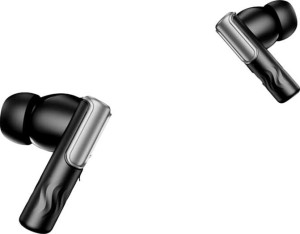
boAt Nirvana Ivy Pro
Realme Buds Air 7 Pro

boAt Nirvana Ivy Pro Realme Buds Air 7 Pro

Overview

When choosing between the boAt Nirvana Ivy Pro and the Realme Buds Air 7 Pro, the decision is far from straightforward. Both truly wireless earbuds share a strong foundation — 11 mm drivers, active noise cancellation, and a 6-microphone setup — yet they diverge in meaningful ways across audio codec support, water resistance, and high-frequency performance. Read on as we break down every specification to help you find the right fit.

Common Features

  • Both products use an in-ear fit.
  • Both products are completely wireless with no cables.
  • Neither product is a neckband-style earbud.
  • Neither product includes wingtips.
  • Neither product features RGB lighting.
  • Both products have stereo speakers.
  • Neither product includes a UV light.
  • Neither product has a display.
  • Both products support active noise cancellation (ANC).
  • Both products provide passive noise reduction.
  • Both products use an 11 mm driver unit.
  • Both products have a lowest frequency of 20 Hz.
  • Dirac Virtuo support is not available on either product.
  • Both products offer 8 hours of battery life.
  • Both products have a charge time of 1.5 hours.
  • Wireless charging is not available on either product.
  • Both products include a battery level indicator.
  • Both products have a rechargeable battery.
  • Both products support fast pairing.
  • Both products use USB Type-C.
  • Bluetooth LE Audio is not supported on either product.
  • aptX Adaptive, aptX Low Latency, aptX HD, aptX, and aptX Lossless are not supported on either product.
  • Both products feature an ambient sound mode.
  • Both products have in/on-ear detection.
  • Both products support fast charging.
  • Both products support multipoint connection with up to 2 devices.
  • Neither product can read notifications.
  • Both products include a mute function.
  • Both products can be used as a headset.
  • Both products have a control panel placed on the device.
  • Both products are equipped with 6 microphones.
  • Both products feature a noise-canceling microphone.

Main Differences

  • The ingress protection rating is IPX4 on boAt Nirvana Ivy Pro and IP55 on Realme Buds Air 7 Pro.
  • The boAt Nirvana Ivy Pro is sweat resistant, while the Realme Buds Air 7 Pro is water resistant.
  • The highest frequency reaches 20000 Hz on boAt Nirvana Ivy Pro and 40000 Hz on Realme Buds Air 7 Pro.
  • Spatial audio support is present on Realme Buds Air 7 Pro but not available on boAt Nirvana Ivy Pro.
  • Dolby Atmos support is present on boAt Nirvana Ivy Pro but not available on Realme Buds Air 7 Pro.
  • A neodymium magnet is featured in Realme Buds Air 7 Pro but not in boAt Nirvana Ivy Pro.
  • The charging case battery life is 42 hours on boAt Nirvana Ivy Pro and 40 hours on Realme Buds Air 7 Pro.
  • The Bluetooth version is 5.3 on boAt Nirvana Ivy Pro and 5.4 on Realme Buds Air 7 Pro.
  • LDAC support is present on boAt Nirvana Ivy Pro but not available on Realme Buds Air 7 Pro.
  • LDHC support is present on Realme Buds Air 7 Pro but not available on boAt Nirvana Ivy Pro.
  • Audio latency is 50 ms on boAt Nirvana Ivy Pro and 45 ms on Realme Buds Air 7 Pro.
  • A find device feature is present on Realme Buds Air 7 Pro but not available on boAt Nirvana Ivy Pro.
Specs Comparison
boAt Nirvana Ivy Pro

boAt Nirvana Ivy Pro

Realme Buds Air 7 Pro

Realme Buds Air 7 Pro

Design:
Fit In-ear In-ear
Ingress Protection (IP) rating IPX4 IP55
water resistance Sweat resistant Water resistant
has no wires or cables
are neckband earbuds
wingtips included
has RGB lighting
has stereo speakers
has UV light
Has a display

Both the boAt Nirvana Ivy Pro and the Realme Buds Air 7 Pro share the same fundamental design DNA: fully wireless, in-ear fit, no neckband, no wingtips, no RGB lighting, and stereo speakers on both sides. For most users, the day-to-day wearing experience will feel largely similar in terms of form factor.

The most meaningful differentiator in this group is water and dust resistance. The Nirvana Ivy Pro carries an IPX4 rating, which means it is protected against sweat and light splashes from any direction — sufficient for workouts and light rain. The Buds Air 7 Pro steps up to a full IP55 rating, adding a ″5″ dust-resistance component and a stronger water-resistance level that can handle sustained, low-pressure water jets. In practical terms, IP55 offers meaningfully broader protection for outdoor use, dusty environments, or heavier rain exposure.

On design, the Realme Buds Air 7 Pro holds a clear edge due to its superior IP55 rating. Both earbuds are otherwise equivalent across every other design attribute provided, so if environmental durability matters to you — especially dust protection — the Buds Air 7 Pro is the stronger choice here.

Sound quality:
has active noise cancellation (ANC)
has passive noise reduction
driver unit size 11 mm 11 mm
lowest frequency 20 Hz 20 Hz
highest frequency 20000 Hz 40000 Hz
supports spatial audio
has Dolby Atmos
has Dirac Virtuo
has a neodymium magnet

At the foundation, these two earbuds are well-matched: both feature 11 mm drivers, ANC, passive noise reduction, and an identical low-end frequency floor of 20 Hz. The shared driver size and bass reach mean neither has a structural advantage in raw loudness or low-frequency rumble.

Where they diverge is in the upper reaches of audio reproduction and the broader listening ecosystem. The Buds Air 7 Pro extends to 40,000 Hz — double the Nirvana Ivy Pro's 20,000 Hz ceiling — and pairs this with a neodymium magnet for stronger magnetic flux, which generally translates to tighter, more controlled driver movement. While human hearing tops out around 20 kHz, the wider frequency range can still contribute to a more natural, less compressed sound with hi-res audio formats. Adding spatial audio support further positions the Buds Air 7 Pro for immersive, three-dimensional soundscapes. The Nirvana Ivy Pro counters with Dolby Atmos, which provides a processed surround-sound effect, but this is a software-layer enhancement rather than a hardware-level capability.

The Realme Buds Air 7 Pro takes a clear edge in sound quality on the strength of its extended frequency response, neodymium magnet driver, and native spatial audio support — all hardware-rooted advantages that give it a more capable sonic foundation compared to the Ivy Pro's Dolby Atmos processing.

Power:
Battery life 8 hours 8 hours
Battery life of charging case 42 hours 40 hours
charge time 1.5 hours 1.5 hours
has wireless charging
Has a solar power battery
has a battery level indicator
has a rechargeable battery

Power performance is remarkably close between these two earbuds. Both deliver 8 hours of earbud playtime and refill in 1.5 hours, meaning neither has an edge in day-to-day endurance or how long you wait plugged into a wall. Both also include a battery level indicator and rechargeable cases, with no wireless charging on either side.

The only numerical gap is in case capacity: the Nirvana Ivy Pro's case extends total listening time to 42 hours, edging out the Buds Air 7 Pro's 40 hours. In practice, that 2-hour difference amounts to roughly one additional partial earbud charge — a marginal real-world distinction that would only matter on extended trips far from a power source.

This group is effectively a tie. The Nirvana Ivy Pro holds a technical lead in total combined battery life, but the gap is too slim to be a meaningful purchase factor. Users prioritizing power longevity will find both earbuds virtually identical in daily use.

Connectivity:
has fast pairing
Has USB Type-C
Bluetooth version 5.3 5.4
has LDAC
has LDHC
has Bluetooth LE Audio
has aptX Adaptive
has aptX Low Latency
has aptX HD
has aptX
has aptX Lossless
audio latency 50 ms 45 ms
has aptX Voice
has Auracast
maximum Bluetooth range 10 m 10 m
supports Bluetooth pairing using NFC
Can be used wirelessly
has AAC

Across the connectivity fundamentals — USB-C charging, fast pairing, AAC support, and a 10 m Bluetooth range — these two earbuds are identical. The Buds Air 7 Pro runs on the slightly newer Bluetooth 5.4 versus the Ivy Pro's 5.3, a generational step that brings incremental improvements in connection stability and energy efficiency, though the practical difference in everyday use is minimal.

The more consequential split is in high-resolution wireless codecs. The Nirvana Ivy Pro supports LDAC, Sony's widely adopted hi-res codec capable of streaming at up to 990 kbps — compatible with a broad range of Android devices. The Buds Air 7 Pro instead offers LDHC (also known as HWA), a competing hi-res codec primarily found on Huawei and Honor source devices. Both codecs target lossless-adjacent audio quality over Bluetooth, but LDAC enjoys significantly wider device ecosystem support. On latency, the Buds Air 7 Pro edges ahead at 45 ms versus 50 ms — a difference that is technically measurable but imperceptible in casual media consumption, with only competitive gaming potentially exposing the gap.

The connectivity edge leans toward the boAt Nirvana Ivy Pro for most users, purely on the strength of LDAC's broader compatibility. Unless a buyer is already within the Huawei/Honor ecosystem where LDHC is natively supported, LDAC is the more universally useful hi-res codec of the two.

Features:
release date July 2025 April 2025
has ambient sound mode
has in/on-ear detection
has find device feature
Supports fast charging
multipoint count 2 2
can read notifications
has a mute function
can be used as a headset
control panel placed on a device
Has voice prompts
travel bag is included
Has an in-line control panel
Has a temperature sensor
Has a built-in camera remote control function

Feature parity between these two earbuds is striking. Ambient sound mode, in-ear detection, fast charging, 2-device multipoint connectivity, mute, headset use, on-device controls, voice prompts, and an included travel bag — all present on both. For the vast majority of everyday use cases, buyers will find no functional gap between them.

The single differentiator in this group is the find device feature, available on the Buds Air 7 Pro but absent on the Nirvana Ivy Pro. This function allows users to locate misplaced earbuds through a companion app, typically by triggering an audible tone — a genuinely useful safety net for frequent travelers or anyone prone to misplacing small accessories.

The Realme Buds Air 7 Pro has a narrow but practical edge here solely due to its find device capability. It is not a transformative advantage, but in a group where everything else is matched spec-for-spec, it is the one feature that could matter on a bad day.

Microphone:
number of microphones 6 6
has a noise-canceling microphone

Microphone hardware is a complete dead heat. Both the Nirvana Ivy Pro and the Buds Air 7 Pro deploy 6 microphones with noise-canceling capability — a configuration that, in practice, enables multi-mic beamforming to isolate the speaker's voice while suppressing wind, crowd, and ambient noise during calls.

A 6-mic array is a strong spec at any price point, indicating that both products are engineered for serious call quality rather than treating the microphone as an afterthought. With noise-canceling mics on both sides, users can expect capable voice pickup in moderately noisy environments on either device.

This group is a complete tie — the provided specs are identical across every dimension. Neither earbud holds any advantage here based on the available data.

Comparison Summary & Verdict

After a thorough comparison, both earbuds prove to be well-rounded options, but each excels in a different area. The boAt Nirvana Ivy Pro stands out for its LDAC codec support and Dolby Atmos compatibility, making it a compelling pick for audiophiles who prioritize high-resolution wireless audio. It also edges ahead with a slightly longer 42-hour case battery life. The Realme Buds Air 7 Pro, on the other hand, offers a superior IP55 water resistance rating, a wider frequency range of 40000 Hz, spatial audio support, a neodymium magnet, lower audio latency of 45 ms, and a handy find-device feature — making it the stronger all-rounder for active users and those wanting more versatile everyday functionality.

boAt Nirvana Ivy Pro
Buy boAt Nirvana Ivy Pro if...

Buy the boAt Nirvana Ivy Pro if you value LDAC high-resolution audio streaming and Dolby Atmos support, and want a slightly longer total battery life from the charging case.

Realme Buds Air 7 Pro
Buy Realme Buds Air 7 Pro if...

Buy the Realme Buds Air 7 Pro if you need stronger IP55 water resistance, spatial audio, a wider frequency range, lower audio latency, and the convenience of a find-device feature.