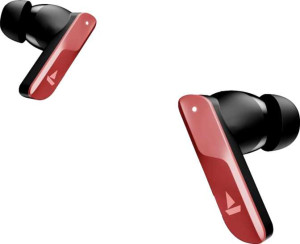
boAt Nirvana X
Realme Buds Air 7

boAt Nirvana X Realme Buds Air 7

Overview

Welcome to our detailed spec comparison between the boAt Nirvana X and the Realme Buds Air 7 — two compelling true wireless earbuds that share a strong foundation yet diverge in meaningful ways. Both offer Bluetooth 5.4, fast charging, and dual-device multipoint connectivity, but key battlegrounds like active noise cancellation, battery endurance, and audio codec support set them apart. Read on to see which one earns a place in your ears.

Common Features

  • Both products use an in-ear fit design.
  • Both products are water resistant.
  • Both products are completely wireless with no cables.
  • Neither product is a neckband earbud style.
  • Neither product includes wingtips.
  • Neither product features RGB lighting.
  • Both products have stereo speakers.
  • Neither product includes a UV light.
  • Both products offer passive noise reduction.
  • Both products have a lowest frequency of 20 Hz and a highest frequency of 20000 Hz.
  • Neither product supports Dolby Atmos.
  • Neither product supports Dirac Virtuo.
  • Neither product uses a neodymium magnet.
  • Both products take 1.5 hours to fully charge.
  • Neither product supports wireless charging.
  • Neither product has a solar power battery.
  • Both products have a battery level indicator.
  • Both products have a rechargeable battery.
  • Both products support fast pairing.
  • Both products use USB Type-C for charging.
  • Both products use Bluetooth version 5.4.
  • Neither product supports Bluetooth LE Audio.
  • Neither product supports aptX Adaptive, aptX Low Latency, aptX HD, or aptX.
  • Both products support in/on-ear detection.
  • Both products support fast charging.
  • Both products support multipoint connection with up to 2 devices simultaneously.
  • Neither product can read notifications.
  • Both products have a mute function.
  • Both products can be used as a headset.
  • Both products have a control panel placed on the device.
  • Both products have voice prompts.
  • Both products have a noise-canceling microphone.

Main Differences

  • The Ingress Protection rating is IPX5 on boAt Nirvana X and IP55 on Realme Buds Air 7.
  • Active noise cancellation is present on Realme Buds Air 7 but not available on boAt Nirvana X.
  • The driver unit size is 10 mm on boAt Nirvana X and 12.4 mm on Realme Buds Air 7.
  • Spatial audio support is available on Realme Buds Air 7 but not on boAt Nirvana X.
  • Battery life is 8 hours on boAt Nirvana X and 13 hours on Realme Buds Air 7.
  • Battery life of the charging case is 32 hours on boAt Nirvana X and 39 hours on Realme Buds Air 7.
  • LDAC support is present on boAt Nirvana X but not available on Realme Buds Air 7.
  • LDHC support is present on Realme Buds Air 7 but not available on boAt Nirvana X.
  • Audio latency is 60 ms on boAt Nirvana X and 45 ms on Realme Buds Air 7.
  • Ambient sound mode is available on Realme Buds Air 7 but not on boAt Nirvana X.
  • The number of microphones is 4 on boAt Nirvana X and 6 on Realme Buds Air 7.
Specs Comparison
boAt Nirvana X

boAt Nirvana X

Realme Buds Air 7

Realme Buds Air 7

Design:
Fit In-ear In-ear
Ingress Protection (IP) rating IPX5 IP55
water resistance Water resistant Water resistant
has no wires or cables
are neckband earbuds
wingtips included
has RGB lighting
has stereo speakers
has UV light
Has a display

Both the boAt Nirvana X and the Realme Buds Air 7 share the same fundamental design philosophy: fully wireless, in-ear earbuds with stereo output and no extras like neckbands, wingtips, RGB lighting, or displays. For the vast majority of users, this means the day-to-day wearing experience will feel broadly similar between the two.

The one meaningful differentiator within this group is the ingress protection rating. The Nirvana X carries an IPX5 rating, which confirms resistance to water jets but leaves dust protection unspecified. The Buds Air 7 steps up to a full IP55 certification, meaning it is tested against both water jets and low-pressure dust ingress. In practice, this matters if you use your earbuds in dusty environments — outdoors, during workouts in sandy or dry conditions, or in workshops — where fine particles could otherwise work their way into the housing over time.

The Realme Buds Air 7 has a clear edge in design durability strictly based on the provided specs. The jump from IPX5 to IP55 is not dramatic, but the added dust resistance is a genuine, real-world advantage that broadens the range of environments where you can confidently use the earbuds without concern.

Sound quality:
has active noise cancellation (ANC)
has passive noise reduction
driver unit size 10 mm 12.4 mm
lowest frequency 20 Hz 20 Hz
highest frequency 20000 Hz 20000 Hz
supports spatial audio
has Dolby Atmos
has Dirac Virtuo
has a neodymium magnet

On paper, both earbuds share the same frequency range of 20 Hz to 20000 Hz, which covers the full spectrum of human hearing. That said, frequency range alone is a poor predictor of actual sound quality — driver size and noise isolation capabilities tell a far more revealing story here.

The Realme Buds Air 7 uses a noticeably larger 12.4 mm driver compared to the Nirvana X's 10 mm driver. Larger drivers generally move more air, which can translate to fuller bass response and a more expansive soundstage, though the actual tuning matters too. More significantly, the Buds Air 7 adds Active Noise Cancellation (ANC) and spatial audio support — two features entirely absent from the Nirvana X. ANC actively counters ambient noise using microphones and inverse sound waves, making a real difference in noisy commutes or open-plan offices, far beyond what passive isolation alone can achieve. Spatial audio, meanwhile, creates a more three-dimensional listening experience for compatible content.

The Realme Buds Air 7 holds a decisive advantage in this category. The combination of a larger driver, ANC, and spatial audio support gives it a substantially richer feature set for sound quality, while the Nirvana X, limited to passive noise reduction and a smaller driver, is better suited for casual, low-demand listening scenarios.

Power:
Battery life 8 hours 13 hours
Battery life of charging case 32 hours 39 hours
charge time 1.5 hours 1.5 hours
has wireless charging
Has a solar power battery
has a battery level indicator
has a rechargeable battery

Battery life is where the gap between these two earbuds becomes particularly tangible. The Realme Buds Air 7 offers 13 hours of playback on a single charge versus 8 hours for the boAt Nirvana X — a difference of over 60%. For heavy users, that gap can mean the difference between getting through a full workday without reaching for the case, or having to top up mid-afternoon.

The total stamina picture follows the same pattern. Combined with their respective cases, the Buds Air 7 delivers 39 hours of total battery life compared to 32 hours for the Nirvana X. Both are respectable figures for multi-day use without hunting for a cable, but the Buds Air 7 extends trips or heavy-use stretches more comfortably. Importantly, both earbuds share an identical 1.5-hour charge time, so neither has an advantage in how quickly you can recover from a dead battery.

The Realme Buds Air 7 wins this category clearly, with meaningfully longer earbud and total case battery life. The Nirvana X is not a poor performer in absolute terms, but if longevity between charges is a priority — especially for commuters, travelers, or all-day listeners — the Buds Air 7 is the stronger choice based strictly on these specs.

Connectivity:
has fast pairing
Has USB Type-C
Bluetooth version 5.4 5.4
has LDAC
has LDHC
has Bluetooth LE Audio
has aptX Adaptive
has aptX Low Latency
has aptX HD
has aptX
has aptX Lossless
audio latency 60 ms 45 ms
has aptX Voice
has Auracast
maximum Bluetooth range 10 m 10 m
supports Bluetooth pairing using NFC
Can be used wirelessly
has AAC

At the foundation, these two earbuds are evenly matched: both run Bluetooth 5.4, support fast pairing, USB-C charging, AAC, and top out at the same 10-meter wireless range. The more revealing differences lie in their choice of high-resolution audio codec and their latency figures.

The boAt Nirvana X supports LDAC, Sony's widely adopted hi-res wireless codec capable of transmitting up to three times the data of standard Bluetooth audio. Its real-world advantage is broad compatibility — LDAC is natively supported by the vast majority of modern Android devices, making it a practical option for users who want higher-fidelity streaming. The Realme Buds Air 7 skips LDAC in favor of LDHC, a codec that also targets high-resolution audio but has significantly narrower device support in the market. Unless your source device explicitly supports LDHC, you will not benefit from it. On the flip side, the Buds Air 7 pulls ahead on latency, clocking in at 45 ms versus the Nirvana X's 60 ms — a gap that matters for gaming or video content where audio-visual sync is noticeable.

This category is a genuine trade-off rather than a clean win. The Nirvana X has the edge for hi-res audio usability thanks to LDAC's widespread device support, while the Buds Air 7 is preferable for low-latency use cases like mobile gaming. Your device ecosystem and primary use case should drive the decision here.

Features:
release date February 2025 February 2025
has ambient sound mode
has in/on-ear detection
Supports fast charging
multipoint count 2 2
can read notifications
has a mute function
can be used as a headset
control panel placed on a device
Has voice prompts
travel bag is included
Has an in-line control panel
Has a temperature sensor
Has a built-in camera remote control function

Across the features category, these two earbuds are remarkably well-matched. Both support fast charging, dual-device multipoint connectivity, in/on-ear detection, mute, voice prompts, on-device controls, headset use, and even include a travel bag. For most users, the day-to-day feature experience will feel essentially identical.

The single differentiator here is ambient sound mode, which the Realme Buds Air 7 supports and the boAt Nirvana X does not. This feature uses the earbuds' microphones to pipe in environmental audio, letting you stay aware of your surroundings — traffic, announcements, conversations — without removing the earbuds. It is a meaningful quality-of-life addition for commuters, pedestrians, or anyone who regularly needs situational awareness while listening.

The Realme Buds Air 7 edges ahead in this group solely on the strength of ambient sound mode. It is a single feature, but a genuinely useful one in everyday scenarios. If you rarely need to hear your environment while wearing earbuds, this distinction will not matter much — but for users who do, the Nirvana X's omission is a real limitation.

Microphone:
number of microphones 4 6
has a noise-canceling microphone

Both earbuds feature noise-canceling microphones, so call clarity in moderately noisy environments is a baseline expectation for either option. The meaningful distinction comes down to microphone count: the boAt Nirvana X uses 4 microphones, while the Realme Buds Air 7 deploys 6 microphones.

More microphones allow for more sophisticated beamforming and multi-directional noise isolation algorithms. With additional pickup points, the device can more accurately triangulate your voice, suppress wind noise and ambient sound from more angles, and deliver cleaner call audio to the listener on the other end. This advantage becomes especially apparent in challenging environments — busy streets, cafés, or windy outdoor settings — where fewer microphones struggle to separate voice from background noise effectively.

The Realme Buds Air 7 has the edge here. While both earbuds are equipped for voice calls, the Buds Air 7's higher microphone count gives it a structural advantage in call quality, particularly in noisy real-world conditions where that extra processing headroom is most valuable.

Comparison Summary & Verdict

After a thorough look at the specs, both earbuds prove to be well-rounded options, but they cater to different priorities. The Realme Buds Air 7 pulls ahead with active noise cancellation, ambient sound mode, spatial audio, a larger 12.4 mm driver, 6 microphones, longer 13-hour battery life (39 hours with case), lower 45 ms latency, and IP55 dust-and-water resistance — making it the stronger all-around performer for commuters and feature-seekers. The boAt Nirvana X, on the other hand, stands out with LDAC codec support for higher-quality wireless audio streaming, making it a smart pick for audiophiles who prioritize audio fidelity over noise cancellation. Both share identical charge times and USB Type-C connectivity, so day-to-day convenience is a tie. Choose the Realme Buds Air 7 for feature-rich everyday use, and the boAt Nirvana X if hi-res audio codec quality is your top concern.

boAt Nirvana X
Buy boAt Nirvana X if...

Buy the boAt Nirvana X if you value LDAC support for high-resolution wireless audio streaming and do not require active noise cancellation.

Realme Buds Air 7
Buy Realme Buds Air 7 if...

Buy the Realme Buds Air 7 if you want active noise cancellation, longer battery life, ambient sound mode, and a more complete feature set for daily use.