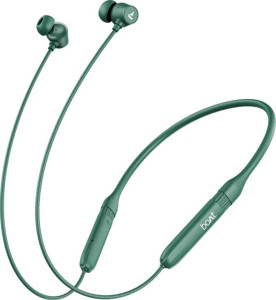
The most significant dividing line between these two headsets is noise isolation capability. The boAt Rockerz 301 ANC offers both passive noise reduction and active noise cancellation (ANC), which uses microphones and inverse sound waves to actively suppress ambient noise — particularly effective against low-frequency drone like traffic, AC hum, or airplane engines. The OnePlus Bullets Wireless Z3 relies solely on passive noise reduction, meaning only the physical seal of the ear tips blocks outside sound. For commuters or travelers, this is a meaningful real-world difference.
Driver size is nearly identical — 13 mm on the Rockerz 301 ANC versus 12.4 mm on the Bullets Z3 — and both share the same frequency range of 20 Hz to 20000 Hz, covering the full audible spectrum. Neither advantage is material enough to predict a clear sonic difference. Where the Bullets Z3 attempts to reclaim ground is with spatial audio support, which can create a more three-dimensional, immersive soundstage — particularly noticeable in gaming, film, or spatially mixed music content — something the Rockerz 301 ANC entirely lacks.
This group is ultimately a trade-off rather than a clean win. The Rockerz 301 ANC has the edge for users who prioritize noise cancellation and focused listening in loud environments, while the Bullets Wireless Z3 appeals more to users who value spatial audio immersion in content consumption. Given that ANC is generally considered the more universally impactful sound quality feature, the Rockerz 301 ANC holds a slight overall advantage in this category.