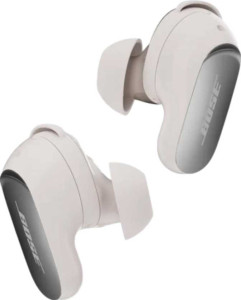
Both earbuds arrive with active noise cancellation and passive noise reduction as standard, so neither has an inherent structural advantage in blocking out the world. Where they diverge is in the underlying hardware driving the sound. The Realme Buds Air 7 Pro uses a larger 11 mm driver paired with a neodymium magnet — a combination that typically translates to stronger magnetic flux, tighter driver control, and more headroom for bass impact. The Bose QC Ultra Earbuds (2nd Gen) counters with a 9.3 mm driver and no stated neodymium magnet, which on paper suggests a more conservative transducer setup.
The frequency response gap is the most analytically significant difference here. Both start at 20 Hz at the low end — the floor of human hearing — but the Realme extends all the way to 40,000 Hz, double the Bose ceiling of 20,000 Hz. In practice, humans cannot perceive frequencies above roughly 20 kHz, so the extended range does not directly translate to audible detail for most listeners. However, it does signal compatibility with hi-res audio formats, and some audiophiles argue that headroom above 20 kHz can subtly affect the perception of air and spaciousness in the upper registers. The Realme also adds spatial audio support, which the Bose lacks entirely — a meaningful feature for immersive content like films and gaming.
On sound quality specs, the Realme Buds Air 7 Pro holds the broader technical advantage: larger driver, neodymium magnet, extended high-frequency range, and spatial audio all point in its favor. The Bose QC Ultra Earbuds (2nd Gen) does not offer a clear on-paper rebuttal in this specific group, making the Realme the stronger choice for users who prioritize hardware-driven audio credentials.