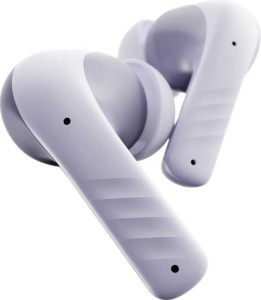
Boult Audio W35
Mivi Duopods Horizon

Boult Audio W35 Mivi Duopods Horizon

Overview

When choosing between the Boult Audio W35 and the Mivi Duopods Horizon, the decision is far from straightforward. Both are truly wireless in-ear earbuds sharing a strong foundation of passive noise reduction, fast charging, and USB Type-C connectivity, yet they diverge in meaningful ways across battery endurance, driver size, audio codec support, and connectivity specs. This detailed spec comparison will help you identify which of the two earbuds is the better match for your listening habits and lifestyle.

Common Features

  • Both products have an in-ear fit.
  • Neither product uses wires or cables.
  • Neither product is a neckband earbud style.
  • Wingtips are not included with either product.
  • RGB lighting is not present on either product.
  • Both products have stereo speakers.
  • UV light is not present on either product.
  • Neither product has a display.
  • Neither product has active noise cancellation (ANC).
  • Both products have passive noise reduction.
  • The lowest frequency on both products is 20 Hz.
  • The highest frequency on both products is 20000 Hz.
  • Spatial audio is not supported on either product.
  • Dolby Atmos is not available on either product.
  • Neither product has a neodymium magnet.
  • Both products have a charge time of 1.5 hours.
  • Neither product supports wireless charging.
  • Neither product has a solar power battery.
  • Both products have a battery level indicator.
  • Both products have a rechargeable battery.
  • Neither product supports fast pairing.
  • Both products have USB Type-C charging.
  • Neither product supports LDAC.
  • Neither product supports LDHC.
  • Neither product supports Bluetooth LE Audio.
  • Neither product supports aptX Adaptive.
  • Neither product supports aptX Low Latency.
  • Neither product supports aptX HD.
  • Neither product has an ambient sound mode.
  • Neither product has in-ear or on-ear detection.
  • Neither product has a find device feature.
  • Both products support fast charging.
  • Neither product can read notifications.
  • Both products have a mute function.
  • Both products can be used as a headset.
  • Both products have a control panel placed on the device.
  • Both products have a noise-canceling microphone.

Main Differences

  • Ingress Protection rating is IPX5 on Boult Audio W35 and IPX4 on Mivi Duopods Horizon.
  • Water resistance on Boult Audio W35 is rated for water resistance, while Mivi Duopods Horizon is rated for sweat resistance only.
  • Driver unit size is 10 mm on Boult Audio W35 and 13 mm on Mivi Duopods Horizon.
  • Battery life is 8 hours on Boult Audio W35 and 8.5 hours on Mivi Duopods Horizon.
  • Battery life of the charging case is 40 hours on Boult Audio W35 and 51.5 hours on Mivi Duopods Horizon.
  • Bluetooth version is 5.4 on Boult Audio W35 and 5.3 on Mivi Duopods Horizon.
  • Audio latency is 45 ms on Boult Audio W35 and 50 ms on Mivi Duopods Horizon.
  • AAC support is present on Boult Audio W35 but not available on Mivi Duopods Horizon.
Specs Comparison
Boult Audio W35

Boult Audio W35

Mivi Duopods Horizon

Mivi Duopods Horizon

Design:
Fit In-ear In-ear
Ingress Protection (IP) rating IPX5 IPX4
water resistance Water resistant Sweat resistant
has no wires or cables
are neckband earbuds
wingtips included
has RGB lighting
has stereo speakers
has UV light
Has a display

Both the Boult Audio W35 and the Mivi Duopods Horizon share the same fundamental design DNA: fully wireless, in-ear fit with stereo audio and no extras like neckbands, wingtips, RGB lighting, or displays. For most users, this means a clean, minimalist experience on both sides.

The clearest differentiator in this group is water resistance. The W35 carries an IPX5 rating, meaning it can withstand sustained, low-pressure water jets — making it genuinely usable in rain or during intense workouts where sweat and splashing are a concern. The Duopods Horizon, rated at IPX4, is protected only against splashing from any direction, which covers casual sweat but offers meaningfully less protection in wetter conditions. In practical terms, IPX5 gives you more confidence in unpredictable environments.

On design, the Boult Audio W35 holds a clear edge solely due to its superior IP rating. If you work out heavily, commute in the rain, or simply want more durability headroom, the W35′s IPX5 certification is a tangible, real-world advantage over the Horizon′s IPX4. Everything else in this category is evenly matched.

Sound quality:
has active noise cancellation (ANC)
has passive noise reduction
driver unit size 10 mm 13 mm
lowest frequency 20 Hz 20 Hz
highest frequency 20000 Hz 20000 Hz
supports spatial audio
has Dolby Atmos
has Dirac Virtuo
has a neodymium magnet

At the architecture level, both earbuds rely on passive noise reduction and cover the full standard human hearing range of 20 Hz to 20,000 Hz — so neither has an edge in frequency response or noise isolation technology. The absence of ANC, spatial audio, Dolby Atmos, or Dirac Virtuo on both sides means the listening experience is driven almost entirely by the physical driver hardware.

That makes the driver size the defining variable here. The Mivi Duopods Horizon uses a 13 mm driver compared to the W35′s 10 mm unit. A larger driver moves more air, which generally translates to greater low-end presence and a more expansive soundstage — particularly noticeable with bass-heavy genres. That said, driver size alone does not guarantee superior tuning; a well-engineered smaller driver can outperform a poorly tuned larger one. Since no additional tuning or audio processing specs are provided, the raw size advantage is the only signal available here.

Based strictly on the provided data, the Mivi Duopods Horizon holds a moderate edge in this category. The 3 mm difference in driver diameter is a meaningful physical advantage that favors richer bass and a fuller sound profile, making it the more compelling choice for users who prioritize audio output in this comparison.

Power:
Battery life 8 hours 8.5 hours
Battery life of charging case 40 hours 51.5 hours
charge time 1.5 hours 1.5 hours
has wireless charging
Has a solar power battery
has a battery level indicator
has a rechargeable battery

Charging infrastructure is identical across both earbuds: a 1.5-hour charge time, no wireless charging, and a battery level indicator on each — so neither product has a logistical edge in how you power them up. The real differentiation lies in how long you can go before reaching for the cable.

Per-earbud, the gap is slim — 8.5 hours for the Mivi Duopods Horizon versus 8 hours for the W35. Half an hour rarely changes a use-case outcome. Where the Horizon pulls meaningfully ahead is in total system endurance: its case delivers 51.5 hours of combined playback against the W35′s 40 hours. That 11.5-hour difference is substantial — it translates to roughly one to two extra full charge cycles, which matters significantly for travelers, frequent commuters, or anyone who goes days between access to a charger.

The Mivi Duopods Horizon wins this category clearly, and the case battery is the decisive factor. Both products offer comparable single-session stamina, but the Horizon′s much larger total reserve makes it the stronger choice for users who prioritize extended, multi-day autonomy without frequent recharging.

Connectivity:
has fast pairing
Has USB Type-C
Bluetooth version 5.4 5.3
has LDAC
has LDHC
has Bluetooth LE Audio
has aptX Adaptive
has aptX Low Latency
has aptX HD
has aptX
has aptX Lossless
audio latency 45 ms 50 ms
has aptX Voice
has Auracast
maximum Bluetooth range 10 m 10 m
supports Bluetooth pairing using NFC
Can be used wirelessly
has AAC

Strip away the shared specs — identical 10 m Bluetooth range, USB-C charging, no fast pairing, no NFC, and a mutual absence of premium codecs like LDAC or aptX — and three meaningful differences emerge between these two earbuds in the connectivity department.

The Boult Audio W35 runs on Bluetooth 5.4, one step ahead of the Horizon′s 5.3. In practice, 5.4 introduces refinements in connection efficiency and power consumption, though real-world impact at this version gap is modest for most users. More tangible is the W35′s support for AAC codec, which the Horizon lacks entirely. AAC matters particularly for iPhone users, as Apple devices prioritize it for higher-quality wireless audio transmission — without it, the Horizon falls back to the more compressed SBC baseline. Finally, the W35 edges ahead on audio latency at 45 ms versus the Horizon′s 50 ms; both are low enough for casual video watching, but the W35′s lower figure gives it a slight advantage for gaming or latency-sensitive content.

The Boult Audio W35 wins this category on the strength of two concrete advantages: AAC codec support and lower audio latency. The Bluetooth version difference is a marginal bonus. For Android users the gap narrows somewhat, but the latency and codec advantages still tip the scales in the W35′s favor.

Features:
release date April 2025 September 2025
has ambient sound mode
has in/on-ear detection
has find device feature
Supports fast charging
can read notifications
has a mute function
can be used as a headset
control panel placed on a device
Has voice prompts
travel bag is included
Has an in-line control panel
Has a temperature sensor
Has a built-in camera remote control function

Across every single feature data point provided, the Boult Audio W35 and the Mivi Duopods Horizon are in complete lockstep. Fast charging, on-device controls, voice prompts, mute function, headset capability, and even the inclusion of a travel bag — every attribute is identical on both sides.

The shared feature set is reasonably practical for the segment: fast charging is a genuine daily convenience, on-device controls keep phone interactions minimal, and a travel bag adds a small but appreciated portability bonus. Notably, neither earbud offers ambient sound mode, ear detection, or a find-my-device feature — absences that are common at this price tier but worth acknowledging for users who consider those features essential.

This category is an unambiguous tie. There is no differentiator here — not a single feature separates these two products based on the provided data. The decision between them will have to rest entirely on how the other spec groups compare.

Microphone:
has a noise-canceling microphone

With only one data point available in this category, the verdict is straightforward: both the Boult Audio W35 and the Mivi Duopods Horizon feature a noise-canceling microphone, placing them on equal footing for call quality and voice input.

A noise-canceling mic is a meaningful inclusion at this segment — it uses additional processing to filter out ambient sound during calls, resulting in cleaner voice pickup in noisy environments like commutes, offices, or busy streets. Its presence on both earbuds means neither user is at a disadvantage when taking calls or using voice assistants.

This category is a tie. The single available spec is identical across both products, and no further microphone data — such as microphone count or beamforming capability — is provided to draw any further distinction.

Comparison Summary & Verdict

After examining every spec, each earbud carves out a distinct identity. The Boult Audio W35 stands out with its superior IPX5 water resistance, making it more capable in wet conditions beyond just sweat, while its support for the AAC codec and newer Bluetooth 5.4 with a lower 45 ms audio latency make it the stronger pick for users who prioritize audio quality and seamless wireless performance. The Mivi Duopods Horizon, on the other hand, wins decisively on endurance, offering a larger 13 mm driver for potentially fuller sound, 8.5 hours of playback, and a remarkable 51.5-hour case battery life that outpaces the W35 by a wide margin. Choose the Boult Audio W35 if polished connectivity and codec support matter most to you; opt for the Mivi Duopods Horizon if long-haul battery life and driver size are your top priorities.

Boult Audio W35
Buy Boult Audio W35 if...

Buy the Boult Audio W35 if you want stronger IPX5 water resistance, AAC codec support, and the latest Bluetooth 5.4 with lower audio latency for a more refined wireless experience.

Mivi Duopods Horizon
Buy Mivi Duopods Horizon if...

Buy the Mivi Duopods Horizon if long battery life is your priority, as its 51.5-hour case endurance and larger 13 mm driver make it ideal for heavy daily use and extended listening sessions.