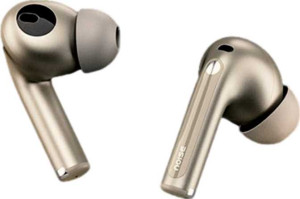
CMF Buds 2
Noise Master Buds

CMF Buds 2 Noise Master Buds

Overview

When comparing the CMF Buds 2 and the Noise Master Buds, two competitive true wireless earbuds emerge with a lot in common — yet with meaningful distinctions worth exploring. Both deliver active noise cancellation, spatial audio, and a six-microphone setup, but they diverge notably on battery life, connectivity features, and driver size. Whether you prioritize endurance on the go or codec flexibility, this head-to-head breakdown will help you find your ideal match.

Common Features

  • Both products use an in-ear fit design.
  • Both products are water resistant.
  • Both products are fully wireless with no wires or cables.
  • Neither product is a neckband-style earbud.
  • Neither product includes wingtips.
  • Neither product features RGB lighting.
  • Both products have stereo speakers.
  • Neither product includes a UV light.
  • Both products support active noise cancellation (ANC).
  • Both products offer passive noise reduction.
  • Both products have a lowest frequency of 20 Hz and a highest frequency of 20000 Hz.
  • Spatial audio is supported on both products.
  • Neither product supports Dolby Atmos or Dirac Virtuo.
  • Neither product uses a neodymium magnet.
  • Both products have a charge time of 1.5 hours.
  • Neither product supports wireless charging or solar power.
  • Both products include a battery level indicator and a rechargeable battery.
  • Both products use USB Type-C and do not support LDAC, Bluetooth LE Audio, aptX Adaptive, aptX Low Latency, aptX HD, aptX, or aptX Lossless.
  • Both products support ambient sound mode, in/on-ear detection, a find device feature, fast charging, multipoint connection for 2 devices, a mute function, and can be used as a headset.
  • Neither product can read notifications.
  • Both products feature 6 microphones and a noise-canceling microphone.

Main Differences

  • The Ingress Protection rating is IP55 on CMF Buds 2 and IPX5 on Noise Master Buds.
  • The weight is 9 g on CMF Buds 2 and 8.4 g on Noise Master Buds.
  • The driver unit size is 11 mm on CMF Buds 2 and 12.4 mm on Noise Master Buds.
  • Battery life is 13.5 hours on CMF Buds 2 and 6 hours on Noise Master Buds.
  • The battery life of the charging case is 41.5 hours on CMF Buds 2 and 38 hours on Noise Master Buds.
  • Fast pairing is available on CMF Buds 2 but not on Noise Master Buds.
  • The Bluetooth version is 5.4 on CMF Buds 2 and 5.3 on Noise Master Buds.
  • LDHC support is present on Noise Master Buds but not available on CMF Buds 2.
Specs Comparison
CMF Buds 2

CMF Buds 2

Noise Master Buds

Noise Master Buds

Design:
Fit In-ear In-ear
Ingress Protection (IP) rating IP55 IPX5
water resistance Water resistant Water resistant
weight 9 g 8.4 g
has no wires or cables
are neckband earbuds
wingtips included
has RGB lighting
has stereo speakers
has UV light
Has a display

Both the CMF Buds 2 and the Noise Master Buds share the same fundamental design philosophy: true wireless, in-ear earbuds with no neckband, no wingtips, and a clean aesthetic free of RGB lighting or displays. For users, this means a familiar, compact form factor focused purely on function.

The most meaningful differentiator in this group is the ingress protection rating. The CMF Buds 2 carries an IP55 certification, while the Noise Master Buds is rated IPX5. Both offer equivalent water resistance — capable of handling sweat and rain — but the ″5″ dust rating on the CMF Buds 2 means it is also certified to resist dust ingress, whereas the ″X″ in the Noise Master Buds′ rating simply means dust resistance was not tested or rated. In real-world use, this gives the CMF Buds 2 a practical edge for outdoor environments like dusty commutes or gym bags. On weight, the difference is marginal: 9 g versus 8.4 g, a gap unlikely to be perceptible during extended wear.

Overall, the CMF Buds 2 holds a clear design advantage here, strictly due to its broader IP55 protection. The weight difference is negligible, and all other design attributes are identical between the two.

Sound quality:
has active noise cancellation (ANC)
has passive noise reduction
driver unit size 11 mm 12.4 mm
lowest frequency 20 Hz 20 Hz
highest frequency 20000 Hz 20000 Hz
supports spatial audio
has Dolby Atmos
has Dirac Virtuo
has a neodymium magnet

At their core, these two earbuds are closely matched on sound fundamentals: both feature active and passive noise cancellation, an identical frequency range of 20 Hz to 20,000 Hz, and spatial audio support — meaning neither holds an edge on noise isolation capability or audio format compatibility based on the provided data.

Where they diverge is driver size. The Noise Master Buds uses a 12.4 mm driver versus the CMF Buds 2′s 11 mm unit. A larger driver generally moves more air, which can translate to stronger bass response and greater overall loudness headroom — though real-world sound signature depends heavily on tuning, which is outside the scope of these specs. Still, the size gap here is meaningful enough to suggest the Noise Master Buds may have a physical advantage in low-end weight and dynamic range potential.

On balance, the Noise Master Buds holds a narrow edge in this group, driven solely by its larger driver unit. All other sound quality indicators are identical, so listeners who prioritize bass presence or fuller soundstage potential may lean toward it, while those indifferent to driver size will find both options essentially equivalent on paper.

Power:
Battery life 13.5 hours 6 hours
Battery life of charging case 41.5 hours 38 hours
charge time 1.5 hours 1.5 hours
has wireless charging
Has a solar power battery
has a battery level indicator
has a rechargeable battery

Battery life is where these two earbuds diverge most sharply. The CMF Buds 2 delivers an impressive 13.5 hours of continuous playback per charge, more than double the Noise Master Buds′ 6 hours. In practical terms, the CMF Buds 2 can carry a user through a full workday and a commute without needing a top-up, while the Noise Master Buds would require a mid-day return to the case for heavy listeners.

The case endurance gap is narrower but still favors the CMF Buds 2: 41.5 hours total system life versus 38 hours for the Noise Master Buds. Given the Noise Master Buds′ shorter per-session battery, it will cycle in and out of the case more frequently, meaning its case reserves deplete faster in real use despite the smaller headline gap. Both share a 1.5-hour charge time and lack wireless charging, so refueling speed and convenience are equal.

The CMF Buds 2 holds a decisive advantage in this group. The per-earbud battery life difference is substantial enough to matter for commuters, travelers, and anyone who forgets to charge regularly — making it the stronger choice for users who prioritize going longer between charges.

Connectivity:
has fast pairing
Has USB Type-C
Bluetooth version 5.4 5.3
has LDAC
has LDHC
has Bluetooth LE Audio
has aptX Adaptive
has aptX Low Latency
has aptX HD
has aptX
has aptX Lossless
has aptX Voice
has Auracast
maximum Bluetooth range 10 m 10 m
supports Bluetooth pairing using NFC
Can be used wirelessly
has AAC

Shared across both earbuds are USB-C charging, a 10 m Bluetooth range, AAC codec support, and wireless-only operation — a solid baseline for everyday connectivity. The differences, however, are meaningful for specific user profiles.

The CMF Buds 2 runs on Bluetooth 5.4, a step ahead of the Noise Master Buds′ 5.3, offering marginally improved connection stability and efficiency in congested environments like busy offices or transit hubs. It also supports fast pairing, which streamlines the initial device setup experience — a convenience the Noise Master Buds lacks. In the other direction, the Noise Master Buds brings LDHC to the table, a high-resolution wireless audio codec capable of transmitting up to 24-bit/192kHz audio — though its real-world benefit depends entirely on whether the paired source device also supports LDHC, which remains uncommon outside certain Android ecosystems.

This group is a trade-off rather than a clean win. The CMF Buds 2 has the edge for most users, thanks to its newer Bluetooth version and fast pairing convenience. The Noise Master Buds′ LDHC support is a meaningful differentiator only for listeners with compatible source devices who actively prioritize high-res wireless audio — a narrower use case.

Features:
release date April 2025 February 2025
has ambient sound mode
has in/on-ear detection
has find device feature
Supports fast charging
multipoint count 2 2
can read notifications
has a mute function
can be used as a headset
control panel placed on a device
Has voice prompts
travel bag is included
Has an in-line control panel
Has a temperature sensor
Has a built-in camera remote control function

Across every feature in this group, the CMF Buds 2 and Noise Master Buds are a perfect match. Both offer ambient sound mode, in-ear detection, a find-device function, fast charging, and multipoint connection to two devices simultaneously — a combination that covers the full checklist for a capable, modern pair of wireless earbuds.

Practically speaking, the shared feature set is strong. Multipoint pairing means seamless switching between, say, a laptop and a phone without manual re-pairing. In-ear detection enables automatic play/pause when an earbud is removed, and ambient sound mode allows users to stay aware of their surroundings without pulling the buds out. The inclusion of a travel bag with both is a minor but welcome addition for portability.

This group is a complete tie. There is no differentiator — not a single feature advantage or gap — to separate these two products here. Buyers can treat this category as neutral and focus their decision on the differences surfaced in other spec groups.

Microphone:
number of microphones 6 6
has a noise-canceling microphone

The microphone specs here tell a straightforward story: the CMF Buds 2 and Noise Master Buds are identical, each equipped with 6 microphones and noise-canceling mic technology. A six-mic array is a generous configuration at this price tier, typically enabling beamforming — where the earbuds isolate the user′s voice while suppressing background noise from other directions — which benefits call clarity in noisy environments like streets or open offices.

With no differences to analyze, this group is a complete tie. Both earbuds offer the same calling and voice pickup capability on paper, and neither holds any advantage based on the provided data.

Comparison Summary & Verdict

After a thorough comparison, the CMF Buds 2 stands out as the better choice for users who demand long battery life, with 13.5 hours of playback and a total case capacity of 41.5 hours — more than double the Noise Master Buds' 6-hour earbud runtime. It also benefits from a newer Bluetooth 5.4 connection and fast pairing support. On the other hand, the Noise Master Buds appeals to audiophiles seeking a slightly larger 12.4 mm driver and LDHC codec support for higher-quality wireless audio transmission, all in a marginally lighter 8.4 g form factor. Both share an impressive feature set including ANC, ambient mode, spatial audio, and multipoint connectivity, making either a solid all-rounder — your choice ultimately comes down to endurance versus audio codec priority.

CMF Buds 2
Buy CMF Buds 2 if...

Buy the CMF Buds 2 if you need exceptional battery endurance, with 13.5 hours of playback and fast pairing support for a seamless, long-lasting wireless experience.

Noise Master Buds
Buy Noise Master Buds if...

Buy the Noise Master Buds if you prioritize a larger 12.4 mm driver and LDHC codec support for higher-quality wireless audio in a slightly lighter earbud.