CMF Watch 3 Pro
Garmin Vivoactive 6

CMF Watch 3 Pro Garmin Vivoactive 6

Overview

When choosing between the CMF Watch 3 Pro and the Garmin Vivoactive 6, you are weighing two very different philosophies in smartwatch design. Both share a solid foundation of health tracking, GPS, and cross-platform compatibility, yet they diverge sharply in areas like display size, connectivity, and activity features. Whether you care most about a larger screen and longer everyday battery life or a lighter build packed with smart integrations, this comparison breaks down every key specification to help you decide.

Common Features

  • Both watches feature an OLED/AMOLED display.
  • Both watches have a 5 ATM water resistance rating.
  • Always-On Display is available on both watches.
  • The watch band is replaceable on both watches.
  • Both watches have a touchscreen display.
  • Sapphire glass is not available on either watch.
  • Neither watch is designed for kids.
  • Blood oxygenation level monitoring is available on both watches.
  • A heart rate monitor is present on both watches.
  • GPS is available on both watches.
  • An accelerometer is present on both watches.
  • Neither watch has a temperature sensor.
  • A compass is available on both watches.
  • Neither watch has a barometer.
  • A gyroscope is present on both watches.
  • Both watches track sleep and provide sleep reports.
  • Both watches track distance, steps taken, and measure pace.
  • Automatic activity detection is available on both watches.
  • Exercise tagging is supported on both watches.
  • A stroke counter for swimming is available on both watches.
  • Neither watch has a cellular module.
  • Both watches are compatible with iOS and Android.
  • Galileo satellite system support is available on both watches.
  • Neither watch supports wireless charging.
  • Both watches have a rechargeable battery.
  • Neither watch has a solar power battery.
  • Neither watch has a removable battery.
  • HRV tracking is available on both watches.
  • VO2 max measurement is available on both watches.
  • Resting heart rate measurement is available on both watches.
  • Fast and slow heart rate notifications are available on both watches.
  • Phone locating functionality is available on both watches.
  • Call control is supported on both watches.
  • Notifications are supported on both watches.
  • Irregular heart rate warnings are not available on either watch.
  • Activity reports are provided by both watches.
  • Inactivity alerts are available on both watches.
  • Calorie burn tracking is available on both watches.
  • Goal setting is supported on both watches.
  • Achievements are available on both watches.
  • The companion app is free and ad-free on both watches.
  • An exercise diary is available on both watches.
  • Neither watch has an external memory slot.
  • Neither watch has a 3.5 mm audio jack socket.
  • A battery level indicator is present on both watches.

Main Differences

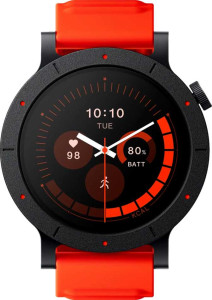
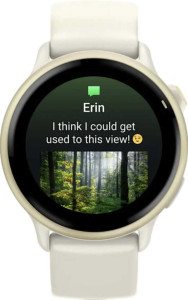
  • Screen size is 1.43″ on CMF Watch 3 Pro and 1.2″ on Garmin Vivoactive 6.
  • Water resistance is sweat resistant on CMF Watch 3 Pro and waterproof on Garmin Vivoactive 6.
  • Pixel density is 326 ppi on CMF Watch 3 Pro and 459 ppi on Garmin Vivoactive 6.
  • Resolution is 466 x 466 px on CMF Watch 3 Pro and 390 x 390 px on Garmin Vivoactive 6.
  • Branded damage-resistant glass is present on Garmin Vivoactive 6 but not available on CMF Watch 3 Pro.
  • Thickness is 14.4 mm on CMF Watch 3 Pro and 10.9 mm on Garmin Vivoactive 6.
  • Weight is 51.9 g on CMF Watch 3 Pro and 36 g on Garmin Vivoactive 6.
  • Height is 45 mm on CMF Watch 3 Pro and 42.2 mm on Garmin Vivoactive 6.
  • Width is 47 mm on CMF Watch 3 Pro and 42.2 mm on Garmin Vivoactive 6.
  • Route tracking is available on CMF Watch 3 Pro but not on Garmin Vivoactive 6.
  • Elevation tracking is available on CMF Watch 3 Pro but not on Garmin Vivoactive 6.
  • Multi-sport mode is available on CMF Watch 3 Pro but not on Garmin Vivoactive 6.
  • Golf-specific design features are present on Garmin Vivoactive 6 but not on CMF Watch 3 Pro.
  • Wi-Fi support is available on Garmin Vivoactive 6 but not on CMF Watch 3 Pro.
  • ANT+ support is available on Garmin Vivoactive 6 but not on CMF Watch 3 Pro.
  • NFC is present on Garmin Vivoactive 6 but not on CMF Watch 3 Pro.
  • Battery life is 13 days on CMF Watch 3 Pro and 11 days on Garmin Vivoactive 6.
  • Charge time is 1.65 hours on CMF Watch 3 Pro and 1.5 hours on Garmin Vivoactive 6.
  • Battery life with GPS on is 17.2 hours on CMF Watch 3 Pro and 21 hours on Garmin Vivoactive 6.
  • The ability to answer calls is available on CMF Watch 3 Pro but not on Garmin Vivoactive 6.
  • Fall detection is available on Garmin Vivoactive 6 but not on CMF Watch 3 Pro.
  • A smart alarm is available on Garmin Vivoactive 6 but not on CMF Watch 3 Pro.
  • Voice commands are supported on CMF Watch 3 Pro but not on Garmin Vivoactive 6.
  • A built-in camera remote control function is available on CMF Watch 3 Pro but not on Garmin Vivoactive 6.
  • Coaching features are available in the Garmin Vivoactive 6 app but not in the CMF Watch 3 Pro app.
  • Route support is available in the Garmin Vivoactive 6 app but not in the CMF Watch 3 Pro app.
  • Calendar sync is supported on Garmin Vivoactive 6 but not on CMF Watch 3 Pro.
  • Music playback is supported on Garmin Vivoactive 6 but not on CMF Watch 3 Pro.
  • App personalisation is available on Garmin Vivoactive 6 but not on CMF Watch 3 Pro.
  • Weight tracking is available on CMF Watch 3 Pro but not on Garmin Vivoactive 6.
  • Auto pause is available on Garmin Vivoactive 6 but not on CMF Watch 3 Pro.
  • Compatibility with external heart rate monitors is available on Garmin Vivoactive 6 but not on CMF Watch 3 Pro.
  • Windows compatibility is supported on Garmin Vivoactive 6 but not on CMF Watch 3 Pro.
  • Mac OS X compatibility is supported on Garmin Vivoactive 6 but not on CMF Watch 3 Pro.
Specs Comparison
CMF Watch 3 Pro

CMF Watch 3 Pro

Garmin Vivoactive 6

Garmin Vivoactive 6

Design:
screen size 1.43" 1.2"
Display type OLED/AMOLED OLED/AMOLED
water resistance Sweat resistant Waterproof
ATM rating 5 ATM 5 ATM
Always-On Display
pixel density 326 ppi 459 ppi
resolution 466 x 466 px 390 x 390 px
Watch band is replaceable
has branded damage-resistant glass
thickness 14.4 mm 10.9 mm
weight 51.9 g 36 g
height 45 mm 42.2 mm
width 47 mm 42.2 mm
Has a display
has a touch screen
Has sapphire glass display
volume 30.456 cm³ 19.411156 cm³
is designed for kids

Both watches share a solid foundation: OLED/AMOLED panels with always-on display support, touchscreens, and replaceable bands — so neither cuts corners on the basics. The clearest physical divide, however, is size and weight. The CMF Watch 3 Pro is noticeably larger (45 × 47 mm, 14.4 mm thick, 51.9 g) versus the Garmin Vivoactive 6's more compact and symmetrical (42.2 × 42.2 mm, 10.9 mm thick, 36 g). That nearly 16 g weight difference and 3.5 mm reduction in thickness translate directly to wrist comfort during extended wear — the Vivoactive 6 will feel significantly less obtrusive, especially during sleep tracking or long workouts.

Display characteristics tell an interesting story. The CMF offers a bigger 1.43″ screen with a 466 × 466 px resolution, while the Vivoactive 6 uses a smaller 1.2″ panel at 390 × 390 px. Despite having fewer raw pixels, the Garmin's smaller canvas yields a much sharper 459 ppi versus the CMF's 326 ppi — meaning text and icons render more crisply on the Vivoactive 6, even though the CMF gives you more screen real estate to work with. Which matters more depends on the user: larger display favors readability at a glance, higher pixel density favors visual quality up close.

On durability, the Garmin Vivoactive 6 holds a meaningful edge. It is rated fully waterproof and includes branded damage-resistant glass, while the CMF Watch 3 Pro is only sweat resistant and lacks any protective glass treatment — despite both sharing a 5 ATM rating label, the Garmin's explicit waterproof designation and glass protection make it the more ruggedized choice for active, outdoor, or aquatic use. Overall, the Vivoactive 6 wins the Design category for users who prioritize a sleek, lightweight form factor and durability; the CMF Watch 3 Pro is the pick for those who prefer a larger display footprint.

Sensors:
Monitors blood oxygenation levels
Has a heart rate monitor
has GPS
has an accelerometer
Has a temperature sensor
has a compass
Has a barometer
has a gyroscope
Has a cadence sensor
Monitors perspiration

Across every sensor listed, the CMF Watch 3 Pro and the Garmin Vivoactive 6 are in complete lockstep. Both carry the core health and navigation stack that active users expect: heart rate monitoring, SpO2 tracking, GPS, an accelerometer, a gyroscope, and a compass. This is a well-rounded set for everyday fitness tracking, route mapping, and movement analysis — covering the needs of most runners, cyclists, and general wellness users without gaps on either side.

Worth noting is what neither watch includes. The absence of a barometer means neither device can track elevation changes with pressure-based accuracy — a limitation for hikers or stair-climbers who rely on altitude data. Similarly, no temperature sensor or cadence sensor is present on either model, ruling out direct environmental readings and precise pedaling-rhythm metrics for cyclists without additional accessories.

Since the sensor suites are identical down to every listed specification, this category is a dead tie. Neither watch holds any sensor-based advantage over the other, and the decision between them should rest entirely on the differences surfaced in other spec groups.

Activity tracking:
Tracks your sleep
Tracks distance
Tracks steps taken
Measures pace
Provides sleep reports
Detects activities automatically
Has a route tracker
Tracks elevation
Has multi-sport mode
Has exercise tagging
Has a stroke counter for swimming
Tracks calorie intake
Designed for diving
Designed for golf

The shared baseline between these two is strong: both track sleep with reports, log steps and distance, measure pace, detect activities automatically, count swimming strokes, and track calorie intake. For a general fitness user, either watch covers the daily essentials without compromise. The real story, however, lies in where their feature sets diverge.

The CMF Watch 3 Pro pulls ahead for versatile, multi-discipline athletes. It supports multi-sport mode, allowing seamless transitions between activities in a single session — critical for triathletes or those who mix workouts regularly. It also adds a route tracker and elevation tracking, giving outdoor runners and hikers a richer picture of their sessions with path mapping and altitude data. The Garmin Vivoactive 6 lacks all three of these features, which is a notable gap given Garmin's reputation in the sports-watch space. On the flip side, the Vivoactive 6 is specifically designed for golf — a niche but meaningful advantage for players who want on-course metric support that the CMF does not offer.

On balance, the CMF Watch 3 Pro holds a clear edge in this category for most active users. Its combination of multi-sport mode, route tracking, and elevation data gives it a broader athletic utility. The Vivoactive 6's golf focus narrows its advantage to a specific audience, making the CMF the stronger all-around choice for activity tracking.

Connectivity:
has a cellular module
Is compatible with iOS
Is compatible with Android
supports Wi-Fi
supports ANT+
has NFC
supports Galileo

Starting with common ground: both watches are compatible with iOS and Android, support the Galileo satellite system for improved GPS accuracy, and neither includes a cellular module — so both depend on a paired phone for notifications and data sync. That shared foundation aside, the connectivity gap between them is significant.

The Garmin Vivoactive 6 brings three features the CMF Watch 3 Pro entirely lacks. Wi-Fi support means the Vivoactive 6 can sync data, download updates, and potentially push workouts to the cloud without needing a phone nearby — a meaningful convenience for users who sync infrequently or have large activity logs. ANT+ compatibility opens up a broad ecosystem of third-party fitness accessories — chest-strap heart rate monitors, cycling power meters, and smart scales — that communicate directly with the watch, something the CMF cannot do. And NFC enables contactless payments, letting users leave their wallet behind during runs or gym sessions.

The Garmin Vivoactive 6 wins this category decisively. Each of its three additional connectivity features — Wi-Fi, ANT+, and NFC — addresses a distinct and practical real-world use case. The CMF Watch 3 Pro's connectivity is functional but lean, better suited to users who stay within a basic smartphone-paired ecosystem and have no need for accessory expansion or tap-to-pay convenience.

Battery:
battery life 13 days 11 days
charge time 1.65 hours 1.5 hours
battery life with GPS on 17.2 hours 21 hours
has wireless charging
has a rechargeable battery
Has a solar power battery
has a removable battery

Battery life splits cleanly into two distinct use cases here, and each watch leads in a different one. For everyday wear without active GPS sessions, the CMF Watch 3 Pro edges ahead with a rated 13 days of battery life versus the Garmin Vivoactive 6's 11 days. That two-day difference is meaningful for users who dislike frequent charging — it can translate to one fewer charging cycle per week depending on usage habits.

Flip to GPS-active mode, however, and the standings reverse. The Vivoactive 6 sustains 21 hours of GPS-on battery life compared to the CMF's 17.2 hours — a nearly 4-hour gap that matters considerably for ultramarathon runners, long-distance cyclists, or hikers on multi-day routes where a single session can last well beyond a half day. Charge time is nearly identical at 1.5 hours versus 1.65 hours, so neither watch holds a meaningful advantage in how quickly it recovers. Both share the same charging architecture: wired only, with no wireless charging or solar option.

This category is a split decision that hinges on how you use your watch. Casual users and daily wearers who rarely engage GPS for extended periods will benefit from the CMF Watch 3 Pro's longer standby endurance. Serious endurance athletes who regularly log multi-hour GPS sessions will find the Garmin Vivoactive 6's staying power under active tracking the more critical advantage. Neither product dominates outright — the right pick depends entirely on your primary use pattern.

Features:
release date July 2025 April 2025
has HRV tracking
measures VO2 max
measures resting heart rate
has fast/slow heart rate notifications
Can be used to answer calls
Locates your phone
Has call control
Has notifications
has irregular heart rate warnings
Has ECG technology
Has silent alarm
Has vibrating alerts
has fall detection
Has a stopwatch
Has smart alarm
has voice commands
Has a built-in camera remote control function
Acquires GPS faster
warranty period 1 years 1 years
has a front camera

The health monitoring core is identical: both watches offer HRV tracking, VO2 max estimation, resting heart rate measurement, and fast/slow heart rate notifications. Neither includes ECG technology or irregular heart rate warnings, so users with clinical-grade cardiac monitoring needs will find both equally limited on that front. Where things diverge is in the practical day-to-day and safety features layered on top of that shared foundation.

The CMF Watch 3 Pro distinguishes itself with smartphone-oriented convenience. It can answer calls directly from the wrist — a feature the Vivoactive 6 lacks despite supporting call control — and adds voice commands and a camera remote control, making it a more interactive companion for users who want their watch to function as an extension of their phone. The Garmin Vivoactive 6 counters with features oriented toward safety and smarter daily routines: fall detection automatically triggers an alert if the wearer takes a hard tumble — genuinely valuable for solo athletes and older users — and a smart alarm wakes users at an optimal point in their sleep cycle, a quality-of-life feature the CMF omits entirely.

Neither watch dominates this category cleanly — they trade advantages based on user priorities. The CMF Watch 3 Pro wins for users who want richer phone integration and hands-free convenience. The Garmin Vivoactive 6 is the stronger pick for those who prioritize personal safety and wellness-oriented intelligence. Both carry equal warranty coverage at 1 year, so that factor offers no tiebreaker.

App & Software:
Provides activity reports
Has inactivity alerts
Counts how many calories you've burned
Has goal setting
Has achievements
Free app
Has exercise diary
Ad-free
Has coaching
Has temperature tracking
Has period notifications
Supports routes
Syncs with existing calendars
Has music playback
Displays fertile window notifications
Doesn’t require account
Predicts ovulation
Predicts start date
Can be personalised
Has barcode scanner on app
Tracks water intake
Has weight tracking

The two companion apps share a solid common core — activity reports, goal setting, exercise diary, inactivity alerts, calorie burn tracking, and a full suite of women's health features including period notifications, fertile window display, and ovulation prediction. Both apps are free and ad-free, so neither watch saddles users with paywalls or intrusive monetization. That said, the Garmin Vivoactive 6's app pulls meaningfully ahead in several areas that matter for engaged, data-driven users.

The Garmin Vivoactive 6 app adds coaching, route support, calendar sync, music playback, and app personalization — none of which are present in the CMF's companion app. Coaching delivers structured, adaptive workout guidance directly through the app, which is a substantial value-add for users looking to follow training plans rather than just log raw activity. Route support complements the hardware-level route tracking noted in the activity specs, creating an end-to-end navigation experience. Calendar sync and music playback further deepen the watch's integration into a user's daily digital life. Personalization means the app experience can be tailored to individual preferences rather than presenting a one-size-fits-all interface.

The CMF Watch 3 Pro app does include weight tracking, which the Garmin app omits — a useful tool for users monitoring body composition alongside fitness. However, that single advantage does not offset the breadth of what the Garmin brings. The Garmin Vivoactive 6 wins this category clearly, offering a richer, more versatile software ecosystem that adds real utility beyond what the hardware alone provides.
Miscellaneous:
has a battery level indicator
Has auto pause
Compatible with external heart rate monitors
Is compatible with Windows
has an external memory slot
Is compatible with Mac OS X
has a socket for a 3.5 mm audio jack

This miscellaneous group is lean on specs, but a few of the differences carry genuine practical weight. Both watches display a battery level indicator, and neither offers an external memory slot or a 3.5mm audio jack — so those limitations are shared equally. The meaningful gaps all fall in the Garmin Vivoactive 6's favor.

Auto pause is a small but impactful feature for runners and cyclists: it automatically stops recording when you slow to a halt — at a traffic light or rest stop — and resumes when you move again, keeping workout data clean without manual intervention. The CMF Watch 3 Pro lacks this entirely. More significantly, the Vivoactive 6 is compatible with external heart rate monitors, allowing users to pair a chest strap for more accurate cardiac data during intense efforts where wrist-based optical sensors can struggle. It also supports both Windows and Mac OS X for desktop connectivity, while the CMF is compatible with neither — a consideration for users who prefer managing their fitness data from a computer rather than solely through a mobile app.

The Garmin Vivoactive 6 takes this category without contest. Each of its three exclusive features — auto pause, external heart rate monitor compatibility, and desktop OS support — adds tangible utility for active users, while the CMF Watch 3 Pro offers nothing in this group that the Garmin does not also include.

Comparison Summary & Verdict

After examining every spec, the right choice comes down to your lifestyle and priorities. The CMF Watch 3 Pro stands out with its larger 1.43″ AMOLED screen, longer everyday battery life of 13 days, route tracking, multi-sport mode, elevation tracking, and the ability to answer calls directly from your wrist — making it a compelling pick for users who want a feature-rich, affordable daily driver. The Garmin Vivoactive 6, on the other hand, wins on build quality with its slimmer 10.9 mm profile and lighter 36 g frame, and pulls ahead with Wi-Fi, NFC, ANT+ support, longer GPS battery life of 21 hours, fall detection, music playback, coaching, and a far richer app ecosystem. It is the stronger choice for serious fitness enthusiasts and golfers who want deep platform integration and a polished, compact wearable.

CMF Watch 3 Pro
Buy CMF Watch 3 Pro if...

Buy the CMF Watch 3 Pro if you want a larger display, longer everyday battery life, multi-sport and elevation tracking, and the convenience of answering calls from your wrist.

Garmin Vivoactive 6
Buy Garmin Vivoactive 6 if...

Buy the Garmin Vivoactive 6 if you prioritize a lighter and slimmer build, Wi-Fi and NFC connectivity, superior GPS endurance, music playback, and a richer coaching and app ecosystem.