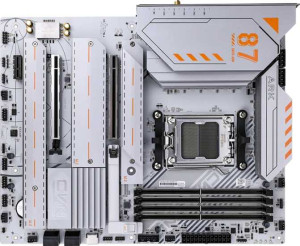
Colorful CVN X870 Ark Frozen V14
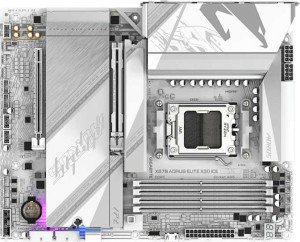
Gigabyte X870 Aorus Elite X3D Ice

Colorful CVN X870 Ark Frozen V14 Gigabyte X870 Aorus Elite X3D Ice

Overview

Welcome to our in-depth specification face-off between the Colorful CVN X870 Ark Frozen V14 and the Gigabyte X870 Aorus Elite X3D Ice — two high-end AM5 motherboards built on the X870 chipset. Both boards arrive with Wi-Fi 7, Bluetooth 5.4, and PCIe 5.0 support as standard, yet they diverge in meaningful ways across memory capacity, USB connectivity, and internal expansion options. Read on to discover which board best fits your next build.

Common Features

  • Both motherboards use the AM5 CPU socket.
  • Both motherboards feature the X870 chipset.
  • Both motherboards have an ATX form factor.
  • Wi-Fi is supported on both motherboards, covering Wi-Fi 4, Wi-Fi 5, Wi-Fi 6, Wi-Fi 6E, and Wi-Fi 7.
  • Bluetooth 5.4 is available on both motherboards.
  • Both motherboards support overclocking.
  • Both motherboards have 4 memory slots.
  • Both motherboards use DDR5 memory.
  • Both motherboards support 2 memory channels.
  • ECC memory is not supported on either motherboard.
  • Both motherboards have 4 USB 3.2 Gen 1 Type-A ports.
  • Neither motherboard has any USB 3.2 Gen 1 Type-C ports.
  • Neither motherboard has any USB 3.2 Gen 2x2 ports.
  • Neither motherboard has any USB 4 20Gbps ports.
  • Neither motherboard has any Thunderbolt 3 ports.
  • Both motherboards have an HDMI output.
  • Both motherboards have 1 RJ45 port.
  • Both motherboards have a USB Type-C port.
  • Both motherboards have 4 USB 2.0 ports available through expansion.
  • Both motherboards include a TPM connector.
  • Neither motherboard has a U.2 socket.
  • Neither motherboard has an mSATA connector.
  • Neither motherboard has any SATA 2 connectors.
  • Both motherboards have 1 PCIe 5.0 x16 slot.
  • Neither motherboard has any PCIe 4.0 x16 slots.
  • Neither motherboard has any PCIe 3.0 x16 slots.
  • Neither motherboard has any PCI slots.
  • Neither motherboard has any PCIe 2.0 x16 slots.
  • Both motherboards have 1 PCIe x4 slot.
  • Neither motherboard has any PCIe x8 slots.
  • Both motherboards have a signal-to-noise ratio of 120 dB on the DAC.
  • Both motherboards support 7.1 audio channels.
  • Both motherboards have an S/PDIF Out port.
  • Both motherboards support RAID 0, RAID 1, RAID 5, and RAID 10.
  • Neither motherboard supports RAID 0+1.

Main Differences

  • HDMI version is 2.0 on Colorful CVN X870 Ark Frozen V14 and 2.1 on Gigabyte X870 Aorus Elite X3D Ice.
  • Easy BIOS reset is available on Gigabyte X870 Aorus Elite X3D Ice but not on Colorful CVN X870 Ark Frozen V14.
  • Height is 245 mm on Colorful CVN X870 Ark Frozen V14 and 244 mm on Gigabyte X870 Aorus Elite X3D Ice.
  • Maximum memory amount is 192 GB on Colorful CVN X870 Ark Frozen V14 and 256 GB on Gigabyte X870 Aorus Elite X3D Ice.
  • Maximum RAM speed is 5000 MHz on Colorful CVN X870 Ark Frozen V14 and 5200 MHz on Gigabyte X870 Aorus Elite X3D Ice.
  • Maximum overclocked RAM speed is 8200 MHz on Colorful CVN X870 Ark Frozen V14 and 9000 MHz on Gigabyte X870 Aorus Elite X3D Ice.
  • USB 3.2 Gen 2 Type-A ports number 1 on Colorful CVN X870 Ark Frozen V14 and 2 on Gigabyte X870 Aorus Elite X3D Ice.
  • USB 3.2 Gen 2 Type-C ports number 0 on Colorful CVN X870 Ark Frozen V14 and 1 on Gigabyte X870 Aorus Elite X3D Ice.
  • USB 2.0 ports number 2 on Colorful CVN X870 Ark Frozen V14 and 1 on Gigabyte X870 Aorus Elite X3D Ice.
  • USB 4 40Gbps ports number 1 on Colorful CVN X870 Ark Frozen V14 and 2 on Gigabyte X870 Aorus Elite X3D Ice.
  • Thunderbolt 4 ports number 1 on Colorful CVN X870 Ark Frozen V14 and 2 on Gigabyte X870 Aorus Elite X3D Ice.
  • DisplayPort outputs number 1 on Colorful CVN X870 Ark Frozen V14 and 0 on Gigabyte X870 Aorus Elite X3D Ice.
  • USB 3.2 Gen 1 ports available through expansion number 2 on Colorful CVN X870 Ark Frozen V14 and 4 on Gigabyte X870 Aorus Elite X3D Ice.
  • SATA 3 connectors number 4 on Colorful CVN X870 Ark Frozen V14 and 2 on Gigabyte X870 Aorus Elite X3D Ice.
  • Fan headers number 5 on Colorful CVN X870 Ark Frozen V14 and 8 on Gigabyte X870 Aorus Elite X3D Ice.
  • USB 3.0 ports available through expansion number 2 on Colorful CVN X870 Ark Frozen V14 and 4 on Gigabyte X870 Aorus Elite X3D Ice.
  • M.2 sockets number 3 on Colorful CVN X870 Ark Frozen V14 and 4 on Gigabyte X870 Aorus Elite X3D Ice.
  • PCIe x1 slots number 1 on Colorful CVN X870 Ark Frozen V14 and 0 on Gigabyte X870 Aorus Elite X3D Ice.
  • Audio connectors number 5 on Colorful CVN X870 Ark Frozen V14 and 2 on Gigabyte X870 Aorus Elite X3D Ice.
Specs Comparison
Colorful CVN X870 Ark Frozen V14

Colorful CVN X870 Ark Frozen V14

Gigabyte X870 Aorus Elite X3D Ice

Gigabyte X870 Aorus Elite X3D Ice

General info:
CPU socket AM5 AM5
chipset X870 X870
form factor ATX ATX
release date April 2025 September 2025
supports Wi-Fi
Wi-Fi version Wi-Fi 4 (802.11n), Wi-Fi 5 (802.11ac), Wi-Fi 6 (802.11ax), Wi-Fi 6E (802.11ax), Wi-Fi 7 (802.11be) Wi-Fi 4 (802.11n), Wi-Fi 5 (802.11ac), Wi-Fi 6 (802.11ax), Wi-Fi 6E (802.11ax), Wi-Fi 7 (802.11be)
Has Bluetooth
Bluetooth version 5.4 5.4
HDMI version HDMI 2.0 HDMI 2.1
Easy to overclock
has RGB lighting
Easy to reset BIOS
Has dual BIOS
has aptX
CPU sockets 1 1
Has integrated graphics
warranty period 3 years 3 years
height 245 mm 244 mm
width 305 mm 305 mm
Has integrated CPU

Both the Colorful CVN X870 Ark Frozen V14 and the Gigabyte X870 Aorus Elite X3D Ice share the same foundational platform: the AM5 socket with the X870 chipset, a standard ATX form factor, and identical dimensions at 305 mm wide (with a negligible 1 mm height difference). Both boards support Wi-Fi 7, Bluetooth 5.4, overclocking, and RGB lighting, and both carry a 3-year warranty. For the vast majority of users, these shared traits mean the two boards are built on an equally capable and modern foundation.

Where they diverge matters in practice. The Gigabyte Aorus Elite X3D Ice includes an HDMI 2.1 port versus the Colorful's HDMI 2.0 — a meaningful difference if you plan to output video directly from the board, since HDMI 2.1 supports higher resolutions and refresh rates (up to 4K@120Hz or 8K@60Hz). More practically, the Gigabyte also offers easy BIOS reset functionality, which the Colorful lacks. This is a genuine quality-of-life advantage: a physical BIOS reset mechanism can save significant troubleshooting time during overclocking or failed updates, making the board more accessible to both enthusiasts and less experienced builders.

In this general-info category, the Gigabyte X870 Aorus Elite X3D Ice holds a clear edge. Its superior HDMI version and BIOS reset convenience are both real-world advantages with no offsetting deficiencies from the provided specs. The Colorful CVN X870 Ark Frozen V14 matches it on every other front but concedes on two features that can directly impact usability.

Memory:
maximum memory amount 192GB 256GB
RAM speed (max) 5000 MHz 5200 MHz
overclocked RAM speed 8200 MHz 9000 MHz
memory slots 4 4
DDR memory version 5 5
memory channels 2 2
Supports ECC memory

On the memory front, both boards share the same structural foundation: 4 DIMM slots, DDR5, and a dual-channel configuration. For most gaming and productivity workloads, these shared traits mean either board will handle everyday memory setups identically. Neither supports ECC memory, so workstation or server use cases requiring error-correcting RAM are off the table for both.

The meaningful separation comes in capacity and speed ceilings. The Gigabyte X870 Aorus Elite X3D Ice supports up to 256 GB of RAM versus the Colorful's 192 GB cap — a 33% higher ceiling that matters primarily for memory-intensive professional workloads like large virtual machines, video editing with heavy timelines, or data-in-memory workflows. On the speed side, the Gigabyte pulls ahead again: its native maximum is 5200 MHz versus 5000 MHz, and its overclocked ceiling reaches 9000 MHz compared to 8200 MHz on the Colorful. The 800 MHz gap at the overclocked ceiling is the more noteworthy figure — for enthusiasts pushing DDR5 kits to their limits, the Gigabyte provides meaningfully more headroom.

The Gigabyte X870 Aorus Elite X3D Ice takes a clear edge in this category across every differentiating metric — capacity, native speed, and overclocked headroom — without any offsetting advantage for the Colorful. For users who will never exceed 192 GB or push RAM past 8200 MHz, the gap is largely academic, but for power users and overclockers, the Gigabyte is the stronger platform.
Ports:
USB 3.2 Gen 2 ports (USB-A) 1 2
USB 3.2 Gen 1 ports (USB-A) 4 4
USB 3.2 Gen 2 ports (USB-C) 0 1
USB 3.2 Gen 1 ports (USB-C) 0 0
USB 2.0 ports 2 1
USB 3.2 Gen 2x2 ports 0 0
USB 4 40Gbps ports 1 2
USB 4 20Gbps ports 0 0
Thunderbolt 4 ports 1 2
Thunderbolt 3 ports 0 0
has an HDMI output
DisplayPort outputs 1 0
RJ45 ports 1 1
Has USB Type-C
eSATA ports 0 0
DVI outputs 0 0
has a VGA connector
PS/2 ports 0 0

Shared groundwork first: both boards offer 4x USB 3.2 Gen 1 Type-A ports, a single RJ45 ethernet jack, HDMI output, and USB Type-C connectivity. Legacy connectors like VGA, DVI, eSATA, and PS/2 are absent on both — a sensible omission on modern X870 hardware. The real story, however, is how differently the two boards allocate their high-speed and premium connectivity.

The Gigabyte X870 Aorus Elite X3D Ice doubles up on the most coveted ports: it offers 2x Thunderbolt 4 and 2x USB 4 (40 Gbps) compared to just 1x each on the Colorful CVN X870 Ark Frozen V14. Thunderbolt 4 at 40 Gbps is the gold standard for connecting fast external SSDs, docking stations, and high-resolution displays — having two of them is a significant practical advantage for users with dense peripheral setups. The Gigabyte also adds a USB 3.2 Gen 2 Type-C port that the Colorful entirely lacks, further strengthening its modern connectivity profile. The one area where the Colorful counters is its DisplayPort output, which the Gigabyte omits entirely — relevant only if you intend to use the board's video output with a DisplayPort monitor without an adapter.

The Gigabyte X870 Aorus Elite X3D Ice wins this category decisively. Its doubled Thunderbolt 4 and USB 4 ports, plus the addition of a USB 3.2 Gen 2 Type-C, represent a substantially more capable rear I/O for high-bandwidth peripherals. The Colorful's exclusive DisplayPort is a minor consolation that won't offset the gap for the vast majority of users.

Connectors:
USB 3.2 Gen 1 ports (through expansion) 2 4
USB 2.0 ports (through expansion) 4 4
SATA 3 connectors 4 2
fan headers 5 8
USB 3.0 ports (through expansion) 2 4
M.2 sockets 3 4
Has TPM connector
U.2 sockets 0 0
Has mSATA connector
SATA 2 connectors 0 0

Internal connectivity tells a revealing story about what kind of builder each board is designed for. The Gigabyte X870 Aorus Elite X3D Ice leads on almost every expansion-oriented metric: it provides 4 M.2 sockets versus the Colorful's 3, and doubles the internal USB 3.2 Gen 1 headers to 4, enabling more front-panel and expansion USB connections without sacrificing speed. For system builders assembling storage-heavy or USB-rich rigs, these differences compound quickly.

Fan and thermal management is another area where the gap is hard to ignore. The Gigabyte's 8 fan headers versus the Colorful's 5 is a meaningful advantage for anyone running a multi-radiator liquid cooling loop or a high-airflow case with numerous fans — more headers means more granular control without needing an external fan hub. Flipping the script, the Colorful CVN X870 Ark Frozen V14 counters with 4 SATA 3 connectors compared to the Gigabyte's 2. If your build relies on multiple traditional hard drives or SATA SSDs — common in NAS-adjacent or large media storage setups — the Colorful's SATA advantage is genuinely useful. Both boards share a TPM connector and identical USB 2.0 expansion headers, so those are non-factors in the decision.

Taken together, the Gigabyte X870 Aorus Elite X3D Ice has the broader edge in this category, offering superior M.2 storage expansion, more internal USB bandwidth, and significantly better fan header coverage. The Colorful's doubled SATA connectivity is a real advantage, but it appeals to a narrower use case — one that is increasingly less common as NVMe storage continues to dominate modern builds.

Expansion slots:
PCIe 4.0 x16 slots 0 0
PCIe 5.0 x16 slots 1 1
PCIe 3.0 x16 slots 0 0
PCIe x1 slots 1 0
PCI slots 0 0
PCIe 2.0 x16 slots 0 0
PCIe x4 slots 1 1
PCIe x8 slots 0 0

Expansion slot layouts on both boards are remarkably similar, and the headline spec is the same: a single PCIe 5.0 x16 slot for the primary GPU, delivering the maximum bandwidth available on the AM5 platform. This ensures neither board creates a bottleneck for current or near-future graphics cards. Both also include a PCIe x4 slot, useful for add-in cards like high-speed storage controllers or capture cards.

The only point of divergence is that the Colorful CVN X870 Ark Frozen V14 includes one additional PCIe x1 slot, which the Gigabyte omits entirely. A PCIe x1 slot accommodates low-bandwidth expansion cards — network adapters, sound cards, USB controllers — that do not require the full bandwidth of a larger slot. It is a modest but real advantage for users who need to drop in a legacy or specialized add-in card without occupying the x4 slot.

This category is essentially a near-tie with a slight edge to the Colorful CVN X870 Ark Frozen V14. The core GPU and secondary expansion capability is identical across both boards; the Colorful simply offers one additional slot that broadens compatibility with a wider range of add-in cards. For most builders this difference will never matter, but for those with specific peripheral expansion needs, it is a useful extra option.

Audio:
Signal-to-Noise ratio (DAC) 120 dB 120 dB
audio channels 7.1 7.1
Has S/PDIF Out port
audio connectors 5 2

Three of the four audio specs here are identical: both boards deliver a 120 dB signal-to-noise ratio from their DAC, support 7.1 surround sound, and include an S/PDIF optical output for connecting to external receivers or DACs. A 120 dB SNR is a strong figure for onboard audio, indicating a clean, low-noise signal well-suited to gaming headsets, studio monitors, and casual listening alike.

The single but notable differentiator is the number of physical audio jacks: the Colorful CVN X870 Ark Frozen V14 provides 5 connectors versus just 2 on the Gigabyte X870 Aorus Elite X3D Ice. In practical terms, 5 jacks allows for a full analog 7.1 surround speaker setup or simultaneous connection of multiple audio devices — front speakers, rear speakers, subwoofer, and microphone — without any switching. Two jacks, by contrast, typically covers only stereo output and microphone input, meaning users wanting multi-channel analog audio would need to rely on the S/PDIF output or an external audio interface.

For this category, the Colorful CVN X870 Ark Frozen V14 holds a clear advantage. While audio quality as measured by SNR is equal, the significantly richer analog connector array makes it a more capable and flexible onboard audio solution — particularly for users running analog surround speaker systems or multiple simultaneous audio devices.

Storage:
Supports RAID 1
Supports RAID 10 (1+0)
Supports RAID 5
Supports RAID 0
Supports RAID 0+1

Storage redundancy support is identical across both boards. The Colorful CVN X870 Ark Frozen V14 and the Gigabyte X870 Aorus Elite X3D Ice each support RAID 0, 1, 5, and 10, covering the full spectrum of configurations that matter for consumer and prosumer use cases — from pure performance striping (RAID 0) to mirrored redundancy (RAID 1) to the parity-based protection of RAID 5 and the combined striping and mirroring of RAID 10. Neither board supports RAID 0+1, but this omission is equally shared and rarely consequential given that RAID 10 achieves a functionally similar outcome.

This is a straightforward complete tie. There is no differentiator to analyze here — both boards offer exactly the same RAID capability, and neither gains any advantage in storage configuration flexibility based on the provided data.

Comparison Summary & Verdict

Both the Colorful CVN X870 Ark Frozen V14 and the Gigabyte X870 Aorus Elite X3D Ice are capable X870 platforms sharing a strong common foundation, but their differences point them toward distinct audiences. The Gigabyte stands out for builders who demand the most from their system: it supports up to 256 GB of DDR5 RAM at speeds reaching 9000 MHz overclocked, offers more USB 4 40Gbps and Thunderbolt 4 ports, provides 4 M.2 sockets, and includes 8 fan headers for complex thermal setups. The Colorful, meanwhile, appeals to users who value more audio connectors, an onboard DisplayPort output, and additional SATA 3 connectivity for traditional storage-heavy configurations. Either way, both boards deliver a premium Wi-Fi 7 and PCIe 5.0 experience on the AM5 platform.

Colorful CVN X870 Ark Frozen V14
Buy Colorful CVN X870 Ark Frozen V14 if...

Buy the Colorful CVN X870 Ark Frozen V14 if you rely on multiple SATA 3 drives, need a DisplayPort output on your motherboard, or want more physical audio connectors for a richer analog audio setup.

Gigabyte X870 Aorus Elite X3D Ice
Buy Gigabyte X870 Aorus Elite X3D Ice if...

Buy the Gigabyte X870 Aorus Elite X3D Ice if you want maximum RAM capacity and speed, more Thunderbolt 4 and USB 4 40Gbps ports, additional M.2 slots, and more fan headers for demanding, high-performance builds.