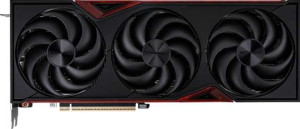
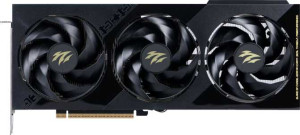
At first glance, the Colorful RTX 5070 Battle AX holds a slight clock speed advantage, running at 2325 MHz base / 2512 MHz boost versus the Galax RTX 5070 Ti Magic Blade's 2295 MHz / 2452 MHz. However, clock speed alone is a misleading lens here — the two cards are built on fundamentally different GPU configurations. The Battle AX operates with 6144 shading units, 192 TMUs, and 80 ROPs, while the Magic Blade scales up massively to 8960 shading units, 280 TMUs, and 96 ROPs. That is a ~46% increase in shader count, which directly multiplies raw throughput regardless of the clock deficit.
The real-world gap becomes undeniable in the throughput figures: the Magic Blade delivers 43.94 TFLOPS of floating-point performance versus the Battle AX's 30.87 TFLOPS — a ~42% advantage. Similarly, texture fill rate swings from 482.3 GTexels/s to 686.6 GTexels/s, and pixel fill rate from 201 to 235.4 GPixel/s. In practice, this means the Magic Blade can push significantly more geometry detail, handle heavier shader workloads, and sustain higher framerates at demanding resolutions. Memory speed is identical at 1750 MHz for both, and both support Double Precision Floating Point, so neither has an edge in memory bandwidth efficiency or compute versatility from those angles.
The performance edge in this group belongs decisively to the Galax RTX 5070 Ti Magic Blade. Its substantially larger execution resource pool overwhelms the marginal clock speed lead of the Battle AX across every key throughput metric. The Battle AX is by no means slow, but users prioritizing raw rendering power — whether for high-resolution gaming, content creation, or GPU-compute tasks — will find the Magic Blade to be the clearly stronger performer based on the provided specifications.