Colorful GeForce RTX 5070 Ti NB EX
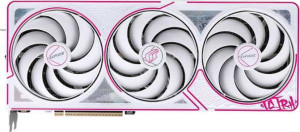
Colorful iGame GeForce RTX 5070 Ti Ultra W OC

Colorful GeForce RTX 5070 Ti NB EX Colorful iGame GeForce RTX 5070 Ti Ultra W OC

Overview

Welcome to our in-depth specification comparison between the Colorful GeForce RTX 5070 Ti NB EX and the Colorful iGame GeForce RTX 5070 Ti Ultra W OC. Both cards are built on the same Blackwell architecture and share a remarkably similar foundation, yet they differ in key areas such as GPU turbo clock speeds, raw compute throughput, and physical dimensions. Read on to see how these two cards stack up across performance, memory, features, and build specs.

Common Features

  • Both cards share a base GPU clock speed of 2295 MHz.
  • Both cards have a GPU memory speed of 1750 MHz.
  • Both cards feature 8960 shading units.
  • Both cards include 280 texture mapping units (TMUs).
  • Both cards have 96 render output units (ROPs).
  • Double Precision Floating Point (DPFP) is supported on both cards.
  • Both cards have an effective memory speed of 28000 MHz.
  • Both cards offer a maximum memory bandwidth of 896 GB/s.
  • Both cards come with 16GB of VRAM.
  • Both cards use GDDR7 memory.
  • Both cards have a 256-bit memory bus width.
  • ECC memory is supported on both cards.
  • Both cards support DirectX 12 Ultimate.
  • Both cards support OpenGL version 4.6.
  • Both cards support OpenCL version 3.
  • Multi-display technology is supported on both cards.
  • Ray tracing is supported on both cards.
  • DLSS is supported on both cards.
  • XeSS (XMX) is not available on either card.
  • 3D support is available on both cards.
  • Both cards have one HDMI 2.1b output and three DisplayPort outputs, with no USB-C, DVI, or mini DisplayPort outputs.
  • Both cards are built on the Blackwell GPU architecture.
  • Both cards have a Thermal Design Power (TDP) of 300W.
  • Both cards use PCIe version 5.
  • Both cards are manufactured on a 5 nm semiconductor process.
  • Both cards contain 45,600 million transistors.
  • Air-water cooling is not available on either card.

Main Differences

  • GPU turbo clock speed is 2452 MHz on Colorful GeForce RTX 5070 Ti NB EX and 2497 MHz on Colorful iGame GeForce RTX 5070 Ti Ultra W OC.
  • Pixel rate is 235.4 GPixel/s on Colorful GeForce RTX 5070 Ti NB EX and 239.7 GPixel/s on Colorful iGame GeForce RTX 5070 Ti Ultra W OC.
  • Floating-point performance is 43.94 TFLOPS on Colorful GeForce RTX 5070 Ti NB EX and 44.75 TFLOPS on Colorful iGame GeForce RTX 5070 Ti Ultra W OC.
  • Texture rate is 686.6 GTexels/s on Colorful GeForce RTX 5070 Ti NB EX and 699.2 GTexels/s on Colorful iGame GeForce RTX 5070 Ti Ultra W OC.
  • Width is 330.6 mm on Colorful GeForce RTX 5070 Ti NB EX and 331 mm on Colorful iGame GeForce RTX 5070 Ti Ultra W OC.
  • Height is 140 mm on Colorful GeForce RTX 5070 Ti NB EX and 139.3 mm on Colorful iGame GeForce RTX 5070 Ti Ultra W OC.
Specs Comparison
Colorful GeForce RTX 5070 Ti NB EX

Colorful GeForce RTX 5070 Ti NB EX

Colorful iGame GeForce RTX 5070 Ti Ultra W OC

Colorful iGame GeForce RTX 5070 Ti Ultra W OC

Performance:
GPU clock speed 2295 MHz 2295 MHz
GPU turbo 2452 MHz 2497 MHz
pixel rate 235.4 GPixel/s 239.7 GPixel/s
floating-point performance 43.94 TFLOPS 44.75 TFLOPS
texture rate 686.6 GTexels/s 699.2 GTexels/s
GPU memory speed 1750 MHz 1750 MHz
shading units 8960 8960
texture mapping units (TMUs) 280 280
render output units (ROPs) 96 96
Has Double Precision Floating Point (DPFP)

At the foundational level, both the Colorful RTX 5070 Ti NB EX and the Colorful iGame RTX 5070 Ti Ultra W OC share identical silicon configurations: the same 8960 shading units, 280 TMUs, 96 ROPs, and a base GPU clock of 2295 MHz. Memory speed is also identical at 1750 MHz. This means both cards are drawing from the same hardware well — any performance difference between them comes down entirely to how aggressively each is factory-overclocked.

That is where the Ultra W OC pulls ahead. Its GPU boost clock reaches 2497 MHz versus 2452 MHz on the NB EX — a gap of 45 MHz, or roughly 1.8%. This directly cascades into every throughput metric: the Ultra W OC delivers 44.75 TFLOPS of floating-point performance against 43.94 TFLOPS, a 239.7 GPixel/s pixel fill rate versus 235.4 GPixel/s, and a texture throughput of 699.2 GTexels/s compared to 686.6 GTexels/s. In practical gaming terms, a ~1.8% clock advantage rarely produces a perceptible frame-rate difference on its own, but it does represent a measurable, consistent edge in GPU-bound workloads and compute tasks.

The iGame Ultra W OC holds the performance edge in this group, driven purely by its higher factory boost clock. The NB EX is not meaningfully slower — the two cards are close enough that real-world results will often overlap within margin of error — but if raw out-of-box GPU throughput is the deciding factor, the Ultra W OC is the objectively faster card of the two.

Memory:
effective memory speed 28000 MHz 28000 MHz
maximum memory bandwidth 896 GB/s 896 GB/s
VRAM 16GB 16GB
GDDR version GDDR7 GDDR7
memory bus width 256-bit 256-bit
Supports ECC memory

On the memory front, these two cards are completely indistinguishable. Both the NB EX and the Ultra W OC feature 16GB of GDDR7 VRAM on a 256-bit bus, running at an effective speed of 28000 MHz and delivering a maximum bandwidth of 896 GB/s. There is no variance across any single memory specification — they are, for all practical purposes, identical memory subsystems.

The specs here are nonetheless worth contextualizing. GDDR7 is the latest generation of graphics memory, and 896 GB/s of bandwidth represents a substantial leap over previous-generation GDDR6X implementations. For users working with high-resolution textures, large AI models, or 4K gaming with ray tracing enabled, this bandwidth headroom matters considerably — it reduces the likelihood of the memory bus becoming a bottleneck. The 16GB capacity is also meaningful: it comfortably handles modern AAA titles at 4K with maxed texture settings, and provides enough overhead for serious creative and compute workloads. ECC memory support is a minor but notable inclusion for users running professional or mixed workloads where data integrity is a concern.

This group is a definitive tie. Neither card offers any memory advantage over the other — a buyer choosing between the NB EX and the Ultra W OC on memory grounds alone has no reason to favor one over the other.

Features:
DirectX version DirectX 12 Ultimate DirectX 12 Ultimate
OpenGL version 4.6 4.6
OpenCL version 3 3
Supports multi-display technology
supports ray tracing
Supports 3D
supports DLSS
has XeSS (XMX)
AMD SAM / Intel Resizable BAR Intel Resizable BAR Intel Resizable BAR
has LHR
has RGB lighting
supported displays 4 4

Feature parity between the NB EX and the Ultra W OC is total — every capability listed is shared identically by both cards. The headline software features are strong: DirectX 12 Ultimate ensures access to the full modern graphics API stack including hardware-accelerated ray tracing, mesh shaders, and variable rate shading. DLSS support is particularly valuable, as it enables AI-driven upscaling and frame generation that can dramatically boost effective frame rates in supported titles with minimal visual cost.

Both cards also support up to 4 simultaneous displays, making either a capable choice for multi-monitor productivity or gaming setups. Intel Resizable BAR support allows the CPU to access the full GPU frame buffer at once rather than in small chunks, which can yield meaningful performance gains in CPU-bound scenarios in supported games and applications. The absence of LHR (Lite Hash Rate) on both is also worth noting — neither card carries mining-era restrictions, which is relevant for users with mixed compute workloads.

With no divergence across any feature spec, this group is another clean tie. Whichever card a buyer leans toward for other reasons — price, cooling, or the clock speed edge the Ultra W OC holds — they will not be giving up or gaining any feature advantage either way.

Ports:
has an HDMI output
HDMI ports 1 1
HDMI version HDMI 2.1b HDMI 2.1b
DisplayPort outputs 3 3
USB-C ports 0 0
DVI outputs 0 0
mini DisplayPort outputs 0 0

Port selection is identical across both cards: one HDMI 2.1b output and three DisplayPort outputs, totalling four display connections — which aligns with the four-display limit noted in the Features group. Neither card offers USB-C output, which is worth knowing for users targeting monitors or displays that rely on that connector.

HDMI 2.1b is the key callout here. It supports up to 10K resolution and high refresh rates at 4K and beyond, making it well-suited for modern gaming monitors and TVs alike. The three DisplayPort outputs round out a versatile connectivity set for multi-monitor productivity users or those mixing a TV connection with desktop displays simultaneously.

No differentiation exists between the NB EX and the Ultra W OC in this category — the port layout is a straightforward tie. Connectivity alone gives neither card any advantage over the other.

General info:
GPU architecture Blackwell Blackwell
release date February 2025 February 2025
Thermal Design Power (TDP) 300W 300W
PCI Express (PCIe) version 5 5
semiconductor size 5 nm 5 nm
number of transistors 45600 million 45600 million
Has air-water cooling
width 330.6 mm 331 mm
height 140 mm 139.3 mm

Underneath their respective cooler designs, the NB EX and the Ultra W OC are built on exactly the same foundation: the Blackwell architecture, manufactured on a 5nm process with 45.6 billion transistors, running over a PCIe 5.0 interface at a 300W TDP. The shared power envelope is particularly relevant — both cards demand the same from a system's power supply, so neither imposes a greater infrastructure requirement than the other.

The 300W TDP is a serious power draw that warrants a high-quality PSU with adequate headroom, and it signals that both cooler solutions are tasked with dissipating the same thermal load. Neither card opts for an air-water hybrid cooling configuration, meaning both rely entirely on their air cooling solutions — making cooler quality and fan design more consequential for sustained performance and noise levels, though those details fall outside the specs provided here.

Physical dimensions are effectively equivalent: the NB EX measures 330.6 × 140 mm while the Ultra W OC comes in at 331 × 139.3 mm — a sub-millimeter difference in both axes that is irrelevant for case compatibility purposes. This group is a near-perfect tie, with both cards sharing the same silicon, power requirements, and footprint. The choice between them cannot be meaningfully informed by general specs alone.

Comparison Summary & Verdict

After examining every specification, it is clear that both cards are closely matched siblings sharing the same Blackwell architecture, 16GB GDDR7 memory, 300W TDP, and a full feature set including ray tracing and DLSS. The distinction lies in raw performance headroom: the Colorful iGame GeForce RTX 5070 Ti Ultra W OC edges ahead with a higher GPU turbo clock of 2497 MHz, a pixel rate of 239.7 GPixel/s, and floating-point performance of 44.75 TFLOPS, making it the marginally faster card for users who demand every last frame. The Colorful GeForce RTX 5070 Ti NB EX, meanwhile, delivers near-identical performance at a slightly more compact height of 140 mm. Both are excellent choices; the decision ultimately comes down to whether that small performance delta justifies your preference.

Colorful GeForce RTX 5070 Ti NB EX
Buy Colorful GeForce RTX 5070 Ti NB EX if...

Buy the Colorful GeForce RTX 5070 Ti NB EX if you want near-identical performance to its sibling in a very slightly more compact form factor and do not need the marginal clock speed advantage of the Ultra W OC.

Colorful iGame GeForce RTX 5070 Ti Ultra W OC
Buy Colorful iGame GeForce RTX 5070 Ti Ultra W OC if...

Buy the Colorful iGame GeForce RTX 5070 Ti Ultra W OC if you want the highest possible GPU turbo clock speed, pixel rate, and floating-point performance available between these two cards.