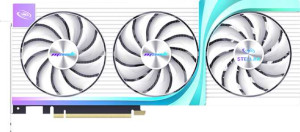
Colorful GeForce RTX 5070 Ti NB EX
Manli Stellar GeForce RTX 5070 Ti OC

Colorful GeForce RTX 5070 Ti NB EX Manli Stellar GeForce RTX 5070 Ti OC

Overview

When choosing between the Colorful GeForce RTX 5070 Ti NB EX and the Manli Stellar GeForce RTX 5070 Ti OC, it quickly becomes clear that these two cards share a remarkably similar DNA, both built on the Blackwell architecture with identical memory configurations. Yet subtle but meaningful differences emerge around GPU boost clocks and throughput figures, physical dimensions, and a key feature distinction that may matter depending on your display setup.

Common Features

  • Both GPUs have a base clock speed of 2295 MHz.
  • Both GPUs have a memory speed of 1750 MHz.
  • Both GPUs feature 8960 shading units.
  • Both GPUs have 280 texture mapping units (TMUs).
  • Both GPUs have 96 render output units (ROPs).
  • Double Precision Floating Point (DPFP) is supported on both GPUs.
  • Both GPUs have an effective memory speed of 28000 MHz.
  • Both GPUs offer a maximum memory bandwidth of 896 GB/s.
  • Both GPUs come with 16GB of VRAM.
  • Both GPUs use GDDR7 memory.
  • Both GPUs use a 256-bit memory bus width.
  • ECC memory is supported on both GPUs.
  • Both GPUs support DirectX 12 Ultimate.
  • Both GPUs support OpenGL version 4.6.
  • Both GPUs support OpenCL version 3.
  • Multi-display technology is supported on both GPUs.
  • Ray tracing is supported on both GPUs.
  • DLSS is supported on both GPUs.
  • XeSS (XMX) is not available on either GPU.
  • Both GPUs support Intel Resizable BAR.
  • Both GPUs have one HDMI 2.1b output.
  • Both GPUs have three DisplayPort outputs.
  • Neither GPU has USB-C or DVI outputs.
  • Both GPUs are based on the Blackwell architecture.
  • Both GPUs have a Thermal Design Power (TDP) of 300W.
  • Both GPUs use PCIe version 5.
  • Both GPUs are manufactured on a 5 nm semiconductor process.
  • Both GPUs feature 45600 million transistors.
  • Air-water cooling is not available on either GPU.

Main Differences

  • GPU turbo clock speed is 2452 MHz on Colorful GeForce RTX 5070 Ti NB EX and 2482 MHz on Manli Stellar GeForce RTX 5070 Ti OC.
  • Pixel rate is 235.4 GPixel/s on Colorful GeForce RTX 5070 Ti NB EX and 238.3 GPixel/s on Manli Stellar GeForce RTX 5070 Ti OC.
  • Floating-point performance is 43.94 TFLOPS on Colorful GeForce RTX 5070 Ti NB EX and 44.48 TFLOPS on Manli Stellar GeForce RTX 5070 Ti OC.
  • Texture rate is 686.6 GTexels/s on Colorful GeForce RTX 5070 Ti NB EX and 695 GTexels/s on Manli Stellar GeForce RTX 5070 Ti OC.
  • 3D support is present on Colorful GeForce RTX 5070 Ti NB EX but not available on Manli Stellar GeForce RTX 5070 Ti OC.
  • Width is 330.6 mm on Colorful GeForce RTX 5070 Ti NB EX and 315 mm on Manli Stellar GeForce RTX 5070 Ti OC.
  • Height is 140 mm on Colorful GeForce RTX 5070 Ti NB EX and 127 mm on Manli Stellar GeForce RTX 5070 Ti OC.
Specs Comparison
Colorful GeForce RTX 5070 Ti NB EX

Colorful GeForce RTX 5070 Ti NB EX

Manli Stellar GeForce RTX 5070 Ti OC

Manli Stellar GeForce RTX 5070 Ti OC

Performance:
GPU clock speed 2295 MHz 2295 MHz
GPU turbo 2452 MHz 2482 MHz
pixel rate 235.4 GPixel/s 238.3 GPixel/s
floating-point performance 43.94 TFLOPS 44.48 TFLOPS
texture rate 686.6 GTexels/s 695 GTexels/s
GPU memory speed 1750 MHz 1750 MHz
shading units 8960 8960
texture mapping units (TMUs) 280 280
render output units (ROPs) 96 96
Has Double Precision Floating Point (DPFP)

At the core, both the Colorful NB EX and the Manli Stellar OC are built on identical GPU silicon: the same 8960 shading units, 280 TMUs, and 96 ROPs, with a matching base clock of 2295 MHz and memory speed of 1750 MHz. This means their theoretical throughput ceiling is defined almost entirely by how aggressively each card boosts under load.

That is precisely where the two diverge. The Manli Stellar OC reaches a higher GPU turbo of 2482 MHz versus the Colorful NB EX's 2452 MHz — a 30 MHz, or roughly 1.2%, advantage. While that gap sounds slim, it cascades across every derived metric: the Manli edges ahead in floating-point performance (44.48 vs 43.94 TFLOPS), texture fill rate (695 vs 686.6 GTexels/s), and pixel rate (238.3 vs 235.4 GPixel/s). In practice, this translates to a marginally faster card in sustained GPU-bound workloads, though the real-world frame rate difference will typically fall within the noise floor of most gaming benchmarks.

Overall, the Manli Stellar OC holds a narrow but consistent performance edge in this group, courtesy of its higher factory boost clock. Both cards support Double Precision Floating Point, making them equally capable for compute tasks that leverage DPFP. For users prioritizing peak GPU throughput out of the box, the Manli has the measurable — if modest — advantage.

Memory:
effective memory speed 28000 MHz 28000 MHz
maximum memory bandwidth 896 GB/s 896 GB/s
VRAM 16GB 16GB
GDDR version GDDR7 GDDR7
memory bus width 256-bit 256-bit
Supports ECC memory

Memory is one area where choosing between these two cards becomes straightforward: every single specification is identical. Both feature 16GB of GDDR7 VRAM running at an effective 28000 MHz across a 256-bit bus, delivering a peak bandwidth of 896 GB/s. That bandwidth figure is substantial — it ensures the GPU can feed its shader units efficiently even at 4K resolutions or in memory-intensive workloads like generative AI inference and large texture streaming.

GDDR7 represents a meaningful generational leap over GDDR6X, and 16GB remains a comfortable buffer for current and near-future AAA titles, content creation workflows, and local AI tasks. The shared support for ECC memory is a welcome addition for users running professional or compute workloads where data integrity matters, though it has no bearing on gaming performance.

This group is a complete tie. There is no memory-related reason to prefer one card over the other — buyers can set this spec group aside entirely and focus their decision on the differences identified elsewhere.

Features:
DirectX version DirectX 12 Ultimate DirectX 12 Ultimate
OpenGL version 4.6 4.6
OpenCL version 3 3
Supports multi-display technology
supports ray tracing
Supports 3D
supports DLSS
has XeSS (XMX)
AMD SAM / Intel Resizable BAR Intel Resizable BAR Intel Resizable BAR
has LHR
has RGB lighting
supported displays 4 4

The feature sets of these two cards are nearly identical across the board — both support DirectX 12 Ultimate, ray tracing, DLSS, OpenCL 3, and Intel Resizable BAR, and both can drive up to 4 displays simultaneously. For the vast majority of users, this shared foundation means equivalent compatibility with modern games, rendering APIs, and GPU-accelerated software.

The one concrete differentiator here is 3D support: the Colorful NB EX lists it as supported, while the Manli Stellar OC does not. In practical terms, 3D output — used for stereoscopic display technologies — is a niche capability with a narrow audience today. For anyone specifically invested in stereoscopic 3D setups, this distinction matters; for everyone else, it is unlikely to influence a purchase decision.

On balance, the Colorful NB EX holds a technical edge in this group solely due to its 3D support. That said, the advantage is highly situational — if stereoscopic 3D is not part of your workflow or entertainment setup, the two cards are effectively feature-equivalent.

Ports:
has an HDMI output
HDMI ports 1 1
HDMI version HDMI 2.1b HDMI 2.1b
DisplayPort outputs 3 3
USB-C ports 0 0
DVI outputs 0 0
mini DisplayPort outputs 0 0

Connectivity is another area where these two cards are in complete lockstep. Both offer the same output configuration: 3 DisplayPort outputs and 1 HDMI 2.1b port, totaling four display connections — which aligns with their shared 4-display support noted in the features group. The absence of USB-C, DVI, or mini DisplayPort outputs is equally consistent across both cards.

HDMI 2.1b is the key headline here, as it supports up to 10K resolution and high refresh rates at 4K and 8K — relevant for users with high-end TVs or next-generation monitors. The three DisplayPort outputs further accommodate demanding multi-monitor setups or high-refresh-rate gaming displays, providing ample flexibility for most desktop configurations.

This is an unambiguous tie. The port layout is byte-for-byte identical, so display connectivity should play no role whatsoever in choosing between the Colorful NB EX and the Manli Stellar OC.

General info:
GPU architecture Blackwell Blackwell
release date February 2025 February 2025
Thermal Design Power (TDP) 300W 300W
PCI Express (PCIe) version 5 5
semiconductor size 5 nm 5 nm
number of transistors 45600 million 45600 million
Has air-water cooling
width 330.6 mm 315 mm
height 140 mm 127 mm

Underneath, these two cards are built on the same foundation: the Blackwell architecture, a 5 nm process node, 45.6 billion transistors, a 300W TDP, and PCIe 5.0. That shared silicon and power envelope means identical platform requirements — same power connectors, same CPU bandwidth ceiling, same thermal load imposed on the system.

Where they diverge is physical footprint. The Colorful NB EX is the larger card at 330.6 × 140 mm, while the Manli Stellar OC measures a notably more compact 315 × 127 mm — roughly 15 mm shorter in length and 13 mm slimmer in height. That difference is meaningful in practice: the Manli is more likely to fit in smaller mid-tower or compact ATX cases where clearance around the GPU is tight, and it leaves more room for airflow or adjacent components.

For users building in spacious full-tower cases, the size gap is irrelevant. But in constrained builds, the Manli Stellar OC has a clear advantage here — its smaller footprint offers meaningfully better case compatibility without any trade-off in TDP or platform requirements.

Comparison Summary & Verdict

Both the Colorful GeForce RTX 5070 Ti NB EX and the Manli Stellar GeForce RTX 5070 Ti OC are grounded in the same core specification set, sharing identical memory, architecture, TDP, and port configurations. When it comes to outright speed, the Manli Stellar holds a measurable edge, delivering a higher boost clock of 2482 MHz, a pixel rate of 238.3 GPixel/s, and 44.48 TFLOPS of floating-point performance, versus 43.94 TFLOPS on the Colorful. The Manli is also the more compact option, measuring 315 x 127 mm compared to the Colorful’s 330.6 x 140 mm, making it better suited to tighter builds. However, the Colorful GeForce RTX 5070 Ti NB EX uniquely offers 3D output support, a feature not present on the Manli, which could be a deciding factor for users with compatible 3D displays. In summary, the Manli Stellar is the stronger pick for those chasing peak performance in a smaller footprint, while the Colorful is the right choice for anyone who needs 3D display compatibility.

Colorful GeForce RTX 5070 Ti NB EX
Buy Colorful GeForce RTX 5070 Ti NB EX if...

Buy the Colorful GeForce RTX 5070 Ti NB EX if 3D display support is a requirement for your setup and you are comfortable accommodating its slightly larger physical footprint.

Manli Stellar GeForce RTX 5070 Ti OC
Buy Manli Stellar GeForce RTX 5070 Ti OC if...

Choose the Manli Stellar GeForce RTX 5070 Ti OC if you want the higher boost clock, better floating-point performance, and a more compact card that fits easily into smaller cases.