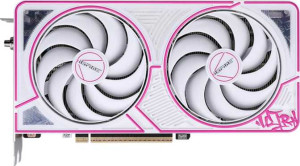
Colorful iGame GeForce RTX 5060 Ultra W Duo OC
Inno3D GeForce RTX 5060 Twin X2 OC

Colorful iGame GeForce RTX 5060 Ultra W Duo OC Inno3D GeForce RTX 5060 Twin X2 OC

Overview

Welcome to our in-depth specification comparison between the Colorful iGame GeForce RTX 5060 Ultra W Duo OC and the Inno3D GeForce RTX 5060 Twin X2 OC. Both cards are built on NVIDIA's Blackwell architecture and share a wealth of common ground, yet they diverge in meaningful ways across boost clock speeds, raw compute throughput, physical dimensions, and aesthetic features — making the choice between them anything but automatic.

Common Features

  • Both cards share a base GPU clock speed of 2280 MHz.
  • Both cards have a GPU memory speed of 1750 MHz.
  • Both cards feature 3840 shading units.
  • Both cards include 120 texture mapping units (TMUs).
  • Both cards have 48 render output units (ROPs).
  • Double Precision Floating Point (DPFP) is supported on both cards.
  • Both cards have an effective memory speed of 28000 MHz.
  • Both cards offer a maximum memory bandwidth of 448 GB/s.
  • Both cards come with 8 GB of VRAM.
  • Both cards use GDDR7 memory.
  • Both cards feature a 128-bit memory bus width.
  • ECC memory is supported on both cards.
  • Both cards support DirectX 12 Ultimate.
  • Both cards support OpenGL version 4.6.
  • Both cards support OpenCL version 3.
  • Multi-display technology is supported on both cards.
  • Ray tracing is supported on both cards.
  • 3D support is available on both cards.
  • DLSS is supported on both cards.
  • XeSS (XMX) is not available on either card.
  • Both cards include one HDMI 2.1b output.
  • Both cards feature three DisplayPort outputs.
  • Neither card has USB-C, DVI, or mini DisplayPort outputs.
  • Both cards are based on the Blackwell GPU architecture.
  • Both cards have a Thermal Design Power (TDP) of 145W.
  • Both cards use PCIe version 5.
  • Both cards are manufactured on a 5 nm semiconductor process.
  • Both cards contain 21,900 million transistors.
  • Neither card features air-water cooling.

Main Differences

  • GPU turbo clock is 2497 MHz on Colorful iGame GeForce RTX 5060 Ultra W Duo OC and 2527 MHz on Inno3D GeForce RTX 5060 Twin X2 OC.
  • Pixel rate is 119.9 GPixel/s on Colorful iGame GeForce RTX 5060 Ultra W Duo OC and 121.3 GPixel/s on Inno3D GeForce RTX 5060 Twin X2 OC.
  • Floating-point performance is 19.18 TFLOPS on Colorful iGame GeForce RTX 5060 Ultra W Duo OC and 19.41 TFLOPS on Inno3D GeForce RTX 5060 Twin X2 OC.
  • Texture rate is 299.6 GTexels/s on Colorful iGame GeForce RTX 5060 Ultra W Duo OC and 303.2 GTexels/s on Inno3D GeForce RTX 5060 Twin X2 OC.
  • RGB lighting is present on Colorful iGame GeForce RTX 5060 Ultra W Duo OC but not available on Inno3D GeForce RTX 5060 Twin X2 OC.
  • Card width is 231 mm on Colorful iGame GeForce RTX 5060 Ultra W Duo OC and 250 mm on Inno3D GeForce RTX 5060 Twin X2 OC.
  • Card height is 120 mm on Colorful iGame GeForce RTX 5060 Ultra W Duo OC and 116 mm on Inno3D GeForce RTX 5060 Twin X2 OC.
Specs Comparison
Colorful iGame GeForce RTX 5060 Ultra W Duo OC

Colorful iGame GeForce RTX 5060 Ultra W Duo OC

Inno3D GeForce RTX 5060 Twin X2 OC

Inno3D GeForce RTX 5060 Twin X2 OC

Performance:
GPU clock speed 2280 MHz 2280 MHz
GPU turbo 2497 MHz 2527 MHz
pixel rate 119.9 GPixel/s 121.3 GPixel/s
floating-point performance 19.18 TFLOPS 19.41 TFLOPS
texture rate 299.6 GTexels/s 303.2 GTexels/s
GPU memory speed 1750 MHz 1750 MHz
shading units 3840 3840
texture mapping units (TMUs) 120 120
render output units (ROPs) 48 48
Has Double Precision Floating Point (DPFP)

At the foundation, both the Colorful iGame RTX 5060 Ultra W Duo OC and the Inno3D RTX 5060 Twin X2 OC share an identical hardware core: the same 2280 MHz base clock, 3840 shading units, 120 TMUs, 48 ROPs, and 1750 MHz memory speed. This means their day-to-day theoretical bandwidth and parallel compute infrastructure are built on the same foundation — neither card has an architectural leg up over the other in raw pipeline capacity.

The real differentiator lives in the boost clock. The Inno3D Twin X2 OC reaches a 2527 MHz turbo versus the iGame Ultra W Duo OC's 2497 MHz — a 30 MHz gap. While that sounds modest in isolation, it directly flows into every derived performance metric: the Inno3D edges ahead with 19.41 TFLOPS of floating-point throughput versus 19.18 TFLOPS, a 303.2 GTexels/s texture fill rate versus 299.6, and a pixel rate of 121.3 GPixel/s versus 119.9. In practice, these are roughly 1–1.5% differences — meaningful on paper but unlikely to be felt in real gaming workloads or benchmarks outside margin-of-error territory.

Both cards support Double Precision Floating Point (DPFP), which matters for compute workloads like simulation or scientific tasks but is largely irrelevant for gaming. Overall, the Inno3D Twin X2 OC holds a narrow performance edge in this group, driven entirely by its higher factory boost clock. For pure performance on paper, it wins — but the gap is slim enough that thermal behavior, power delivery, and real-world sustained clocks will likely matter far more than these spec-sheet differences.
Memory:
effective memory speed 28000 MHz 28000 MHz
maximum memory bandwidth 448 GB/s 448 GB/s
VRAM 8GB 8GB
GDDR version GDDR7 GDDR7
memory bus width 128-bit 128-bit
Supports ECC memory

Memory is one area where no trade-offs need to be made between these two cards — the specs are a perfect mirror. Both carry 8GB of GDDR7 across a 128-bit bus, running at an effective 28000 MHz for a maximum bandwidth of 448 GB/s. The jump to GDDR7 over the previous generation's GDDR6X is significant: it delivers substantially higher bandwidth per pin, which directly benefits texture streaming, high-resolution frame buffers, and latency-sensitive workloads like ray tracing.

The 128-bit bus width is worth contextualizing. On older GDDR generations, a 128-bit interface was a limiting factor; with GDDR7's efficiency gains, the same bus width now pushes bandwidth that would have required a 192-bit or wider GDDR6 interface. That said, 8GB of VRAM remains a consideration for users targeting very high resolutions or heavily modded games with large texture packs — it is adequate for 1080p and solid at 1440p, but not as future-proof as wider-memory counterparts in higher GPU tiers. Both cards also support ECC memory, a feature more relevant to professional compute use cases than gaming, but a welcome inclusion for users running mixed workloads.

This group is an unambiguous dead tie. Every single memory specification — capacity, type, speed, bandwidth, bus width, and ECC support — is identical across the iGame Ultra W Duo OC and the Twin X2 OC. Memory performance will play no role whatsoever in differentiating these two cards in real-world use.

Features:
DirectX version DirectX 12 Ultimate DirectX 12 Ultimate
OpenGL version 4.6 4.6
OpenCL version 3 3
Supports multi-display technology
supports ray tracing
Supports 3D
supports DLSS
has XeSS (XMX)
AMD SAM / Intel Resizable BAR Intel Resizable BAR Intel Resizable BAR
has LHR
has RGB lighting
supported displays 4 4

Functionally, these two cards are in complete lockstep. Both support DirectX 12 Ultimate, ray tracing, and DLSS — the trio that defines the modern gaming feature set on NVIDIA hardware. DirectX 12 Ultimate in particular ensures compatibility with the full range of next-gen rendering features including mesh shaders and variable rate shading, while DLSS provides AI-driven upscaling and frame generation that can meaningfully boost perceived performance beyond raw rasterization numbers. Neither card supports XeSS, which is expected given that is an Intel-native technology.

Both also support Intel Resizable BAR, which allows the CPU to access the full GPU frame buffer at once rather than in smaller chunks — a low-cost system-level optimization that can yield a few percent of extra performance in supported games with no hardware cost. The shared support for up to 4 simultaneous displays makes either card a capable multi-monitor solution for productivity or sim-racing setups alike.

The sole differentiator in this group is cosmetic: the iGame Ultra W Duo OC includes RGB lighting, while the Inno3D Twin X2 OC does not. This gives the iGame a clear edge for users building aesthetically themed systems, but contributes nothing to rendering performance or feature breadth. Whether that constitutes an advantage depends entirely on the buyer's priorities — for a windowed case build, it matters; for a closed chassis, it is irrelevant.

Ports:
has an HDMI output
HDMI ports 1 1
HDMI version HDMI 2.1b HDMI 2.1b
DisplayPort outputs 3 3
USB-C ports 0 0
DVI outputs 0 0
mini DisplayPort outputs 0 0

Port configurations are identical on both cards: 3 DisplayPort outputs and 1 HDMI 2.1b port, totaling four display connections — which aligns with the four-display limit noted in the Features group. This layout is a sensible modern standard, prioritizing the high-bandwidth DisplayPort interface for monitors while retaining a single HDMI for TVs or projectors.

The HDMI 2.1b specification is worth highlighting. It supports up to 10K resolution and high refresh rates at 4K, including 4K/144Hz and beyond, making it more than sufficient for any current consumer display. On the DisplayPort side, the version is not explicitly specified in the provided data, but three outputs give users ample flexibility for multi-monitor productivity or gaming setups. Neither card offers USB-C or Thunderbolt connectivity, which rules out direct connection to USB-C monitors without an adapter — a minor but real consideration for users with newer display ecosystems.

This group is a complete tie. Every port — type, count, and version — is identical between the iGame Ultra W Duo OC and the Twin X2 OC. Display connectivity will not factor into any purchasing decision between these two cards.

General info:
GPU architecture Blackwell Blackwell
release date May 2025 May 2025
Thermal Design Power (TDP) 145W 145W
PCI Express (PCIe) version 5 5
semiconductor size 5 nm 5 nm
number of transistors 21900 million 21900 million
Has air-water cooling
width 231 mm 250 mm
height 120 mm 116 mm

Under the hood, these two cards are built from the same silicon. Both are based on NVIDIA's Blackwell architecture, manufactured on a 5 nm process with 21.9 billion transistors, and share an identical 145W TDP with a PCIe 5.0 interface. The 5 nm node brings meaningful efficiency gains over prior generations, and the 145W power envelope is relatively modest for a card of this performance class — meaning neither board will demand exotic power delivery or heavy-duty cooling infrastructure from the host system.

Where the two diverge is physical footprint. The iGame Ultra W Duo OC measures 231 mm wide and 120 mm tall, while the Inno3D Twin X2 OC is 250 mm wide but slightly shorter at 116 mm. The Inno3D is 19 mm longer, which could matter in compact Mini-ITX or mATX builds where clearance between the GPU and the front panel or drive cages is tight. The iGame's shorter length gives it a tangible installation advantage in space-constrained cases, while its marginally greater height is unlikely to cause issues in any standard chassis.

For case compatibility, the iGame Ultra W Duo OC holds a practical edge thanks to its shorter length — a real consideration for small-form-factor builders. For standard mid-tower and full-tower builds, the size difference is inconsequential. Everything else in this group — architecture, process node, TDP, and PCIe generation — is a clean tie.

Comparison Summary & Verdict

After examining every specification, the Colorful iGame GeForce RTX 5060 Ultra W Duo OC and the Inno3D GeForce RTX 5060 Twin X2 OC are remarkably close siblings. The Inno3D edges ahead with a higher GPU turbo clock of 2527 MHz, a slightly better floating-point performance of 19.41 TFLOPS, and superior pixel and texture rates — advantages that will appeal to users who want to extract every last drop of performance from their RTX 5060. The Colorful card, on the other hand, wins on physical compactness at just 231 mm wide, making it a stronger fit for tighter cases, and it adds RGB lighting for those who care about system aesthetics. Both cards are identical where it truly counts for most users: 8 GB of GDDR7 memory, 448 GB/s bandwidth, a 145 W TDP, and full support for ray tracing and DLSS. Your choice should come down to whether you prioritize a small performance edge and raw output, or a more compact form factor with visual flair.

Colorful iGame GeForce RTX 5060 Ultra W Duo OC
Buy Colorful iGame GeForce RTX 5060 Ultra W Duo OC if...

Buy the Colorful iGame GeForce RTX 5060 Ultra W Duo OC if you need a more compact card that fits smaller cases and you want RGB lighting to complement your build aesthetics.

Inno3D GeForce RTX 5060 Twin X2 OC
Buy Inno3D GeForce RTX 5060 Twin X2 OC if...

Buy the Inno3D GeForce RTX 5060 Twin X2 OC if you want the marginally higher boost clock, better floating-point performance, and superior texture and pixel rates without any concern for RGB lighting.