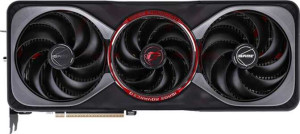
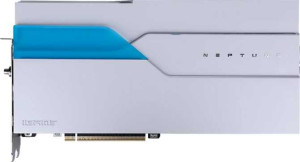
On paper, these two cards share more memory DNA than separates them. Both carry 16GB of GDDR7 across a 256-bit bus, and both support ECC memory — a feature relevant for professional and compute workloads where data integrity matters. The architectural foundation is identical, which means the real differentiation comes down to how fast that shared infrastructure actually runs.
That is where a meaningful gap emerges. The 5080 Neptune operates at an effective memory speed of 30,000 MHz versus 28,000 MHz on the 5070 Ti Advanced OC — a roughly 7% clock advantage that flows directly into bandwidth figures of 960 GB/s versus 896 GB/s. In practical terms, bandwidth is the pipeline that feeds the GPU's shader cores with texture data, frame buffer reads, and compute inputs. A wider, faster pipeline matters most under demanding conditions: high resolutions like 4K, scenes with large texture assets, or AI inference workloads. The 5080's bandwidth edge is modest but consistent, and it complements the compute advantages seen in its raw performance specs.
For this group, the iGame RTX 5080 Neptune OC holds a narrow but real advantage in memory throughput. Crucially, neither card is bandwidth-constrained relative to the other in an absolute sense — both represent the high end of current GDDR7 implementations on a 256-bit bus. However, if you are pushing workloads that are genuinely bandwidth-hungry, the 5080's additional headroom gives it a practical edge the 5070 Ti cannot match.