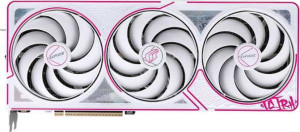
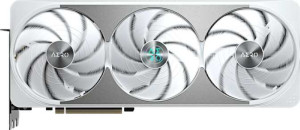
Both cards share the same foundation: identical base clocks of 2295 MHz, the same 8960 shading units, 280 TMUs, 96 ROPs, and matched memory speeds of 1750 MHz. This means the underlying GPU silicon and memory subsystem are equivalent — any performance gap between them comes down entirely to how aggressively each manufacturer has tuned the boost clock.
That is where the Gigabyte GeForce RTX 5070 Ti Aero OC pulls ahead. Its GPU turbo reaches 2588 MHz versus the Colorful iGame's 2497 MHz — a difference of 91 MHz, or roughly 3.6%. Because pixel rate, texture rate, and floating-point throughput all scale directly with clock speed, the Aero OC leads across every derived metric: 46.38 TFLOPS vs 44.75 TFLOPS, 724.6 GTexels/s vs 699.2 GTexels/s, and 248.4 GPixel/s vs 239.7 GPixel/s. In practice, a ~3.6% clock advantage translates to a similarly sized gap in raw rendering throughput — noticeable in benchmarks but unlikely to be felt as a dramatic difference in most games at equivalent settings.
The Gigabyte Aero OC holds a clear but modest performance edge in this group, driven purely by its higher factory boost clock. Both cards support Double Precision Floating Point, so neither has an advantage for compute workloads on that front. For users who prioritize peak out-of-the-box performance without manual overclocking, the Aero OC is the stronger card here — though the margin is narrow enough that thermal behavior and power delivery (not covered in this group) could close or widen that gap in sustained workloads.