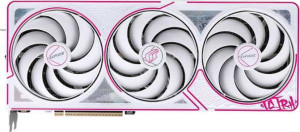
Colorful iGame GeForce RTX 5070 Ti Ultra W OC
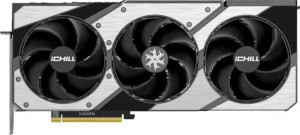
Inno3D GeForce RTX 5070 Ti iChill X3

Colorful iGame GeForce RTX 5070 Ti Ultra W OC Inno3D GeForce RTX 5070 Ti iChill X3

Overview

Welcome to this in-depth specification face-off between the Colorful iGame GeForce RTX 5070 Ti Ultra W OC and the Inno3D GeForce RTX 5070 Ti iChill X3. Both cards are built on the same Blackwell architecture and share an identical memory configuration, yet subtle differences in GPU turbo clocks and physical dimensions could tip the scales for certain buyers. Read on to find out exactly how these two RTX 5070 Ti variants stack up against each other.

Common Features

  • Both cards share a base GPU clock speed of 2295 MHz.
  • Both cards have a GPU memory speed of 1750 MHz.
  • Both cards feature 8960 shading units.
  • Both cards include 280 texture mapping units (TMUs).
  • Both cards have 96 render output units (ROPs).
  • Double Precision Floating Point (DPFP) is supported on both cards.
  • Both cards have an effective memory speed of 28000 MHz.
  • Both cards offer a maximum memory bandwidth of 896 GB/s.
  • Both cards come with 16GB of VRAM.
  • Both cards use GDDR7 memory.
  • Both cards feature a 256-bit memory bus width.
  • ECC memory is supported on both cards.
  • Both cards support DirectX 12 Ultimate.
  • Both cards support OpenGL version 4.6.
  • Both cards support OpenCL version 3.
  • Multi-display technology is supported on both cards.
  • Ray tracing is supported on both cards.
  • 3D support is available on both cards.
  • DLSS is supported on both cards.
  • XeSS (XMX) is not available on either card.
  • Both cards include one HDMI port using HDMI version 2.1b.
  • Both cards feature three DisplayPort outputs.
  • Neither card includes USB-C ports, DVI outputs, or mini DisplayPort outputs.
  • Both cards are based on the Blackwell GPU architecture.
  • Both cards have a Thermal Design Power (TDP) of 300W.
  • Both cards use PCIe version 5.
  • Both cards are manufactured on a 5 nm semiconductor process.
  • Both cards contain 45600 million transistors.
  • Air-water cooling is not available on either card.

Main Differences

  • GPU turbo clock speed is 2497 MHz on the Colorful iGame GeForce RTX 5070 Ti Ultra W OC and 2512 MHz on the Inno3D GeForce RTX 5070 Ti iChill X3.
  • Pixel rate is 239.7 GPixel/s on the Colorful iGame GeForce RTX 5070 Ti Ultra W OC and 241.2 GPixel/s on the Inno3D GeForce RTX 5070 Ti iChill X3.
  • Floating-point performance is 44.75 TFLOPS on the Colorful iGame GeForce RTX 5070 Ti Ultra W OC and 45.02 TFLOPS on the Inno3D GeForce RTX 5070 Ti iChill X3.
  • Texture rate is 699.2 GTexels/s on the Colorful iGame GeForce RTX 5070 Ti Ultra W OC and 703.4 GTexels/s on the Inno3D GeForce RTX 5070 Ti iChill X3.
  • Card width is 331 mm on the Colorful iGame GeForce RTX 5070 Ti Ultra W OC and 334 mm on the Inno3D GeForce RTX 5070 Ti iChill X3.
  • Card height is 139.3 mm on the Colorful iGame GeForce RTX 5070 Ti Ultra W OC and 148 mm on the Inno3D GeForce RTX 5070 Ti iChill X3.
Specs Comparison
Colorful iGame GeForce RTX 5070 Ti Ultra W OC

Colorful iGame GeForce RTX 5070 Ti Ultra W OC

Inno3D GeForce RTX 5070 Ti iChill X3

Inno3D GeForce RTX 5070 Ti iChill X3

Performance:
GPU clock speed 2295 MHz 2295 MHz
GPU turbo 2497 MHz 2512 MHz
pixel rate 239.7 GPixel/s 241.2 GPixel/s
floating-point performance 44.75 TFLOPS 45.02 TFLOPS
texture rate 699.2 GTexels/s 703.4 GTexels/s
GPU memory speed 1750 MHz 1750 MHz
shading units 8960 8960
texture mapping units (TMUs) 280 280
render output units (ROPs) 96 96
Has Double Precision Floating Point (DPFP)

At their core, both the Colorful iGame RTX 5070 Ti Ultra W OC and the Inno3D iChill X3 are built on the same fundamental silicon, sharing identical base clocks of 2295 MHz, the same 8960 shading units, 280 TMUs, 96 ROPs, and matching memory speeds of 1750 MHz. This means the vast majority of their compute throughput is structurally equivalent — both cards draw from the same well of raw GPU resources.

The only meaningful performance differentiator lies in the GPU turbo (boost) clock. The iChill X3 reaches 2512 MHz versus the iGame Ultra W OC's 2497 MHz — a gap of just 15 MHz. This marginal boost advantage cascades into slightly higher derived throughput figures: the iChill X3 leads in pixel rate (241.2 vs 239.7 GPixel/s), texture rate (703.4 vs 699.2 GTexels/s), and floating-point performance (45.02 vs 44.75 TFLOPS). In practice, a 0.6% boost clock difference like this falls well within day-to-day performance variance and would be statistically invisible in real gaming or rendering workloads.

In conclusion, the Inno3D iChill X3 holds a technical edge on paper thanks to its slightly higher turbo clock, but the advantage is so slim that no user would perceive it in actual usage. For all practical purposes, these two cards are performance-equivalent in this spec group, and buying decisions should rest on other factors such as cooling, design, or price rather than these negligible throughput differences.
Memory:
effective memory speed 28000 MHz 28000 MHz
maximum memory bandwidth 896 GB/s 896 GB/s
VRAM 16GB 16GB
GDDR version GDDR7 GDDR7
memory bus width 256-bit 256-bit
Supports ECC memory

Memory is where some GPU matchups are decided — but not this one. The iGame Ultra W OC and the iChill X3 are in complete lockstep across every memory specification: both carry 16GB of GDDR7 over a 256-bit bus, running at an effective speed of 28000 MHz and delivering 896 GB/s of peak bandwidth. There is no tiebreaker to be found here.

What these shared numbers do tell us is that both cards are well-equipped for demanding modern workloads. GDDR7 represents a generational leap in memory efficiency and throughput over GDDR6X, and 896 GB/s of bandwidth is substantial enough to feed the GPU's shading units without bottlenecking even at high resolutions or with ray tracing enabled. The 16GB frame buffer, meanwhile, provides comfortable headroom for 4K gaming, large texture packs, and AI-accelerated features — use cases where 8GB or 12GB cards can visibly struggle.

Both cards also support ECC memory, a feature typically associated with professional and workstation GPUs that helps detect and correct memory errors — a minor but noteworthy bonus for users doing precision compute work. The verdict here is a complete tie: memory configuration is identical in every measurable way, and neither card holds any advantage in this group.

Features:
DirectX version DirectX 12 Ultimate DirectX 12 Ultimate
OpenGL version 4.6 4.6
OpenCL version 3 3
Supports multi-display technology
supports ray tracing
Supports 3D
supports DLSS
has XeSS (XMX)
AMD SAM / Intel Resizable BAR Intel Resizable BAR Intel Resizable BAR
has LHR
has RGB lighting
supported displays 4 4

Feature parity continues to be the defining theme of this matchup. Both the iGame Ultra W OC and the iChill X3 support DirectX 12 Ultimate and ray tracing — the two pillars of modern GPU feature sets. DirectX 12 Ultimate ensures compatibility with the full suite of current-gen rendering techniques, including mesh shaders and variable-rate shading, while hardware ray tracing support means both cards can handle physically accurate lighting and reflections without falling back to slower software-based methods.

On the upscaling front, both cards support DLSS but not XeSS — which is expected given these are NVIDIA parts. DLSS, particularly in its latest iterations, is widely regarded as one of the strongest AI-driven upscaling solutions available, allowing users to push higher frame rates or resolutions with minimal perceptible quality loss. Intel Resizable BAR support on both cards also enables the CPU to access the full GPU frame buffer simultaneously, a feature that can yield modest but real frame rate improvements in compatible systems. Neither card has LHR (Lite Hash Rate) limitations, though this is largely a moot point in the current market context.

Both cards round out their feature sets with RGB lighting and support for up to 4 simultaneous displays — useful for multi-monitor productivity or sim-racing setups. With no divergence across any single feature in this group, the result is an unambiguous tie: buyers gain exactly the same software and API capabilities regardless of which card they choose.

Ports:
has an HDMI output
HDMI ports 1 1
HDMI version HDMI 2.1b HDMI 2.1b
DisplayPort outputs 3 3
USB-C ports 0 0
DVI outputs 0 0
mini DisplayPort outputs 0 0

Connectivity is another area where these two cards offer no grounds for differentiation. Both the iGame Ultra W OC and the iChill X3 ship with an identical port layout: 3 DisplayPort outputs and 1 HDMI 2.1b port, totaling four display outputs — which aligns with the four-display limit noted in their features. The absence of USB-C, DVI, or mini DisplayPort outputs is consistent with modern high-end GPU design, where those legacy or niche connectors have been largely phased out.

The presence of HDMI 2.1b is worth highlighting as a genuinely useful specification. It supports 4K at up to 144Hz and 8K at up to 120Hz without compression, and is also the standard required for variable refresh rate over HDMI to modern TVs — relevant for users who game on a large screen rather than a dedicated monitor. The three DisplayPort outputs, meanwhile, comfortably cover high-refresh-rate PC monitor setups, including multi-monitor configurations up to the four-display maximum.

There is nothing to separate these two cards on ports — the layout, versions, and counts are a perfect match. Users on either side of this comparison can expect the same connectivity options and the same degree of future-proofing for their display setup.

General info:
GPU architecture Blackwell Blackwell
release date February 2025 February 2025
Thermal Design Power (TDP) 300W 300W
PCI Express (PCIe) version 5 5
semiconductor size 5 nm 5 nm
number of transistors 45600 million 45600 million
Has air-water cooling
width 331 mm 334 mm
height 139.3 mm 148 mm

Underneath their respective coolers, these two cards are built on identical foundations. Both run NVIDIA's Blackwell architecture on a 5nm process node with 45.6 billion transistors, draw the same 300W TDP, and connect via PCIe 5.0. The shared TDP is particularly important for build planning — both cards impose the same power delivery requirements, so neither offers an efficiency advantage, and both will need adequate case airflow and PSU headroom to operate optimally.

Where this group finally surfaces a difference is in physical dimensions. The iChill X3 is measurably larger: 334 mm wide and 148 mm tall, compared to the iGame Ultra W OC's 331 mm width and 139.3 mm height. The 8.7mm height gap is the more significant of the two — in cases with tight vertical clearance or where the card sits close to a side panel, that extra height could matter. The width difference of 3mm is negligible for most builds. Neither card uses liquid cooling, so both rely entirely on their air cooler designs to manage that 300W thermal load.

On the whole, the iGame Ultra W OC holds a modest but real advantage here for users with space-constrained builds, thanks to its slightly more compact footprint. For everyone else with a standard mid-tower or larger, the dimensional difference is unlikely to influence a buying decision — the two cards are otherwise indistinguishable at the platform and architecture level.

Comparison Summary & Verdict

After examining every specification, it is clear that the Colorful iGame GeForce RTX 5070 Ti Ultra W OC and the Inno3D GeForce RTX 5070 Ti iChill X3 are remarkably close competitors. Both deliver identical 16GB GDDR7 memory, a 300W TDP, and full support for ray tracing and DLSS. Where they diverge is in the finer details: the Inno3D card edges ahead with a slightly higher GPU turbo clock of 2512 MHz and marginally better compute figures of 45.02 TFLOPS, making it the better choice for enthusiasts who want every last drop of performance. The Colorful card, on the other hand, is the more compact option at 139.3 mm tall versus 148 mm, which may matter in smaller or tighter chassis builds. Choose the Inno3D for peak clock speeds; choose the Colorful for a slightly smaller footprint.

Colorful iGame GeForce RTX 5070 Ti Ultra W OC
Buy Colorful iGame GeForce RTX 5070 Ti Ultra W OC if...

Buy the Colorful iGame GeForce RTX 5070 Ti Ultra W OC if you need a more compact card, as its smaller height of 139.3 mm makes it the better fit for tighter PC cases.

Inno3D GeForce RTX 5070 Ti iChill X3
Buy Inno3D GeForce RTX 5070 Ti iChill X3 if...

Buy the Inno3D GeForce RTX 5070 Ti iChill X3 if you want the highest possible out-of-the-box performance, thanks to its higher GPU turbo clock of 2512 MHz and leading floating-point output of 45.02 TFLOPS.