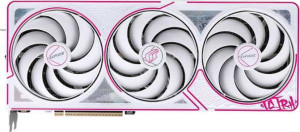
Colorful iGame GeForce RTX 5070 Ti Ultra W OC
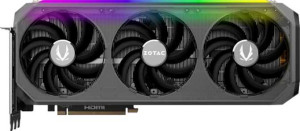
Zotac Gaming GeForce RTX 5070 Ti AMP Extreme Infinity

Colorful iGame GeForce RTX 5070 Ti Ultra W OC Zotac Gaming GeForce RTX 5070 Ti AMP Extreme Infinity

Overview

Choosing between two premium RTX 5070 Ti cards from different manufacturers can be a challenge when both share so much common ground. This page puts the Colorful iGame GeForce RTX 5070 Ti Ultra W OC directly against the Zotac Gaming GeForce RTX 5070 Ti AMP Extreme Infinity, examining the key battlegrounds of GPU turbo clock speeds, floating-point performance, texture rates, and physical dimensions to help you determine which card is the right fit for your build.

Common Features

  • Both cards share a base GPU clock speed of 2295 MHz.
  • Both cards have a GPU memory speed of 1750 MHz.
  • Both cards feature 8960 shading units.
  • Both cards include 280 texture mapping units (TMUs).
  • Both cards have 96 render output units (ROPs).
  • Double Precision Floating Point (DPFP) is supported on both cards.
  • Both cards have an effective memory speed of 28000 MHz.
  • Both cards offer a maximum memory bandwidth of 896 GB/s.
  • Both cards come with 16GB of VRAM.
  • Both cards use GDDR7 memory.
  • Both cards have a 256-bit memory bus width.
  • ECC memory is supported on both cards.
  • Both cards support DirectX 12 Ultimate.
  • Both cards support OpenGL version 4.6.
  • Both cards support OpenCL version 3.
  • Multi-display technology is supported on both cards.
  • Ray tracing is supported on both cards.
  • 3D output is supported on both cards.
  • DLSS is supported on both cards.
  • XeSS (XMX) is not available on either card.
  • Both cards include one HDMI 2.1b output port.
  • Both cards feature three DisplayPort outputs.
  • Neither card includes any USB-C or DVI outputs.
  • Both cards are based on the Blackwell GPU architecture.
  • Both cards have a Thermal Design Power (TDP) of 300W.
  • Both cards use PCIe version 5.
  • Both cards are manufactured on a 5 nm semiconductor process.
  • Both cards feature 45600 million transistors.
  • Air-water cooling is not available on either card.

Main Differences

  • GPU turbo clock speed is 2497 MHz on Colorful iGame GeForce RTX 5070 Ti Ultra W OC and 2512 MHz on Zotac Gaming GeForce RTX 5070 Ti AMP Extreme Infinity.
  • Pixel rate is 239.7 GPixel/s on Colorful iGame GeForce RTX 5070 Ti Ultra W OC and 241.2 GPixel/s on Zotac Gaming GeForce RTX 5070 Ti AMP Extreme Infinity.
  • Floating-point performance is 44.75 TFLOPS on Colorful iGame GeForce RTX 5070 Ti Ultra W OC and 45.02 TFLOPS on Zotac Gaming GeForce RTX 5070 Ti AMP Extreme Infinity.
  • Texture rate is 699.2 GTexels/s on Colorful iGame GeForce RTX 5070 Ti Ultra W OC and 703.4 GTexels/s on Zotac Gaming GeForce RTX 5070 Ti AMP Extreme Infinity.
  • Card width is 331 mm on Colorful iGame GeForce RTX 5070 Ti Ultra W OC and 332.1 mm on Zotac Gaming GeForce RTX 5070 Ti AMP Extreme Infinity.
  • Card height is 139.3 mm on Colorful iGame GeForce RTX 5070 Ti Ultra W OC and 137.5 mm on Zotac Gaming GeForce RTX 5070 Ti AMP Extreme Infinity.
Specs Comparison
Colorful iGame GeForce RTX 5070 Ti Ultra W OC

Colorful iGame GeForce RTX 5070 Ti Ultra W OC

Zotac Gaming GeForce RTX 5070 Ti AMP Extreme Infinity

Zotac Gaming GeForce RTX 5070 Ti AMP Extreme Infinity

Performance:
GPU clock speed 2295 MHz 2295 MHz
GPU turbo 2497 MHz 2512 MHz
pixel rate 239.7 GPixel/s 241.2 GPixel/s
floating-point performance 44.75 TFLOPS 45.02 TFLOPS
texture rate 699.2 GTexels/s 703.4 GTexels/s
GPU memory speed 1750 MHz 1750 MHz
shading units 8960 8960
texture mapping units (TMUs) 280 280
render output units (ROPs) 96 96
Has Double Precision Floating Point (DPFP)

At the core, both the Colorful iGame RTX 5070 Ti Ultra W OC and the Zotac Gaming RTX 5070 Ti AMP Extreme Infinity share identical silicon configurations: 8960 shading units, 280 TMUs, and 96 ROPs. This means neither card has a structural hardware advantage — any performance differences come purely from clock speeds, which are where factory overclocking decisions play out.

The base GPU clock is exactly the same at 2295 MHz, but the two cards diverge under boost conditions. The Zotac AMP Extreme Infinity reaches a turbo of 2512 MHz versus the Colorful iGame's 2497 MHz — a 15 MHz difference. That gap flows directly into every derived metric: the Zotac edges ahead with 45.02 TFLOPS of floating-point throughput versus 44.75 TFLOPS, and a texture rate of 703.4 GTexels/s versus 699.2 GTexels/s. In practical terms, this is a sub-1% advantage — imperceptible in real-world gaming framerates and unlikely to be measurable outside of synthetic benchmarks.

In conclusion, the Zotac holds a narrow but technically factual edge in peak performance thanks to its slightly higher boost clock. However, given the virtually identical shader and rasterization hardware, and the negligible clock delta, these two cards are effectively performance-equivalent for any real-world workload. The decision between them should rest on factors outside this spec group — thermal design, noise, memory, or price — rather than raw compute numbers.
Memory:
effective memory speed 28000 MHz 28000 MHz
maximum memory bandwidth 896 GB/s 896 GB/s
VRAM 16GB 16GB
GDDR version GDDR7 GDDR7
memory bus width 256-bit 256-bit
Supports ECC memory

Memory is one area where these two cards offer absolutely no grounds for differentiation. Both carry 16GB of GDDR7 across a 256-bit bus, hitting an effective speed of 28000 MHz and delivering 896 GB/s of bandwidth — figures that are identical down to the last specification.

That said, the shared memory configuration is worth understanding in context. GDDR7 represents a generational leap in memory technology, and 896 GB/s of bandwidth is substantial — it ensures the GPU's shader and texture hardware is rarely starved of data, which matters most in high-resolution workloads like 4K gaming or large texture environments. The 16GB frame buffer is also well-suited for today's VRAM-hungry titles and creative applications. ECC memory support on both cards is a quiet but meaningful inclusion, providing error correction that benefits professional and compute workloads where data integrity is critical.

This group is a complete tie. Every single memory specification is shared between the Colorful iGame RTX 5070 Ti Ultra W OC and the Zotac Gaming RTX 5070 Ti AMP Extreme Infinity, so neither card holds any advantage here. Memory should play no role in choosing between these two GPUs.

Features:
DirectX version DirectX 12 Ultimate DirectX 12 Ultimate
OpenGL version 4.6 4.6
OpenCL version 3 3
Supports multi-display technology
supports ray tracing
Supports 3D
supports DLSS
has XeSS (XMX)
AMD SAM / Intel Resizable BAR Intel Resizable BAR Intel Resizable BAR
has LHR
has RGB lighting
supported displays 4 4

Feature parity is total between these two cards. Both support DirectX 12 Ultimate — the current gold standard for gaming APIs, enabling hardware-accelerated ray tracing, mesh shaders, and variable-rate shading in supported titles. Alongside that, DLSS support is a meaningful shared asset, giving users access to NVIDIA's AI-driven upscaling technology that can significantly boost framerates with minimal visual quality loss, particularly at 4K.

Ray tracing support on both cards is worth noting beyond the checkbox — as an RTX 5070 Ti-class GPU, the underlying hardware is capable of handling ray tracing workloads at a level where the feature is genuinely usable, not just technically present. Multi-display support across up to 4 simultaneous outputs serves both multi-monitor gaming setups and productivity users equally well on either card. Intel Resizable BAR is also enabled on both, which allows the CPU to access the full GPU frame buffer at once — a feature that yields modest but real performance gains in supported games.

There is no differentiator to be found in this group. Every software feature, API version, and capability listed is shared identically by the Colorful iGame RTX 5070 Ti Ultra W OC and the Zotac Gaming RTX 5070 Ti AMP Extreme Infinity, making this another complete tie. Feature set should not factor into the buying decision between these two.

Ports:
has an HDMI output
HDMI ports 1 1
HDMI version HDMI 2.1b HDMI 2.1b
DisplayPort outputs 3 3
USB-C ports 0 0
DVI outputs 0 0
mini DisplayPort outputs 0 0

Connectivity is straightforward and identical on both cards: a layout of 3 DisplayPort outputs and 1 HDMI 2.1b port covers the full four-display maximum that both GPUs support. HDMI 2.1b is the latest revision of the standard, capable of handling 4K at high refresh rates and 8K output — making it future-proof for next-generation displays and home theater setups alike. The three DisplayPort outputs similarly provide ample flexibility for high-refresh-rate gaming monitors in multi-display configurations.

Notably absent on both cards is a USB-C port, which some competing GPUs include to support direct connection to USB-C monitors or VR headsets without an adapter. Neither card offers this, so users with USB-C display requirements will need to rely on adapters regardless of which they choose — that limitation applies equally to both.

With an identical port count, layout, and HDMI version, this category is a complete tie. The Colorful iGame RTX 5070 Ti Ultra W OC and the Zotac Gaming RTX 5070 Ti AMP Extreme Infinity offer the exact same connectivity options, and display setup compatibility will be no different between them.

General info:
GPU architecture Blackwell Blackwell
release date February 2025 February 2025
Thermal Design Power (TDP) 300W 300W
PCI Express (PCIe) version 5 5
semiconductor size 5 nm 5 nm
number of transistors 45600 million 45600 million
Has air-water cooling
width 331 mm 332.1 mm
height 139.3 mm 137.5 mm

Fundamentally, these two cards are cut from the same cloth. Both are built on NVIDIA's Blackwell architecture using a 5nm process with 45.6 billion transistors — the same silicon foundation that defines their performance ceiling and efficiency characteristics equally. A shared 300W TDP means power delivery and cooling requirements are identical, so neither card will demand more from a PSU or case airflow than the other.

PCIe 5.0 support on both is worth a brief mention: while current-generation systems rarely saturate even PCIe 4.0 bandwidth for gaming, PCIe 5.0 compatibility provides longevity as platform bandwidth demands grow over time. Both cards also rely entirely on air cooling, with no hybrid water-cooling option — a relevant note for users building in thermally constrained cases who might have hoped for a factory water-cooled variant.

Physical dimensions are where the only measurable divergence appears, and it is marginal: the Zotac AMP Extreme Infinity is fractionally wider at 332.1 mm versus 331 mm, while the Colorful iGame is slightly taller at 139.3 mm versus 137.5 mm. These differences are under 2mm in either direction and will have no practical impact on case compatibility for the overwhelming majority of builds. Overall, this group is effectively a tie — the two cards are physically and architecturally near-identical, and neither holds a meaningful advantage here.

Comparison Summary & Verdict

Both the Colorful iGame GeForce RTX 5070 Ti Ultra W OC and the Zotac Gaming GeForce RTX 5070 Ti AMP Extreme Infinity are built on the same Blackwell architecture, share identical 16GB GDDR7 memory with 896 GB/s bandwidth, and offer the same feature set including ray tracing, DLSS, and DirectX 12 Ultimate support. The differences between them are slim but measurable: the Zotac edges ahead with a higher GPU turbo clock of 2512 MHz, a slightly better floating-point performance of 45.02 TFLOPS, and a marginally superior texture rate. The Colorful card, meanwhile, is fractionally narrower at 331 mm versus 332.1 mm. For users who want every last drop of out-of-the-box performance, the Zotac is the stronger choice, while the Colorful suits those who value a marginally more compact footprint without sacrificing any core features.

Colorful iGame GeForce RTX 5070 Ti Ultra W OC
Buy Colorful iGame GeForce RTX 5070 Ti Ultra W OC if...

Buy the Colorful iGame GeForce RTX 5070 Ti Ultra W OC if you want a slightly more compact card width of 331 mm while retaining the full RTX 5070 Ti feature set.

Zotac Gaming GeForce RTX 5070 Ti AMP Extreme Infinity
Buy Zotac Gaming GeForce RTX 5070 Ti AMP Extreme Infinity if...

Buy the Zotac Gaming GeForce RTX 5070 Ti AMP Extreme Infinity if you want the marginally higher GPU turbo clock, pixel rate, texture rate, and floating-point performance of the two cards.