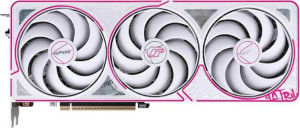
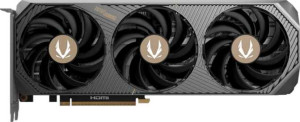
Both the Colorful iGame RTX 5070 Ultra W OC and the Zotac Gaming RTX 5070 Solid share an identical foundation: the same 2325 MHz base clock, 6144 shading units, 192 TMUs, 80 ROPs, and 1750 MHz memory speed. This means both cards draw from the same underlying GPU silicon and memory subsystem, giving them a near-identical performance floor under light or non-boosted workloads.
The meaningful separation appears at boost clocks. The iGame Ultra W OC reaches a 2557 MHz GPU turbo versus the Zotac Solid's 2512 MHz — a 45 MHz advantage that flows directly into every derived throughput metric. Its 31.42 TFLOPS of floating-point performance edges out the Zotac's 30.87 TFLOPS, and its texture rate of 490.9 GTexels/s versus 482.3 GTexels/s translates to marginally faster texture processing in complex scenes. In practice, this ~1.8% gap is unlikely to be perceptible in most gaming scenarios, but in sustained, boost-heavy workloads — think ray tracing, compute tasks, or AI-accelerated features — the iGame's higher sustained ceiling gives it a slight but consistent edge.
In summary, the iGame Ultra W OC holds a narrow performance advantage over the Zotac Solid, driven entirely by its higher factory boost clock. The Zotac Solid is not meaningfully slower for everyday use, but if peak throughput matters — particularly in compute or heavily GPU-bound rendering — the iGame is the stronger card based strictly on these specs.