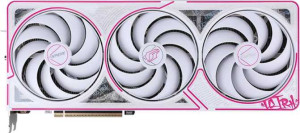
Both cards are built on an identical hardware foundation: the same 10,752 shading units, 336 TMUs, 112 ROPs, and a base clock of 2295 MHz. Memory bandwidth potential is also equal, with both running at 1875 MHz GPU memory speed. This means the two cards are essentially the same silicon configured at the same starting point, and any performance gap will come entirely from how aggressively each manufacturer's factory overclock pushes the boost behavior.
That is where a small but consistent separation emerges. The Colorful iGame GeForce RTX 5080 Ultra W OC reaches a GPU turbo of 2655 MHz, compared to 2640 MHz on the Inno3D GeForce RTX 5080 X3 OC — a 15 MHz advantage. Modest as that gap sounds, it compounds across every derived metric: the iGame edges ahead with 57.09 TFLOPS of floating-point throughput versus 56.77 TFLOPS, a texture rate of 892.1 GTexels/s versus 887 GTexels/s, and a pixel fill rate of 297.4 GPixel/s versus 295.7 GPixel/s. In practice, these differences — roughly 0.5% across the board — will not be perceptible in any real-world workload or benchmark result.
In summary, the iGame Ultra W OC holds a technical edge on paper thanks to its slightly higher turbo clock, but the margin is so slim that these two cards are effectively performance-identical for any practical purpose. The decision between them should rest on cooling design, acoustics, price, and build quality rather than the negligible compute gap shown here.