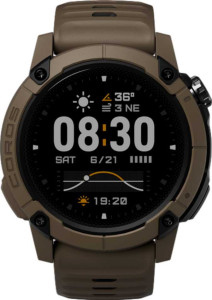
Coros Nomad
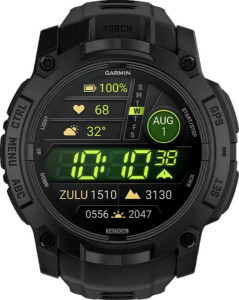
Garmin Instinct 3 AMOLED Tactical Edition

Coros Nomad Garmin Instinct 3 AMOLED Tactical Edition

Overview

When comparing the Coros Nomad and the Garmin Instinct 3 AMOLED Tactical Edition, two serious contenders in the rugged outdoor smartwatch space emerge with very different philosophies. This head-to-head dives into key battlegrounds including display technology and resolution, battery endurance, sensor capabilities, and smart connectivity features to help you decide which watch truly fits your lifestyle and demands.

Common Features

  • Both watches are waterproof.
  • Neither watch features branded damage-resistant glass.
  • The watch band is replaceable on both watches.
  • Neither watch has a sapphire glass display.
  • Both watches have an Always-On Display.
  • Both watches have GPS.
  • Both watches have a heart rate monitor.
  • Both watches monitor blood oxygenation levels.
  • Both watches have a barometer.
  • Both watches have an accelerometer.
  • Both watches have a compass.
  • Both watches have a temperature sensor.
  • Both watches have a gyroscope.
  • Both watches have a route tracker.
  • Both watches track distance and measure pace.
  • Both watches track sleep and support multi-sport mode.
  • Both watches are compatible with iOS and Android.
  • Neither watch supports Wi-Fi or has a cellular module.
  • Neither watch has wireless charging or a solar power battery.
  • Both watches have a rechargeable, non-removable battery.
  • Both watches support HRV tracking and measure VO2 max.
  • Both watches have a stopwatch, silent alarm, and phone locator.
  • Both watches provide activity reports, inactivity alerts, calorie tracking, goal setting, achievements, an exercise diary, and a free ad-free app.
  • Both watches have a battery level indicator and auto pause.
  • Both watches are compatible with external heart rate monitors and available on PC.
  • Neither watch has an external memory slot or a 3.5 mm audio jack socket.

Main Differences

  • Screen size is 1.4″ on Coros Nomad and 1.3″ on Garmin Instinct 3 AMOLED Tactical Edition.
  • Display type is LCD on Coros Nomad and OLED/AMOLED on Garmin Instinct 3 AMOLED Tactical Edition.
  • ATM rating is 5 ATM on Coros Nomad and 10 ATM on Garmin Instinct 3 AMOLED Tactical Edition.
  • Resolution is 260 x 260 px on Coros Nomad and 416 x 416 px on Garmin Instinct 3 AMOLED Tactical Edition.
  • Touchscreen support is present on Coros Nomad but not available on Garmin Instinct 3 AMOLED Tactical Edition.
  • Weight is 61 g on Coros Nomad and 59 g on Garmin Instinct 3 AMOLED Tactical Edition.
  • Thickness is 16.4 mm on Coros Nomad and 14.4 mm on Garmin Instinct 3 AMOLED Tactical Edition.
  • Height is 47.8 mm on Coros Nomad and 50 mm on Garmin Instinct 3 AMOLED Tactical Edition.
  • Pixel density is 282 ppi on Coros Nomad and 452 ppi on Garmin Instinct 3 AMOLED Tactical Edition.
  • Width is 47.8 mm on Coros Nomad and 50 mm on Garmin Instinct 3 AMOLED Tactical Edition.
  • Band width is 24 mm on Coros Nomad and 26 mm on Garmin Instinct 3 AMOLED Tactical Edition.
  • Volume is 37.47 cm³ on Coros Nomad and 36 cm³ on Garmin Instinct 3 AMOLED Tactical Edition.
  • A cadence sensor is present on Garmin Instinct 3 AMOLED Tactical Edition but not available on Coros Nomad.
  • Golf-specific design features are present on Garmin Instinct 3 AMOLED Tactical Edition but not available on Coros Nomad.
  • ANT+ support is present on Garmin Instinct 3 AMOLED Tactical Edition but not available on Coros Nomad.
  • NFC support is present on Garmin Instinct 3 AMOLED Tactical Edition but not available on Coros Nomad.
  • Battery life is 22 days on Coros Nomad and 9 days on Garmin Instinct 3 AMOLED Tactical Edition.
  • Battery life with GPS on is 34 hours on Coros Nomad and 40 hours on Garmin Instinct 3 AMOLED Tactical Edition.
  • Map uploading is supported on Coros Nomad but not available on Garmin Instinct 3 AMOLED Tactical Edition.
  • Irregular heart rate warnings are available on Coros Nomad but not on Garmin Instinct 3 AMOLED Tactical Edition.
  • Fall detection is present on Garmin Instinct 3 AMOLED Tactical Edition but not available on Coros Nomad.
  • Call control is available on Coros Nomad but not on Garmin Instinct 3 AMOLED Tactical Edition.
  • Sunrise/sunset time information is provided on Garmin Instinct 3 AMOLED Tactical Edition but not on Coros Nomad.
  • Internal storage is 32GB on Coros Nomad and 4GB on Garmin Instinct 3 AMOLED Tactical Edition.
  • Thunderstorm risk alerts are available on Garmin Instinct 3 AMOLED Tactical Edition but not on Coros Nomad.
  • Personalisation options are available on Garmin Instinct 3 AMOLED Tactical Edition but not on Coros Nomad.
Specs Comparison
Coros Nomad

Coros Nomad

Garmin Instinct 3 AMOLED Tactical Edition

Garmin Instinct 3 AMOLED Tactical Edition

Design:
screen size 1.4" 1.3"
Display type LCD OLED/AMOLED
water resistance Waterproof Waterproof
has branded damage-resistant glass
ATM rating 5 ATM 10 ATM
resolution 260 x 260 px 416 x 416 px
Watch band is replaceable
has a touch screen
weight 61 g 59 g
Has sapphire glass display
thickness 16.4 mm 14.4 mm
Always-On Display
height 47.8 mm 50 mm
pixel density 282 ppi 452 ppi
Has a display
width 47.8 mm 50 mm
width of band 24 mm 26 mm
volume 37.471376 cm³ 36 cm³

The most consequential design difference between these two watches is the display technology. The Coros Nomad uses an LCD panel at 260 x 260 px (282 ppi), while the Garmin Instinct 3 AMOLED Tactical sports an AMOLED screen at 416 x 416 px (452 ppi). In practice, AMOLED delivers deeper blacks, higher contrast, and more vivid colors compared to LCD — and at nearly 60% more pixels per inch, the Garmin renders maps, text, and data fields noticeably sharper. The Coros partially compensates with a marginally larger 1.4″ screen versus the Garmin's 1.3″, but the density gap still heavily favors the Garmin for readability and visual quality.

On the physical side, the two watches are surprisingly close in weight — 61 g vs. 59 g — meaning neither will feel meaningfully lighter on the wrist. Where they diverge is thickness and water resistance: the Garmin is 2 mm slimmer at 14.4 mm and carries a more robust 10 ATM water rating versus the Coros's 5 ATM, making it the better choice for swimming or high-pressure water exposure. One notable trade-off is that the Coros includes a touchscreen, while the Garmin is button-only — a deliberate tactical design choice for gloved-hand or extreme-condition operability, but a limitation for those who prefer swipe navigation.

Overall, the Garmin Instinct 3 AMOLED Tactical has a clear design edge in display quality and water resistance, while the Coros Nomad offers the convenience of touch interaction and a fractionally larger screen canvas. Both share always-on display capability and replaceable bands, but users who prioritize visual clarity and durability will find the Garmin's specifications more compelling.

Sensors:
has GPS
Has a heart rate monitor
Monitors blood oxygenation levels
Has a barometer
has an accelerometer
has a compass
Has a temperature sensor
Has a cadence sensor
has a gyroscope
Has a wind speed sensor
Monitors perspiration

Across the core sensor suite, these two watches are remarkably aligned. Both carry GPS, heart rate monitoring, blood oxygen (SpO2), barometer, accelerometer, compass, temperature sensor, and gyroscope — a comprehensive foundation that covers navigation, altitude tracking, fitness monitoring, and motion detection for serious outdoor use. For the vast majority of activities, either watch gives you the same raw data-gathering capability.

The single differentiator in this category is the cadence sensor, which the Garmin Instinct 3 AMOLED Tactical includes and the Coros Nomad does not. A cadence sensor measures steps per minute for running or pedal revolutions per minute for cycling — data that is particularly valuable for athletes looking to optimize their running efficiency or pacing strategy. Its absence on the Coros is a genuine gap for performance-focused users, though it has no impact on general outdoor or navigation use cases.

On balance, the Garmin holds a narrow but real edge here strictly due to cadence tracking. For trail runners, cyclists, or multi-sport athletes who rely on cadence metrics, this distinction matters. For hikers, tactical users, or those focused on general health monitoring, the sensor parity between the two watches is effectively complete.

Activity tracking:
Has a route tracker
Tracks distance
Measures pace
Has trackback mode
Tracks your sleep
Has multi-sport mode
Detects activities automatically
Tracks elevation
Tracks steps taken
Provides sleep reports
Has exercise tagging
Has a stroke counter for swimming
Tracks calorie intake
Designed for diving
Designed for golf

Activity tracking is one of the strongest points of agreement between these two watches — virtually every capability listed is shared by both. Route tracking, pace, elevation, sleep monitoring with reports, multi-sport mode, automatic activity detection, swim stroke counting, and calorie intake tracking are all present on both the Coros Nomad and the Garmin Instinct 3 AMOLED Tactical. For most athletes and outdoor enthusiasts, this shared breadth means neither watch leaves you wanting for core tracking functionality.

The only differentiator in this group is golf mode, which the Garmin supports and the Coros does not. Golf-specific features typically include course mapping, shot distance tracking, and scoring — functionality that is irrelevant to the Coros Nomad's apparent outdoor and tactical positioning, but a genuine bonus for Garmin users who play the course as well as the trail.

In practice, this group is essentially a tie for anyone not interested in golf. The Garmin earns a marginal edge solely due to its golf support, but the Coros Nomad matches it completely across every other tracked activity. Users should not let this single distinction drive their decision unless golf tracking is genuinely part of their lifestyle.

Connectivity:
Is compatible with iOS
Is compatible with Android
supports Wi-Fi
has a cellular module
supports ANT+
has NFC

Both watches share the same baseline connectivity profile — compatible with iOS and Android, but lacking Wi-Fi and a cellular module. That means neither can operate independently of a paired phone for data syncing or notifications, and neither supports over-the-air map or software updates without a Bluetooth connection to a device. For most users in this product category, that is an expected and acceptable trade-off in favor of battery life.

Where the Garmin Instinct 3 AMOLED Tactical pulls ahead is in two additional protocols: ANT+ and NFC. ANT+ is particularly significant for serious athletes — it enables wireless pairing with third-party accessories like external heart rate straps, power meters, cadence sensors, and cycling computers, expanding the Garmin's ecosystem considerably beyond what its onboard sensors alone provide. NFC, meanwhile, enables contactless payments directly from the wrist, adding a layer of everyday convenience the Coros Nomad simply cannot match.

The Garmin holds a clear connectivity advantage here. The absence of ANT+ on the Coros is a meaningful limitation for multi-sport athletes who rely on external accessories, and the lack of NFC removes a practical daily-use feature. Users who operate within a broader fitness accessory ecosystem, or who want to pay on the go, will find the Garmin's connectivity spec sheet substantially more capable.

Battery:
battery life 22 days 9 days
battery life with GPS on 34 hours 40 hours
has wireless charging
Has a solar power battery
has a rechargeable battery
has a removable battery

Battery life is where the Coros Nomad establishes its most dominant advantage in this entire comparison. Its rated smartwatch endurance of 22 days dwarfs the Garmin Instinct 3 AMOLED Tactical's 9 days — a gap of nearly two and a half times. For extended expeditions, remote deployments, or simply users who dislike frequent charging, this difference is not marginal; it fundamentally changes how often you need access to a power source. The Garmin's 9-day figure is respectable for an AMOLED watch, but it reflects the well-known energy cost of that display technology compared to the Coros's LCD.

The dynamic shifts when GPS is active. Here the Garmin actually pulls ahead with 40 hours of GPS-on runtime versus the Coros's 34 hours. This is a noteworthy reversal — the Garmin edges out the Coros for continuous navigation sessions, which matters most for ultra-endurance athletes or multi-day route tracking without turning GPS off. Neither figure, however, is sufficient for events stretching beyond roughly 40 hours without a recharge.

Neither watch supports wireless charging or solar input, so both rely entirely on their internal rechargeable batteries. On balance, the Coros Nomad wins this category decisively for everyday and expedition use thanks to its commanding 22-day smartwatch endurance, while the Garmin holds a narrower but real edge for sustained GPS-heavy use cases. The right choice depends on whether battery longevity in daily wear or prolonged GPS tracking is the bigger priority.

Features:
release date August 2025 April 2025
has HRV tracking
measures VO2 max
measures resting heart rate
has fast/slow heart rate notifications
shows readiness level
Can upload maps
Has a stopwatch
Locates your phone
Has silent alarm
has irregular heart rate warnings
has fall detection
Has notifications
Acquires GPS faster
Has call control
Provides the sunrise/sunset time
internal storage 32GB 4GB
Can be used to answer calls
supports Galileo
Has smart alarm
Informs about the risk of thunderstorms
has voice commands
Has a built-in camera remote control function

Both watches share a strong common foundation — HRV tracking, VO2 max, readiness scoring, fast/slow heart rate notifications, and Galileo satellite support all appear on both devices, giving either a capable health and navigation feature set. The divergence, however, lies in a handful of specific capabilities that reveal clearly different design philosophies. The Coros Nomad supports map uploading and backs it up with a substantial 32GB of internal storage, compared to the Garmin's 4GB with no map upload support. For backcountry navigation, this is a significant practical edge — the Coros can carry detailed offline maps directly on the watch, while the Garmin cannot.

The Garmin counters with a different set of real-world utilities. Fall detection, sunrise/sunset times, and thunderstorm risk alerts are all exclusive to the Garmin Instinct 3 AMOLED Tactical. Fall detection adds a meaningful safety layer for solo hikers or tactical users in rugged terrain. Environmental awareness features like storm warnings and sun timing are genuinely useful for outdoor trip planning and safety — absences that are mildly surprising on the Coros given its outdoor positioning. The Coros, for its part, includes irregular heart rate warnings and call control, neither of which the Garmin offers.

This group ends in a context-dependent split rather than a clean winner. The Coros Nomad has a decisive edge for navigation-focused users thanks to map uploading and its cavernous storage advantage. The Garmin edges ahead for safety-conscious and environmentally aware outdoor use with fall detection and weather alerting. Users should weigh which cluster of features aligns more closely with their primary use case.

App & Software:
Provides activity reports
Has inactivity alerts
Counts how many calories you've burned
Has goal setting
Has achievements
Free app
Has exercise diary
Ad-free
Has weight tracking
Tracks water intake
Has coaching
Has temperature tracking
Supports routes
Syncs with existing calendars
Has music playback
Doesn’t require account
Predicts start date
Supports widgets
Can be personalised
Has barcode scanner on app

Of all the specification groups in this comparison, App & Software is the closest to a dead heat. Every single feature listed — activity reports, coaching, goal setting, exercise diary, route support, calendar sync, music playback, menstrual cycle prediction, widgets, water and temperature tracking, and more — is shared by both companion apps. Both are free and ad-free, which is worth noting given that some competing platforms gate meaningful functionality behind subscriptions.

The only distinction in the entire group is app personalisation, which the Garmin Instinct 3 AMOLED Tactical supports and the Coros Nomad does not. In practice, personalisation typically refers to the ability to customize dashboards, data layouts, and the overall app experience to match individual preferences. It is not a transformative feature, but for users who spend significant time in the companion app reviewing training data, the ability to tailor that experience to their workflow adds genuine day-to-day value.

The Garmin claims a marginal edge here on the strength of app personalisation alone. However, this is the thinnest advantage across all categories analyzed — the software experience between the two watches is, for all practical purposes, equivalent. Neither app should be a deciding factor in choosing between these two devices.

Miscellaneous:
has a battery level indicator
Has auto pause
Compatible with external heart rate monitors
Available on PC
has an external memory slot
has a socket for a 3.5 mm audio jack

The Miscellaneous category delivers the most clear-cut result of this entire comparison: a complete tie. Every spec listed — battery level indicator, auto pause, compatibility with external heart rate monitors, PC availability, absence of an external memory slot, and no 3.5mm audio jack — is identical between the Coros Nomad and the Garmin Instinct 3 AMOLED Tactical. There is simply no differentiator to analyze here.

A few of the shared specs are worth contextualizing. Compatibility with external heart rate monitors is a useful baseline for users who prefer chest strap accuracy over optical wrist-based readings — though as noted in the sensors comparison, only the Garmin can leverage ANT+ accessories wirelessly. The absence of an external memory slot on both watches means storage is fixed at whatever each device ships with — a more consequential limitation for the Coros given its map-upload capability, but manageable given its generous 32GB of built-in storage.

This group requires no tiebreaker — the two watches are evenly matched across every listed specification. Users should weight this category accordingly and look to the more differentiated groups in this comparison to inform their final decision.

Comparison Summary & Verdict

After reviewing all the specs, both watches serve distinct audiences. The Coros Nomad stands out with its exceptional 22-day battery life, massive 32GB of internal storage, map uploading capability, and touchscreen — making it an excellent pick for long-haul adventurers and navigation-focused users who need a self-sufficient device in the field. The Garmin Instinct 3 AMOLED Tactical Edition, on the other hand, excels with its superior 452 ppi AMOLED display, higher 10 ATM water resistance, ANT+ and NFC support, fall detection, cadence sensor, and golf-mode — making it the stronger choice for athletes, tactical users, and those who value a richer connected experience and sharper visuals over raw battery longevity.

Coros Nomad
Buy Coros Nomad if...

Buy the Coros Nomad if you prioritize exceptional battery life of up to 22 days, a large 32GB internal storage, map uploading, and a touchscreen display for extended off-grid adventures.

Garmin Instinct 3 AMOLED Tactical Edition
Buy Garmin Instinct 3 AMOLED Tactical Edition if...

Buy the Garmin Instinct 3 AMOLED Tactical Edition if you want a sharper AMOLED display, higher water resistance, ANT+ and NFC connectivity, fall detection, and sport-specific features like a cadence sensor and golf mode.