Coros Nomad
Garmin Instinct 3 Solar 45mm

Coros Nomad Garmin Instinct 3 Solar 45mm

Overview

When choosing between the Coros Nomad and the Garmin Instinct 3 Solar 45mm, outdoor enthusiasts and fitness-focused users face a compelling decision. Both watches share a strong foundation of sensors, activity tracking, and durability, yet they diverge sharply in areas like battery life, display size, and connectivity features. This side-by-side comparison breaks down every key specification to help you find the watch that truly fits your lifestyle.

Common Features

  • Both watches use an LCD display type.
  • Both watches are waterproof.
  • Neither watch features branded damage-resistant glass.
  • Both watches have a replaceable watch band.
  • Neither watch has a sapphire glass display.
  • Both watches have an always-on display.
  • Both watches have GPS.
  • Both watches include a heart rate monitor.
  • Both watches monitor blood oxygenation levels.
  • Both watches have a barometer.
  • Both watches include an accelerometer.
  • Both watches have a compass.
  • Both watches include a temperature sensor.
  • Both watches have a gyroscope.
  • Both watches have a route tracker and support trackback mode.
  • Both watches track distance, pace, elevation, and sleep.
  • Both watches support multi-sport mode and automatic activity detection.
  • Both watches are compatible with iOS and Android.
  • Neither watch supports Wi-Fi or has a cellular module.
  • Neither watch supports wireless charging, and both have a rechargeable, non-removable battery.
  • Both watches include HRV tracking, VO2 max measurement, and resting heart rate monitoring.
  • Both watches provide fast/slow heart rate notifications and readiness level.
  • Both watches have a stopwatch, silent alarm, and phone locator feature.
  • Both watches provide activity reports, inactivity alerts, calorie tracking, goal setting, achievements, an exercise diary, and a free ad-free app.
  • Both watches have a battery level indicator, auto pause, and compatibility with external heart rate monitors.
  • Both watches are available on PC and have no external memory slot or 3.5 mm audio jack.

Main Differences

  • Screen size is 1.4″ on Coros Nomad and 0.9″ on Garmin Instinct 3 Solar 45mm.
  • ATM rating is 5 ATM on Coros Nomad and 10 ATM on Garmin Instinct 3 Solar 45mm.
  • Resolution is 260 x 260 px on Coros Nomad and 176 x 176 px on Garmin Instinct 3 Solar 45mm.
  • Touchscreen support is present on Coros Nomad but not available on Garmin Instinct 3 Solar 45mm.
  • Weight is 61 g on Coros Nomad and 52 g on Garmin Instinct 3 Solar 45mm.
  • Thickness is 16.4 mm on Coros Nomad and 14.9 mm on Garmin Instinct 3 Solar 45mm.
  • Height is 47.8 mm on Coros Nomad and 45 mm on Garmin Instinct 3 Solar 45mm.
  • Pixel density is 282 ppi on Coros Nomad and 276 ppi on Garmin Instinct 3 Solar 45mm.
  • Width is 47.8 mm on Coros Nomad and 45 mm on Garmin Instinct 3 Solar 45mm.
  • Band width is 24 mm on Coros Nomad and 22 mm on Garmin Instinct 3 Solar 45mm.
  • Volume is 37.471376 cm³ on Coros Nomad and 30.1725 cm³ on Garmin Instinct 3 Solar 45mm.
  • A cadence sensor is present on Garmin Instinct 3 Solar 45mm but not available on Coros Nomad.
  • Golf-specific design features are present on Garmin Instinct 3 Solar 45mm but not available on Coros Nomad.
  • ANT+ support is present on Garmin Instinct 3 Solar 45mm but not available on Coros Nomad.
  • NFC is present on Garmin Instinct 3 Solar 45mm but not available on Coros Nomad.
  • Battery life is 22 days on Coros Nomad and unlimited on Garmin Instinct 3 Solar 45mm.
  • Battery life with GPS on is 34 hours on Coros Nomad and 130 hours on Garmin Instinct 3 Solar 45mm.
  • Solar power charging is available on Garmin Instinct 3 Solar 45mm but not on Coros Nomad.
  • Map upload capability is available on Coros Nomad but not on Garmin Instinct 3 Solar 45mm.
  • Irregular heart rate warnings are available on Coros Nomad but not on Garmin Instinct 3 Solar 45mm.
  • Fall detection is available on Garmin Instinct 3 Solar 45mm but not on Coros Nomad.
  • Call control is available on Coros Nomad but not on Garmin Instinct 3 Solar 45mm.
  • Sunrise/sunset time information is provided on Garmin Instinct 3 Solar 45mm but not on Coros Nomad.
  • Internal storage is 32GB on Coros Nomad and 0.128GB on Garmin Instinct 3 Solar 45mm.
  • Thunderstorm risk alerts are available on Garmin Instinct 3 Solar 45mm but not on Coros Nomad.
  • Watch personalisation options are available on Garmin Instinct 3 Solar 45mm but not on Coros Nomad.
Specs Comparison
Coros Nomad

Coros Nomad

Garmin Instinct 3 Solar 45mm

Garmin Instinct 3 Solar 45mm

Design:
screen size 1.4" 0.9"
Display type LCD LCD
water resistance Waterproof Waterproof
has branded damage-resistant glass
ATM rating 5 ATM 10 ATM
resolution 260 x 260 px 176 x 176 px
Watch band is replaceable
has a touch screen
weight 61 g 52 g
Has sapphire glass display
thickness 16.4 mm 14.9 mm
Always-On Display
height 47.8 mm 45 mm
pixel density 282 ppi 276 ppi
Has a display
width 47.8 mm 45 mm
width of band 24 mm 22 mm
volume 37.471376 cm³ 30.1725 cm³

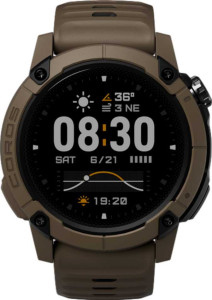
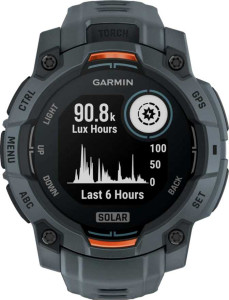
The most striking design difference between these two watches is physical scale. The Coros Nomad sports a 1.4″ screen at 47.8 × 47.8 mm with a 16.4 mm thickness, while the Garmin Instinct 3 Solar 45mm offers a much more compact 0.9″ display in a 45 × 45 mm, 14.9 mm-thin body. In real-world terms, the Nomad's larger face means more screen real estate for maps, data fields, and readability at a glance — but it comes at the cost of a bulkier wrist presence and a heavier 61 g versus the Instinct 3's 52 g. That 9-gram gap is noticeable over long runs or multi-day expeditions.

Despite their size difference, both watches achieve nearly identical pixel densities — 282 ppi on the Nomad versus 276 ppi on the Instinct 3 — meaning neither has a meaningfully sharper image per inch. Both use LCD panels with Always-On Display, so readability in direct sunlight is comparable in type, if not in size. One meaningful input difference: the Nomad includes a touchscreen, while the Instinct 3 is button-only — a deliberate ruggedness trade-off Garmin has long favored, since touch panels can misfire with wet gloves or rain. The Instinct 3 also doubles down on water resistance with a 10 ATM rating versus the Nomad's 5 ATM, making it the more capable choice for swimming or diving scenarios.

Overall, the Coros Nomad holds the edge in screen size and touchscreen convenience, suiting users who prioritize display usability. The Garmin Instinct 3 Solar counters with a slimmer, lighter, and significantly more water-resistant build — advantages that matter most to athletes and outdoor users who want a watch that disappears on the wrist and survives harsher conditions.

Sensors:
has GPS
Has a heart rate monitor
Monitors blood oxygenation levels
Has a barometer
has an accelerometer
has a compass
Has a temperature sensor
Has a cadence sensor
has a gyroscope
Has a wind speed sensor
Monitors perspiration

At a sensor-by-sensor level, these two watches are remarkably well-matched. Both carry GPS, an optical heart rate monitor, blood oxygen (SpO2) tracking, a barometer, accelerometer, compass, gyroscope, and a temperature sensor — a comprehensive suite that covers the vast majority of outdoor and endurance athletic use cases without needing any external accessories.

The one place the data reveals a real difference is the cadence sensor: the Garmin Instinct 3 Solar has it, the Coros Nomad does not. A built-in cadence sensor tracks steps or pedal strokes per minute natively, which is particularly valuable for runners fine-tuning their stride efficiency or cyclists who prefer not to rely on a separate crank-mounted sensor. It is a niche but meaningful advantage for athletes who treat cadence as a core training metric.

For the majority of users, the shared sensor stack makes this category effectively a tie in practical terms. However, for runners and cyclists where cadence data is part of regular training analysis, the Garmin Instinct 3 Solar holds a modest but clear edge.

Activity tracking:
Has a route tracker
Tracks distance
Measures pace
Has trackback mode
Tracks your sleep
Has multi-sport mode
Detects activities automatically
Tracks elevation
Tracks steps taken
Provides sleep reports
Has exercise tagging
Has a stroke counter for swimming
Tracks calorie intake
Designed for diving
Designed for golf

When it comes to activity tracking breadth, these two watches are nearly identical. Both cover the full spectrum of endurance and everyday tracking — route logging, pace, elevation, steps, sleep reports, automatic activity detection, multi-sport mode, swim stroke counting, and even calorie intake tracking. For trail runners, triathletes, hikers, and general fitness users, neither watch leaves a meaningful gap in this category.

The sole differentiator is that the Garmin Instinct 3 Solar is designed for golf, while the Coros Nomad is not. Golf-specific functionality on a GPS watch typically encompasses course mapping, shot distance measurement, and hole-by-hole navigation — features that are genuinely useful on the course but entirely irrelevant outside of it. It is a narrow advantage, but a real one for anyone who splits training time between the fairway and the trail.

For the vast majority of athletes, this category is a practical tie — the shared tracking feature set is deep and well-rounded on both sides. The Garmin Instinct 3 Solar earns a marginal edge strictly by virtue of its golf mode, making it the more versatile pick for users whose activity mix includes that sport.

Connectivity:
Is compatible with iOS
Is compatible with Android
supports Wi-Fi
has a cellular module
supports ANT+
has NFC

Both watches share the same baseline: iOS and Android compatibility, no Wi-Fi, and no cellular module. The absence of Wi-Fi and cellular keeps both firmly in the ″tethered″ category — syncing and smart notifications depend on a paired smartphone, which is standard for sport-focused GPS watches at this tier.

Where the Garmin Instinct 3 Solar pulls ahead is in two meaningful extras. ANT+ support enables wireless pairing with a wide ecosystem of third-party sensors — chest-strap heart rate monitors, power meters, foot pods, and more — without relying on Bluetooth. For athletes who already own ANT+ accessories or train in environments where multiple Bluetooth devices compete for signal, this is a genuinely practical advantage. The addition of NFC adds contactless payment capability, meaning the Instinct 3 can be used to pay at compatible terminals without reaching for a phone or wallet — a small but convenient real-world perk during everyday use or post-workout stops.

The Coros Nomad offers neither ANT+ nor NFC, which limits its accessory compatibility and removes the payments option entirely. For users deeply embedded in a sensor ecosystem or who value wrist-based payments, the Garmin Instinct 3 Solar holds a clear connectivity edge in this category.

Battery:
battery life 22 days Infinity days
battery life with GPS on 34 hours 130 hours
has wireless charging
Has a solar power battery
has a rechargeable battery
has a removable battery

Battery life is where the gap between these two watches becomes dramatic. The Coros Nomad delivers a solid 22 days of daily use and 34 hours with GPS active — respectable figures that cover most multi-day adventures and long ultras. The Garmin Instinct 3 Solar, however, operates on a different level entirely: 130 hours of GPS runtime and a listed daily battery life of effectively unlimited, thanks to its solar charging panel. In practical terms, this means the Instinct 3 can sustain multi-day expedition use — think 100-mile races, extended mountaineering trips, or thru-hiking segments — while continuously topping up its charge in sunlight, potentially eliminating the need to plug in for weeks at a time under the right conditions.

The 130-hour GPS figure versus 34 hours is not a marginal difference — it is nearly four times the active tracking endurance. For an athlete running a 30-hour ultra, the Nomad finishes with battery to spare; for a 5-day traverse where GPS is running most of the day, the Nomad may need careful power management or a recharge mid-route, while the Instinct 3 Solar leans on sunlight to extend its reserves. Neither watch supports wireless charging, so both require a physical cable connection when they do need to charge.

This category is not a close call. The Garmin Instinct 3 Solar holds a commanding advantage for anyone prioritizing endurance battery performance, and the solar capability adds a meaningful layer of self-sufficiency for outdoor use. The Coros Nomad's battery is competent for most users, but it cannot match the Instinct 3's combination of raw GPS stamina and solar replenishment.

Features:
release date August 2025 January 2025
has HRV tracking
measures VO2 max
measures resting heart rate
has fast/slow heart rate notifications
shows readiness level
Can upload maps
Has a stopwatch
Locates your phone
Has silent alarm
has irregular heart rate warnings
has fall detection
Has notifications
Acquires GPS faster
Has call control
Provides the sunrise/sunset time
internal storage 32GB 0.128GB
Can be used to answer calls
supports Galileo
Has smart alarm
Informs about the risk of thunderstorms
has voice commands
Has a built-in camera remote control function

The Coros Nomad and Garmin Instinct 3 Solar 45mm both include several advanced features for health and fitness tracking. Both devices have HRV tracking, measure VO2 max, and track resting heart rate, with fast/slow heart rate notifications and readiness level displays. Both also include a stopwatch, phone locator, silent alarm, and notifications. They both acquire GPS quickly and support Galileo satellite connectivity. Neither can be used to answer calls, but both have call control functionality.

However, there are notable differences. The Coros Nomad includes a feature for uploading maps, while the Garmin Instinct 3 Solar 45mm cannot upload maps. The Nomad also has 32GB of internal storage, significantly more than the Garmin’s 0.128GB. Additionally, the Garmin model includes fall detection and provides sunrise/sunset times, features that the Coros Nomad lacks. The Garmin also provides information on the risk of thunderstorms, a feature absent from the Nomad, while the Nomad offers irregular heart rate warnings, which the Garmin does not.

In terms of overall features, the Coros Nomad focuses more on health tracking and storage capacity, whereas the Garmin Instinct 3 Solar 45mm offers additional safety features like fall detection and weather-related alerts, making them tailored to slightly different user needs.

App & Software:
Provides activity reports
Has inactivity alerts
Counts how many calories you've burned
Has goal setting
Has achievements
Free app
Has exercise diary
Ad-free
Has weight tracking
Tracks water intake
Has coaching
Has temperature tracking
Supports routes
Syncs with existing calendars
Has music playback
Doesn’t require account
Predicts start date
Supports widgets
Can be personalised
Has barcode scanner on app

The Coros Nomad and Garmin Instinct 3 Solar 45mm share many similar app and software features. Both provide activity reports, inactivity alerts, calorie counting, goal setting, achievements, a free app, exercise diaries, ad-free experiences, weight tracking, water intake tracking, coaching, temperature tracking, route support, calendar syncing, music playback, start date predictions, widget support, and do not require an account. These similarities make the software experience quite comparable across both devices.

The main difference between the two is personalization. The Garmin Instinct 3 Solar 45mm allows for app personalization, while the Coros Nomad does not. Both products lack a barcode scanner on their apps.

Overall, while the app and software features are very similar, the key distinction is that the Garmin model supports personalization, providing a slightly more customizable experience compared to the Coros Nomad.

Miscellaneous:
has a battery level indicator
Has auto pause
Compatible with external heart rate monitors
Available on PC
has an external memory slot
has a socket for a 3.5 mm audio jack

The Coros Nomad and Garmin Instinct 3 Solar 45mm are almost identical in terms of miscellaneous features. Both watches come with a battery level indicator, auto pause functionality, and are compatible with external heart rate monitors. Additionally, both can be used with a PC, and neither offers an external memory slot or a socket for a 3.5 mm audio jack.

There are no differences between the two products in this group, as all the specifications match exactly across both devices.

In conclusion, the miscellaneous features of the Coros Nomad and Garmin Instinct 3 Solar 45mm are completely aligned, with no distinguishing factors between the two in this category.

Comparison Summary & Verdict

After examining every specification, both watches serve distinct audiences. The Coros Nomad stands out with its larger 1.4″ touchscreen, massive 32GB internal storage, map upload capability, call control, and irregular heart rate warnings, making it a strong choice for those who want a feature-rich, interactive experience on longer adventures. The Garmin Instinct 3 Solar 45mm, on the other hand, excels in battery endurance with unlimited solar-assisted life and 130 hours of GPS usage, a higher 10 ATM water resistance rating, and extras like ANT+, NFC, fall detection, golf mode, and thunderstorm alerts. If longevity in the field and rugged reliability matter most, Garmin wins; if screen real estate and onboard storage are your priorities, the Coros Nomad delivers.

Coros Nomad
Buy Coros Nomad if...

Buy the Coros Nomad if you want a larger touchscreen, substantial onboard storage for maps and media, call control, and irregular heart rate monitoring in a capable adventure watch.

Garmin Instinct 3 Solar 45mm
Buy Garmin Instinct 3 Solar 45mm if...

Buy the Garmin Instinct 3 Solar 45mm if you need virtually unlimited battery life through solar charging, superior water resistance, ANT+ and NFC connectivity, and extras like fall detection and golf mode.