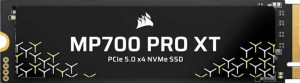
Corsair MP700 Pro XT 1TB
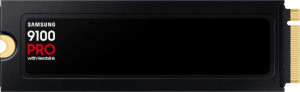
Samsung 9100 Pro 1TB

Corsair MP700 Pro XT 1TB Samsung 9100 Pro 1TB

Overview

Welcome to our in-depth specification comparison between the Corsair MP700 Pro XT 1TB and the Samsung 9100 Pro 1TB — two of the most powerful PCIe 5.0 NVMe SSDs on the market today. Both drives share a strong common foundation, yet they diverge in meaningful ways across sequential and random performance metrics, endurance ratings, and controller technology. Read on to see how these two flagship drives stack up against each other.

Common Features

  • Both use the M2 form factor.
  • Both feature a DRAM cache.
  • Both are NVMe SSDs.
  • Both support NVMe version 2.
  • Both offer 1000GB of internal storage.
  • Both use TLC NAND flash storage.
  • Both use PCIe version 5.
  • Both have 8 controller channels.

Main Differences

  • Sequential read speed is 14900 MB/s on Corsair MP700 Pro XT 1TB and 14700 MB/s on Samsung 9100 Pro 1TB.
  • Random read speed is 1500000 IOPS on Corsair MP700 Pro XT 1TB and 1850000 IOPS on Samsung 9100 Pro 1TB.
  • Sequential write speed is 14200 MB/s on Corsair MP700 Pro XT 1TB and 13300 MB/s on Samsung 9100 Pro 1TB.
  • Random write speed is 3300000 IOPS on Corsair MP700 Pro XT 1TB and 2600000 IOPS on Samsung 9100 Pro 1TB.
  • The controller is Phison PS5028-E28-86 on Corsair MP700 Pro XT 1TB and Samsung Presto (S4LY027) on Samsung 9100 Pro 1TB.
  • Terabytes Written (TBW) is 700 TB on Corsair MP700 Pro XT 1TB and 600 TB on Samsung 9100 Pro 1TB.
Specs Comparison
Corsair MP700 Pro XT 1TB

Corsair MP700 Pro XT 1TB

Samsung 9100 Pro 1TB

Samsung 9100 Pro 1TB

Read speed:
sequential read speed 14900 MB/s 14700 MB/s
random read speed 1500000 IOPS 1850000 IOPS

Both drives operate at the absolute top tier of sequential read performance, with the Corsair MP700 Pro XT reaching 14,900 MB/s and the Samsung 9100 Pro close behind at 14,700 MB/s. That 200 MB/s gap is negligible in practice — at these speeds, neither large file transfers nor sequential workloads will feel meaningfully different between the two.

The real differentiator emerges in random read performance, where the 9100 Pro pulls ahead with 1,850,000 IOPS versus the MP700 Pro XT's 1,500,000 IOPS — a roughly 23% advantage. Random IOPS matter far more in everyday computing than sequential speeds: OS responsiveness, application launch times, database queries, and multitasking all depend on how quickly a drive can handle small, scattered read requests. This is where the Samsung's edge translates into tangible, perceptible gains.

For sequential throughput alone, the two drives are effectively tied. But on the more practically relevant random read metric, the Samsung 9100 Pro holds a clear and meaningful advantage, making it the stronger performer for general-purpose and latency-sensitive workloads.

Write speed:
sequential write speed 14200 MB/s 13300 MB/s
random write speed 3300000 IOPS 2600000 IOPS

Write performance is where the tables turn decisively. The Corsair MP700 Pro XT leads on sequential writes at 14,200 MB/s compared to the Samsung 9100 Pro's 13,300 MB/s — a ~7% gap that, while not dramatic for typical use, becomes relevant during sustained large-file operations like video editing timelines, backup jobs, or moving massive datasets.

More striking is the random write gap: the MP700 Pro XT posts 3,300,000 IOPS against the 9100 Pro's 2,600,000 IOPS — a 27% advantage. High random write IOPS directly benefit write-intensive workloads such as virtual machine storage, log-heavy applications, and professional content creation pipelines where the drive is constantly handling bursts of small, non-sequential write operations. This is not a marginal edge; it represents a meaningfully faster drive under pressure.

Across both sequential and random write metrics, the Corsair MP700 Pro XT holds a clear advantage. For users whose workflows are write-heavy — creators, developers, or power users running demanding storage tasks — the MP700 Pro XT is the stronger choice in this category.

General info:
type M2 M2
SSD cache DRAM cache DRAM cache
Is an NVMe SSD
NVMe version 2 2
internal storage 1000GB 1000GB
release date October 2025 February 2025
controller Phison PS5028-E28-86 Samsung Presto (S4LY027)
SSD storage type TLC TLC
PCI Express (PCIe) version 5 5
Controller channels 8 8
Terabytes Written (TBW) 700 600
MTBF 1.5million hours 1.5million hours
warranty period 5 years 5 years
Has an integrated heatsink
bits of encryption supported 256 256
has RGB lighting

At their core, these two drives share an identical foundation: both are M.2 PCIe Gen 5 NVMe 2.0 SSDs with 1TB of TLC NAND, DRAM cache, 8 controller channels, and matching endurance ratings of 1.5 million hours MTBF and 5-year warranties. For buyers, this means neither drive cuts corners on the fundamentals — both are built to the same generational standard with equivalent reliability guarantees.

The one meaningful differentiator here is endurance: the Corsair MP700 Pro XT is rated for 700 TBW versus the Samsung 9100 Pro's 600 TBW — a 17% advantage. TBW (Terabytes Written) represents the total data a drive is rated to write before wear becomes a concern. For most everyday users this distinction is academic, but for write-intensive environments — NAS arrays, video production workstations, or developer machines running frequent builds and compilations — the MP700 Pro XT's higher endurance rating offers a longer operational lifespan on paper.

Beyond TBW, this group is essentially a draw. Both drives use the same interface, cache type, NAND technology, channel count, and warranty terms. The Corsair MP700 Pro XT holds a narrow but real edge in rated endurance, making it the marginally more compelling option for heavy-write use cases — but for the vast majority of users, general info alone gives neither drive a decisive advantage.

Comparison Summary & Verdict

Both the Corsair MP700 Pro XT 1TB and the Samsung 9100 Pro 1TB are exceptional PCIe 5.0 NVMe drives that share the same form factor, TLC NAND, DRAM cache, and NVMe 2.0 standard — making either a top-tier choice for demanding workloads. However, their strengths differ in important ways. The Corsair MP700 Pro XT 1TB pulls ahead in sequential read and write speeds, random write IOPS, and offers a higher 700 TBW endurance rating, making it ideal for users who push large files frequently and want maximum longevity. The Samsung 9100 Pro 1TB, on the other hand, leads in random read performance at 1,850,000 IOPS, which translates to snappier responsiveness in workloads involving many small, simultaneous read operations. Choose the Corsair for raw throughput and endurance; choose the Samsung if low-latency random reads are your priority.

Corsair MP700 Pro XT 1TB
Buy Corsair MP700 Pro XT 1TB if...

Buy the Corsair MP700 Pro XT 1TB if you prioritize the highest sequential read and write throughput, superior random write IOPS, and a longer endurance rating of 700 TBW.

Samsung 9100 Pro 1TB
Buy Samsung 9100 Pro 1TB if...

Buy the Samsung 9100 Pro 1TB if your workloads demand best-in-class random read performance, where its 1,850,000 IOPS advantage gives it an edge in responsiveness.