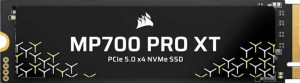
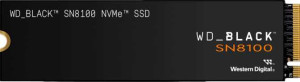
Corsair MP700 Pro XT 1TB
Western Digital WD Black SN8100 1TB

Corsair MP700 Pro XT 1TB Western Digital WD Black SN8100 1TB

Overview

Welcome to our in-depth comparison of the Corsair MP700 Pro XT 1TB and the Western Digital WD Black SN8100 1TB, two high-performance PCIe 5.0 NVMe SSDs competing at the very top of the consumer storage market. Both drives share a strong common foundation, yet they diverge in meaningful ways across write performance, endurance ratings, and controller technology — areas that can make a real difference depending on your workload.

Common Features

  • Both drives share the same sequential read speed of 14900 MB/s.
  • Both drives use the M.2 form factor.
  • Both drives feature a DRAM cache.
  • Both drives are NVMe SSDs.
  • Both drives support NVMe version 2.
  • Both drives offer 1000GB of internal storage.
  • Both drives use TLC NAND flash storage.
  • Both drives connect via PCIe version 5.
  • Both drives have 8 controller channels.

Main Differences

  • Random read speed is 1500000 IOPS on Corsair MP700 Pro XT 1TB and 1600000 IOPS on Western Digital WD Black SN8100 1TB.
  • Sequential write speed is 14200 MB/s on Corsair MP700 Pro XT 1TB and 11000 MB/s on Western Digital WD Black SN8100 1TB.
  • Random write speed is 3300000 IOPS on Corsair MP700 Pro XT 1TB and 2400000 IOPS on Western Digital WD Black SN8100 1TB.
  • The controller is Phison PS5028-E28-86 on Corsair MP700 Pro XT 1TB and Silicon Motion SM2508 on Western Digital WD Black SN8100 1TB.
  • Terabytes Written (TBW) is 700 TB on Corsair MP700 Pro XT 1TB and 600 TB on Western Digital WD Black SN8100 1TB.
  • MTBF is 1.5 million hours on Corsair MP700 Pro XT 1TB and 1.8 million hours on Western Digital WD Black SN8100 1TB.
Specs Comparison
Corsair MP700 Pro XT 1TB

Corsair MP700 Pro XT 1TB

Western Digital WD Black SN8100 1TB

Western Digital WD Black SN8100 1TB

Read speed:
sequential read speed 14900 MB/s 14900 MB/s
random read speed 1500000 IOPS 1600000 IOPS

Both the Corsair MP700 Pro XT 1TB and the WD Black SN8100 1TB share an identical sequential read speed of 14,900 MB/s, meaning neither drive has an advantage when it comes to large, sustained data transfers — think copying massive video files or loading large game assets in a single stream. At this level, both drives push the current limits of the PCIe Gen 5 interface.

The only differentiator in this group is random read performance: the SN8100 reaches 1,600,000 IOPS versus the MP700 Pro XT's 1,500,000 IOPS — a 6.7% advantage for the WD Black. Random read speed governs how quickly a drive can fetch many small, scattered files simultaneously, which is exactly what happens during OS boot, application launches, and multitasking with many open files. In practice, the gap is modest, but it is consistently in the SN8100's favor for these everyday, latency-sensitive workloads.

The WD Black SN8100 holds a narrow but real edge in this group. Sequential throughput is a dead heat, but its higher random read IOPS gives it a slight advantage in the real-world scenarios most users encounter daily. The MP700 Pro XT trails only marginally and neither drive will feel slow, but if random read responsiveness is a priority, the SN8100 is the better choice based on these specs alone.

Write speed:
sequential write speed 14200 MB/s 11000 MB/s
random write speed 3300000 IOPS 2400000 IOPS

Write speed is where these two drives diverge sharply. The Corsair MP700 Pro XT posts a sequential write speed of 14,200 MB/s, compared to the WD Black SN8100's 11,000 MB/s — a gap of nearly 30%. For sustained write workloads like video editing, large file ingestion, or drive-to-drive cloning, that difference is tangible: the MP700 Pro XT will finish the job meaningfully faster.

The random write gap is even more pronounced. The MP700 Pro XT delivers 3,300,000 IOPS versus the SN8100's 2,400,000 IOPS — roughly a 37% advantage. Random write performance matters most in write-heavy multitasking scenarios: compiling large codebases, running virtual machines, or handling database transactions where the drive is constantly being asked to commit many small writes to scattered locations. The MP700 Pro XT's lead here is substantial enough to be felt in demanding professional workflows.

The Corsair MP700 Pro XT wins this group decisively on both metrics. Whether the workload involves long sequential streams or a barrage of small random writes, it outpaces the SN8100 by a significant margin. Users who frequently push large amounts of data onto their drive — content creators, developers, or power users — will find the MP700 Pro XT's write performance a clear differentiator.

General info:
type M2 M2
SSD cache DRAM cache DRAM cache
Is an NVMe SSD
NVMe version 2 2
internal storage 1000GB 1000GB
release date October 2025 May 2025
controller Phison PS5028-E28-86 Silicon Motion SM2508
SSD storage type TLC TLC
PCI Express (PCIe) version 5 5
Controller channels 8 8
Terabytes Written (TBW) 700 600
MTBF 1.5million hours 1.8million hours
warranty period 5 years 5 years
Has an integrated heatsink
has RGB lighting

At the architectural level, these two drives are remarkably similar: both are M.2 PCIe 5.0 NVMe 2.0 SSDs with DRAM cache, TLC NAND, 8 controller channels, and identical 1TB capacities. The shared foundation explains why their sequential read speeds are neck-and-neck. The meaningful distinctions come down to controller choice, endurance, and reliability ratings.

On endurance, the Corsair MP700 Pro XT carries a TBW rating of 700TB versus the WD Black SN8100's 600TB — a 17% advantage. TBW is the manufacturer's estimate of how much data can be written to the drive over its lifetime before wear becomes a concern; the higher figure makes the MP700 Pro XT a slightly better fit for write-intensive use cases like video production or regular large backups. Reliability tells a different story: the SN8100 claims an MTBF of 1.8 million hours compared to the MP700 Pro XT's 1.5 million hours. MTBF is a statistical measure of expected operational lifespan, and the SN8100's higher figure suggests greater projected long-term dependability — though both numbers are far beyond what a typical consumer would ever approach.

Neither drive edges out the other cleanly in this group. The MP700 Pro XT wins on write endurance, which matters more to heavy users, while the SN8100 counters with a stronger MTBF rating, appealing to those prioritizing longevity. For most users, both drives offer equivalent and ample durability under their shared 5-year warranty. The choice here comes down to whether you write data in large volumes frequently — favoring the MP700 Pro XT — or simply want the statistically more reliable component over time, where the SN8100 has a modest edge.

Comparison Summary & Verdict

After examining the full spec sheet, both drives prove to be exceptional PCIe 5.0 NVMe SSDs with identical sequential read speeds and the same 1TB TLC capacity. However, their strengths point in different directions. The Corsair MP700 Pro XT 1TB stands out with a significantly higher sequential write speed of 14200 MB/s and a commanding 3300000 IOPS random write speed, making it the stronger choice for users who frequently write large files or run storage-intensive creative workloads. It also edges ahead with a higher TBW rating of 700TB, suggesting greater long-term write endurance. The Western Digital WD Black SN8100 1TB, on the other hand, offers a slightly better random read speed and a higher MTBF of 1.8 million hours, indicating stronger rated reliability for read-heavy tasks and longevity in demanding environments. Choose the Corsair for raw write throughput; choose the WD Black for reliability-focused and read-intensive use cases.

Corsair MP700 Pro XT 1TB
Buy Corsair MP700 Pro XT 1TB if...

Buy the Corsair MP700 Pro XT 1TB if you need maximum write performance, with class-leading sequential and random write speeds and a higher TBW endurance rating for write-heavy workloads.

Western Digital WD Black SN8100 1TB
Buy Western Digital WD Black SN8100 1TB if...

Buy the Western Digital WD Black SN8100 1TB if you prioritize long-term reliability and slightly faster random read speeds, backed by a higher MTBF rating of 1.8 million hours.