Corsair MP700 Pro XT 1TB
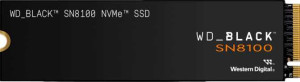
Western Digital WD Black SN8100 4TB

Corsair MP700 Pro XT 1TB Western Digital WD Black SN8100 4TB

Overview

Welcome to our in-depth spec comparison between the Corsair MP700 Pro XT 1TB and the Western Digital WD Black SN8100 4TB. Both drives operate on the cutting-edge PCIe 5.0 interface and share an impressive sequential read speed, but they take notably different approaches when it comes to storage capacity, random I/O performance, and endurance ratings. Read on to explore where each drive leads and where they align.

Common Features

  • Both drives share the same sequential read speed of 14900 MB/s.
  • Both drives use the M.2 form factor.
  • Both drives feature a DRAM cache.
  • Both drives are NVMe SSDs.
  • Both drives use NVMe version 2.
  • Both drives use TLC NAND storage.
  • Both drives use PCIe version 5.
  • Both drives have 8 controller channels.
  • Both drives come with a 5-year warranty.

Main Differences

  • Random read speed is 1500000 IOPS on Corsair MP700 Pro XT 1TB and 2300000 IOPS on Western Digital WD Black SN8100 4TB.
  • Sequential write speed is 14200 MB/s on Corsair MP700 Pro XT 1TB and 14000 MB/s on Western Digital WD Black SN8100 4TB.
  • Random write speed is 3300000 IOPS on Corsair MP700 Pro XT 1TB and 2400000 IOPS on Western Digital WD Black SN8100 4TB.
  • Internal storage capacity is 1000GB on Corsair MP700 Pro XT 1TB and 4000GB on Western Digital WD Black SN8100 4TB.
  • The controller is Phison PS5028-E28-86 on Corsair MP700 Pro XT 1TB and Silicon Motion SM2508 on Western Digital WD Black SN8100 4TB.
  • Terabytes Written (TBW) endurance rating is 700 TB on Corsair MP700 Pro XT 1TB and 2400 TB on Western Digital WD Black SN8100 4TB.
Specs Comparison
Corsair MP700 Pro XT 1TB

Corsair MP700 Pro XT 1TB

Western Digital WD Black SN8100 4TB

Western Digital WD Black SN8100 4TB

Read speed:
sequential read speed 14900 MB/s 14900 MB/s
random read speed 1500000 IOPS 2300000 IOPS

Both the Corsair MP700 Pro XT 1TB and the WD Black SN8100 4TB reach identical sequential read speeds of 14900 MB/s, placing them at the absolute cutting edge of consumer NVMe performance. For large sequential workloads — think transferring massive video files, loading large game assets, or reading big datasets — neither drive has a meaningful advantage over the other.

Where a real gap emerges is in random read performance. The SN8100 hits 2,300,000 IOPS versus the MP700 Pro XT's 1,500,000 IOPS — a 53% higher random read throughput. Random IOPS governs how quickly a drive handles the small, scattered read requests typical of OS boot, application launches, database queries, and multitasking workloads. In practice, this means the SN8100 will feel noticeably snappier in day-to-day system responsiveness compared to the MP700 Pro XT.

Edge: WD Black SN8100 4TB. Sequential read performance is a dead heat, but the SN8100's commanding lead in random reads gives it a meaningful real-world advantage in the workloads most users encounter most often. The MP700 Pro XT is not slow by any measure, but if read responsiveness is a priority, the SN8100 is the stronger choice based solely on these specs.

Write speed:
sequential write speed 14200 MB/s 14000 MB/s
random write speed 3300000 IOPS 2400000 IOPS

Sequential write speeds are essentially matched here — the MP700 Pro XT posts 14,200 MB/s against the SN8100's 14,000 MB/s, a difference of roughly 1.4% that will never be perceptible in practice. For sustained large-file writes like encoding video, copying backups, or writing large data archives, both drives perform at the same tier.

The more telling story is in random write IOPS. The MP700 Pro XT pulls decisively ahead here with 3,300,000 IOPS versus the SN8100's 2,400,000 IOPS — a 37.5% advantage. High random write throughput matters most in write-intensive scenarios: compiling large codebases, running virtual machines, handling transactional database writes, or sustained mixed workloads where small randomized writes are constantly queued. In these contexts, the MP700 Pro XT's headroom translates to less latency and more consistent throughput under pressure.

Edge: Corsair MP700 Pro XT 1TB. Sequential write parity means neither drive wins on bulk transfers, but the MP700 Pro XT's substantial lead in random write performance gives it a genuine advantage for power users and professionals pushing write-heavy workloads. For general consumer use the gap is less critical, but for demanding tasks it is a meaningful differentiator.

General info:
type M2 M2
SSD cache DRAM cache DRAM cache
Is an NVMe SSD
NVMe version 2 2
internal storage 1000GB 4000GB
release date October 2025 May 2025
controller Phison PS5028-E28-86 Silicon Motion SM2508
SSD storage type TLC TLC
PCI Express (PCIe) version 5 5
Controller channels 8 8
Terabytes Written (TBW) 700 2400
warranty period 5 years 5 years
Has an integrated heatsink
has RGB lighting

At the foundational level, these two drives share the same architectural DNA: both are M.2 NVMe 2.0 SSDs on a PCIe 5.0 interface, backed by DRAM cache and built on TLC NAND with an 8-channel controller. That common platform is why their peak speeds are so closely matched — the interface and controller channel count set a ceiling that both drives approach equally.

The sharpest divergence in this group is capacity and endurance. The MP700 Pro XT is a 1TB drive rated for 700 TBW, while the SN8100 offers 4TB of storage with a 2,400 TBW endurance rating. TBW — terabytes written — is the manufacturer's estimate of total data a drive can write before NAND wear becomes a concern. The SN8100's rating is more than three times higher in absolute terms, which matters for write-intensive professional environments, NAS-adjacent workloads, or simply users who want long-term peace of mind. Both carry a 5-year warranty, so coverage period is not a differentiator. The controller difference — Phison PS5028-E28 versus Silicon Motion SM2508 — is worth noting as each vendor tunes firmware differently, but the spec sheet alone does not reveal a meaningful advantage either way.

Edge: Western Digital WD Black SN8100 4TB on capacity and longevity. Four times the storage and over three times the endurance rating make it the stronger choice for users who need room to grow or run demanding write workloads over the long haul. For users where 1TB suffices, the MP700 Pro XT is a fully capable alternative with no architectural disadvantages in this category.

Comparison Summary & Verdict

After examining the full spec sheet, both drives are clearly high-end PCIe 5.0 NVMe SSDs with strong credentials. The Corsair MP700 Pro XT 1TB stands out with a superior random write speed of 3,300,000 IOPS and a slightly higher sequential write speed, making it a compelling pick for workloads that demand intense write throughput. The Western Digital WD Black SN8100 4TB, on the other hand, pulls ahead with a significantly higher random read speed of 2,300,000 IOPS, a massive 4TB storage capacity, and a much larger TBW endurance rating of 2,400 TB, making it far better suited for users who need long-term reliability and ample space. Choose the Corsair if raw write performance and a lower price point matter most; choose the WD Black if longevity, capacity, and read-heavy workloads are your priority.

Corsair MP700 Pro XT 1TB
Buy Corsair MP700 Pro XT 1TB if...

Buy the Corsair MP700 Pro XT 1TB if you prioritize exceptional random write performance and need a high-speed PCIe 5.0 drive in a 1TB capacity tier.

Western Digital WD Black SN8100 4TB
Buy Western Digital WD Black SN8100 4TB if...

Buy the Western Digital WD Black SN8100 4TB if you need a high-capacity drive with superior read IOPS and a much higher endurance rating for demanding, long-term workloads.