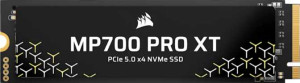
Corsair MP700 Pro XT 2TB
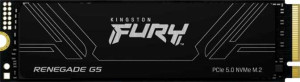
Kingston Fury Renegade G5 2TB

Corsair MP700 Pro XT 2TB Kingston Fury Renegade G5 2TB

Overview

Welcome to our in-depth comparison of the Corsair MP700 Pro XT 2TB and the Kingston Fury Renegade G5 2TB, two of the most powerful PCIe 5.0 NVMe SSDs on the market. Both drives share a strong common foundation, yet they diverge in key areas such as peak read and write speeds, endurance ratings, and controller choice — factors that could meaningfully impact your storage decision.

Common Features

  • Both products use the M2 form factor.
  • Both products feature a DRAM cache.
  • Both products are NVMe SSDs.
  • Both products use NVMe version 2.
  • Both products offer 2000GB of internal storage.
  • Both products use TLC NAND flash storage.
  • Both products support PCIe version 5.
  • Both products have an 8-channel controller.

Main Differences

  • Sequential read speed is 14900 MB/s on Corsair MP700 Pro XT 2TB and 14700 MB/s on Kingston Fury Renegade G5 2TB.
  • Random read speed is 2700000 IOPS on Corsair MP700 Pro XT 2TB and 2200000 IOPS on Kingston Fury Renegade G5 2TB.
  • Sequential write speed is 14500 MB/s on Corsair MP700 Pro XT 2TB and 14000 MB/s on Kingston Fury Renegade G5 2TB.
  • Random write speed is 3300000 IOPS on Corsair MP700 Pro XT 2TB and 2200000 IOPS on Kingston Fury Renegade G5 2TB.
  • The controller is a Phison PS5028-E28-86 on Corsair MP700 Pro XT 2TB and a Silicon Motion SM2508 on Kingston Fury Renegade G5 2TB.
  • Terabytes Written (TBW) is 1400 TB on Corsair MP700 Pro XT 2TB and 2000 TB on Kingston Fury Renegade G5 2TB.
  • MTBF is 1.5 million hours on Corsair MP700 Pro XT 2TB and 2 million hours on Kingston Fury Renegade G5 2TB.
Specs Comparison
Corsair MP700 Pro XT 2TB

Corsair MP700 Pro XT 2TB

Kingston Fury Renegade G5 2TB

Kingston Fury Renegade G5 2TB

Read speed:
sequential read speed 14900 MB/s 14700 MB/s
random read speed 2700000 IOPS 2200000 IOPS

Both drives operate at the bleeding edge of consumer NVMe performance, with sequential read speeds of 14,900 MB/s and 14,700 MB/s for the Corsair MP700 Pro XT and Kingston Fury Renegade G5 respectively. That 200 MB/s gap is negligible in practice — transferring a 10 GB file would complete in virtually identical time on either drive. For large sequential workloads like game installs, video exports, or OS imaging, users will not feel a meaningful difference between the two.

The more telling differentiator is random read performance. The MP700 Pro XT posts 2,700,000 IOPS versus the Renegade G5′s 2,200,000 IOPS — a roughly 23% advantage. Random IOPS governs how a drive handles the small, scattered read requests that dominate real-world desktop and workstation use: launching applications, loading game levels, or running a database. A gap of this size is noticeable in sustained mixed workloads, even if single-task scenarios rarely expose it.

On read performance, the Corsair MP700 Pro XT holds a clear edge. Sequential speeds are essentially tied, but its substantially higher random read throughput gives it a practical advantage in multitasking and I/O-intensive environments where many small files are accessed simultaneously.

Write speed:
sequential write speed 14500 MB/s 14000 MB/s
random write speed 3300000 IOPS 2200000 IOPS

Write performance tells a more decisive story than reads did. The Corsair MP700 Pro XT reaches 14,500 MB/s sequential write against the Kingston Fury Renegade G5′s 14,000 MB/s — a modest 3.5% gap that, much like the sequential read difference, will rarely surface during everyday large-file transfers. Both drives are comfortably elite in this regard.

Random write IOPS, however, is where the gap widens significantly. The MP700 Pro XT delivers 3,300,000 IOPS compared to the Renegade G5′s 2,200,000 IOPS — a 50% advantage in favor of Corsair. Random write throughput directly impacts workloads like compiling large codebases, writing virtual machine disk images, or handling high-frequency database transactions. At this scale of difference, the advantage is not theoretical — sustained write-heavy tasks will complete faster and with less controller latency on the MP700 Pro XT.

The Corsair MP700 Pro XT wins this category outright. Its sequential write lead is marginal, but the commanding random write IOPS gap makes it the stronger choice for prosumer and workstation use cases where writes are frequent and varied in size.

General info:
type M2 M2
SSD cache DRAM cache DRAM cache
Is an NVMe SSD
NVMe version 2 2
internal storage 2000GB 2000GB
release date October 2025 April 2025
controller Phison PS5028-E28-86 Silicon Motion SM2508
SSD storage type TLC TLC
PCI Express (PCIe) version 5 5
Controller channels 8 8
Terabytes Written (TBW) 1400 2000
MTBF 1.5million hours 2million hours
warranty period 5 years 5 years
Has an integrated heatsink
has RGB lighting

At the foundational level, these two drives share an identical architecture: both are M.2 PCIe 5.0 NVMe 2.0 SSDs with DRAM cache, TLC NAND, 8 controller channels, and 2TB of usable storage. The practical implication is that neither drive has a structural advantage in terms of interface bandwidth ceiling or cache strategy — any performance differences seen elsewhere in this comparison stem from controller firmware and tuning, not architectural divergence.

Where the specs do diverge is in long-term endurance. The Kingston Fury Renegade G5 is rated for 2,000 TBW versus the Corsair MP700 Pro XT′s 1,400 TBW — a 43% higher write endurance rating. Paired with an MTBF of 2 million hours against Corsair′s 1.5 million hours, Kingston′s reliability figures are meaningfully stronger on paper. For typical consumer use, both drives will likely outlast their relevance, but for NAS deployments, write-intensive workstations, or anyone planning to keep the drive for many years under heavy load, the Renegade G5′s endurance headroom is a genuine differentiator. Both carry a 5-year warranty, so the coverage window is equal.

On general specifications, the Kingston Fury Renegade G5 holds a clear advantage in rated durability. The shared foundation makes this category entirely about longevity — and Kingston wins it decisively with substantially higher TBW and MTBF figures.

Comparison Summary & Verdict

Both the Corsair MP700 Pro XT 2TB and the Kingston Fury Renegade G5 2TB are exceptional PCIe 5.0 NVMe SSDs that share the same capacity, TLC NAND, DRAM cache, and 8-channel architecture. However, their differences reveal two distinct profiles. The Corsair MP700 Pro XT 2TB holds the edge in raw sequential and random performance, offering higher read and write speeds across the board, making it ideal for users who demand the absolute fastest data throughput for tasks like large file transfers or high-speed creative workflows. The Kingston Fury Renegade G5 2TB, on the other hand, stands out with a significantly higher TBW rating of 2000 TB and a longer MTBF of 2 million hours, making it the stronger choice for users prioritizing long-term reliability and drive longevity in write-intensive environments.

Corsair MP700 Pro XT 2TB
Buy Corsair MP700 Pro XT 2TB if...

Buy the Corsair MP700 Pro XT 2TB if you want the highest possible sequential and random read/write speeds for maximum raw performance.

Kingston Fury Renegade G5 2TB
Buy Kingston Fury Renegade G5 2TB if...

Buy the Kingston Fury Renegade G5 2TB if you prioritize long-term drive endurance, with a higher TBW rating and a longer MTBF for write-intensive workloads.